In the standard GNOME Shell environment, media playback has long been relegated to the notification and calendar pop-over menu attached to the central clock. While that native controller performs adequately when a user is listening to a single, continuous stream—such as an uninterrupted local album or a dedicated streaming session—its utility degrades rapidly as workflows become more complex. Modern computing routines rarely adhere to a single media pipeline. Throughout an ordinary workday, users frequently move between native streaming clients like Spotify, dedicated podcast players, local audio libraries, and various web browser tabs handling everything from video lectures and conference calls to short clips on video sharing platforms.
Under standard conditions, activating audio in one application often displaces or entirely dismisses the controls of another within the desktop environment’s MPRIS (Media Player Remote Interfacing Specification) interface. When a listener pauses an hour-long podcast or a curated music playlist to quickly watch a video embedded in a web browser, the original player frequently disappears from view. Resuming the paused content typically requires hunting down the specific minimized window, unminimizing the application, or navigating through dozens of open browser tabs.
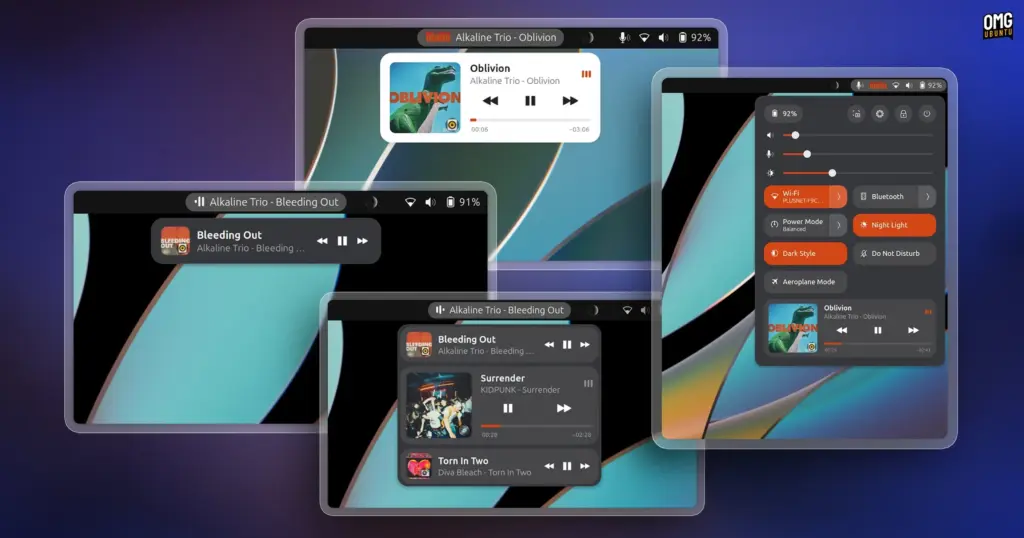
Now Playing Card alters this workflow by maintaining persistent cards for every active media player detected across the system. Rather than discarding or overwriting suspended sessions, the extension retains them side by side in a singular, easily accessible interface. As a result, a paused Spotify track and a partially heard podcast episode remain anchored in place while a browser video plays, staying primed for immediate resumption the moment the secondary media concludes.
To keep this multi-source management from overwhelming the desktop interface, Now Playing Card introduces a distinct card-based architecture built around an interactive accordion layout. Displaying controls, cover art, and metadata for several independent players simultaneously could easily clutter the screen, especially within the constrained dimensions of the Quick Settings panel or a top-bar dropdown. The extension addresses this spatial constraint by actively managing the footprint of each player. Only a single player card is rendered in an expanded state at any given moment, presenting its complete suite of controls and artwork. All remaining detected media streams are compressed into compact, unobtrusive strips stacked alongside it. When a user clicks on any of the minimized strips, the accordion dynamically shifts, smoothly expanding the selected player into full view while collapsing the previously focused card.
Within each expanded card, Now Playing Card delivers an extensive set of controls and visual indicators. The design features album artwork whose sizing can be adjusted by the user, alongside a distinct icon indicating the parent application, ensuring that users can immediately identify which software is managing the stream. Playback navigation includes responsive seek bars that allow listeners to scrub back and forth across a track’s timeline, provided the underlying player software supports seeking functionality over MPRIS. In addition to primary transport functions such as play, pause, next, and previous track buttons, the extension accommodates advanced playback toggles, exposing shuffle and loop buttons whenever the respective media player makes those capabilities available.
Beyond housing multiple players within the dropdown menu or Quick Settings panel, Now Playing Card caters to users who prefer continuous, at-a-glance visibility directly from the desktop panel. For many desktop users, the quintessential media controller use case is simply casting an eye upward to answer the immediate question of what track is currently playing. The extension accommodates this preference by allowing the currently active track title, artist name, and a selection of playback control buttons to be positioned directly along the top panel. The configuration settings grant users granular control over the behavior, placement, and visual sizing of these panel items, making it straightforward to match personal desktop aesthetics.
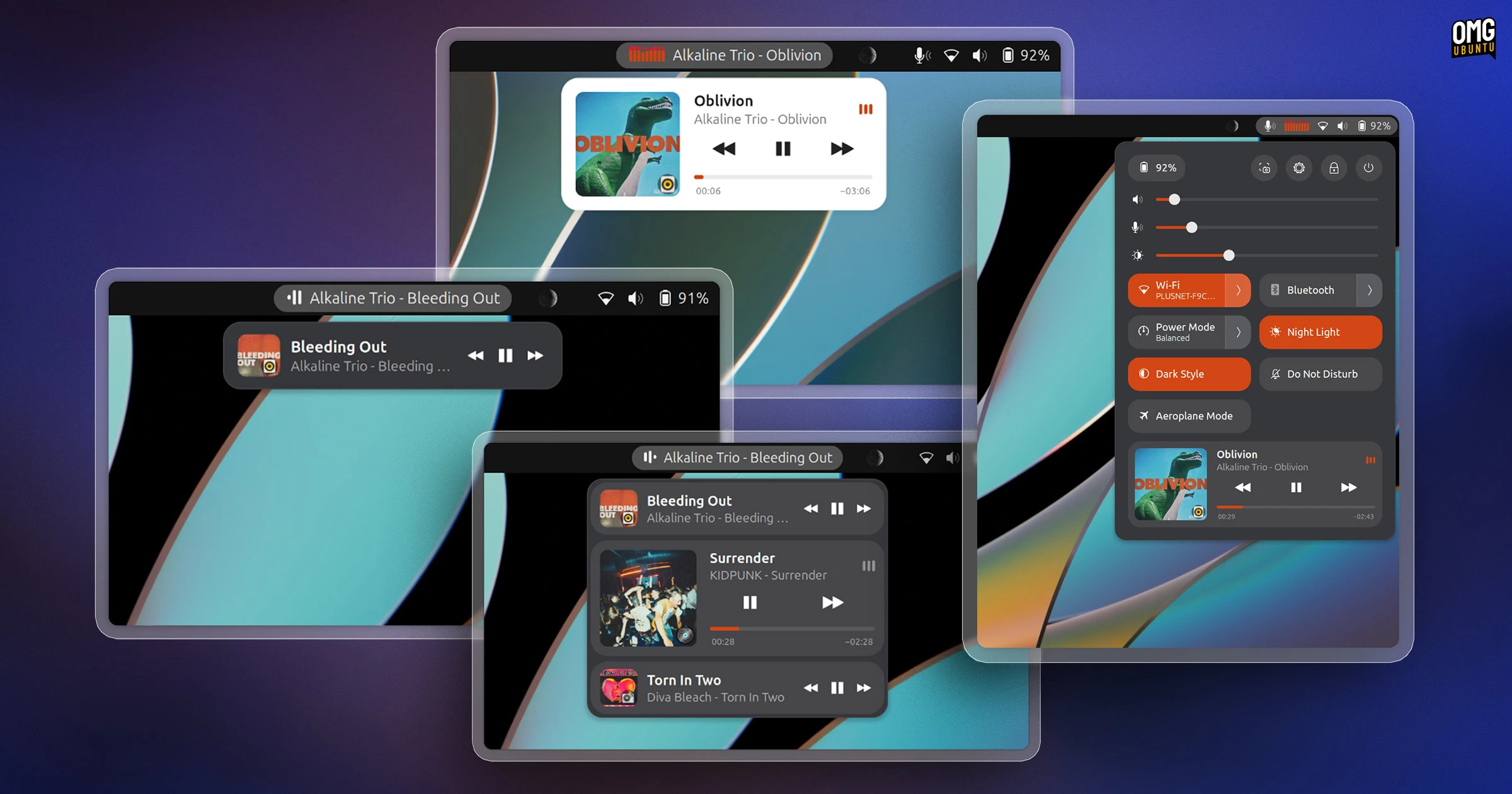
Visual flair is another area where the extension provides substantial flexibility. To complement the text label on the top panel, users can enable an animated sound wave indicator that pulses during playback. For those who want more dynamic desktop ornamentation, Now Playing Card includes a real-time reactive audio spectrum analyzer whose graphic bars bounce in direct synchronization with the system’s sound output. Recognizing that visual movement on the top bar can occasionally prove distracting during focused work, the developer has also included a clean, static option, allowing users to turn off animations entirely in favor of an understated, strictly utilitarian text display.
The extension also offers deliberate integration choices to prevent desktop redundancy. When Now Playing Card is enabled, it automatically suppresses GNOME’s stock media controller located inside the notification and calendar pop-over. This suppression ensures that users are not presented with conflicting or duplicate media widgets across different corners of the GNOME desktop shell, keeping the calendar tray reserved purely for alerts, tasks, and scheduling information while consolidating all playback functionality into the extension’s designated space.
Managing multiple media feeds across modern operating systems often introduces unwanted background noise due to how indiscriminately MPRIS interfaces can broadcast media events. Modern web browsers, in particular, frequently expose media sessions for intrusive audio elements, video advertisements, and auto-playing clips embedded across web pages. If left unmanaged, these transient media streams could quickly flood the extension’s interface with useless entries. To maintain a clean and relevant overview, Now Playing Card incorporates a dedicated ignore list within its preference panel. Users can specify applications or media sources that should be barred from generating cards, ensuring that only deliberate, primary listening tools populate the applet.
In daily operation, the extension accommodates up to ten individual players simultaneously, a scale that necessitates certain design compromises. One noticeable characteristic of the interface is its typography scaling, where text within the applet cards appears somewhat smaller than the sizing found in GNOME’s native system menus. This tighter text scaling appears to be an intentional design measure by the developer, engineered specifically to ensure that the interface can fit numerous media players and dense metadata sets within the popup without forcing excessive, cumbersome scrolling.
From a software compatibility standpoint, Now Playing Card boasts broad support across the modern GNOME ecosystem, maintaining compatibility across GNOME Shell versions 45 through 51. This extensive version coverage ensures that the extension integrates seamlessly across several generations of Linux distributions, providing full operational support for setups running from Ubuntu 24.04 LTS through to Ubuntu 26.10.
For Linux users who routinely divide their audio attention across local media players, streaming services, and multi-tab browser sessions, Now Playing Card provides a refined, space-conscious alternative to default desktop media handling. The extension is open source and can be obtained directly through the official GNOME Extensions directory or inspected via its repository on GitHub, giving desktop enthusiasts a versatile tool for harmonizing multi-source audio workflows.
 Linux & Open Source Solutions
Hylki Brings Modern Rust Engineering and Deep Customization to the GNOME Desktop
For years, the Linux desktop has maintained a complicated relationship with the...
 Linux & Open Source Solutions
Linux Mint Unveils "Superlight," a Modern System Monitor Slated for Version 27
Linux Mint is preparing a major refresh of its core software lineup...
 Linux & Open Source Solutions
Ubuntu 26.10 Introduces Restricted Media Codec Installation to App Center’s Add-Ons Hub
Ubuntu 26.10 has expanded the functionality of its modern App Center by...