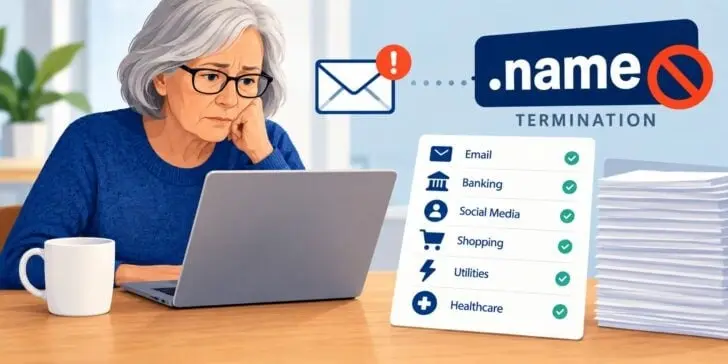
The decision by the Internet Corporation for Assigned Names and Numbers (ICANN) and Verisign to terminate third-level .name domain registrations is evolving from a technical policy shift into a significant administrative crisis for long-time internet users. For those who adopted the .name extension during its infancy in the early 2000s, the sunsetting of these domains represents more than just the loss of a web address; it is the forced dismantling of a digital identity built over a quarter of a century.
A recently published reconsideration request filed with ICANN highlights the profound personal hardship caused by this decision. The filing, submitted by Judy Johnston, provides a detailed look at the logistical nightmare facing individuals who relied on the promise of a "permanent" personal email address. Johnston’s story is not an isolated incident, but rather a representative example of the collateral damage caused when infrastructure providers prioritize administrative simplification over the stability of the end-user experience.
A Legacy of Digital Identity
In 2002, the .name top-level domain (TLD) was marketed as the premier destination for individuals. Unlike .com or .net, which were seen as commercial or technical, .name was designed for personal use. One of its unique features was the support for third-level registrations, typically following the format of "firstname.lastname.name." This allowed users to secure an email address that was both professional and deeply personal.
Judy Johnston was an early adopter of this system. For nearly 25 years, she has utilized a third-level .name domain as the primary hub for her digital life. The domain was not merely a vanity project; it became the foundational identifier for her communications, financial records, and online presence. Furthermore, the domain provided an essential service for her 97-year-old mother, who also uses an email address tied to the registration.
For Johnston and her mother, the impending termination of the .name third-level structure is not a minor inconvenience. It is a disruption of a two-decade-old communication system that connects them to the modern world. The decision by Verisign, the registry operator for .name, and ICANN, the global coordinator of the domain name system, to end support for these registrations effectively evicts these users from their long-held digital homes.
The Administrative Burden of Disconnection
The scale of the task ahead for Johnston is staggering. In her filing to ICANN, she revealed that she has identified at least 211 separate online accounts that are currently tied to her .name email address. These accounts span the entirety of a modern life, likely including banking institutions, healthcare portals, government services, utility providers, and social media platforms.
Updating 211 accounts is a Herculean effort under the best of circumstances. However, the process of changing a primary email address is rarely as simple as typing a new address into a settings field. In the current era of heightened cybersecurity, many platforms treat a change of email as a high-risk event. This often triggers a cascade of security protocols, including multi-factor authentication (MFA) challenges, "forgot password" loops, and, in many cases, manual identity verification.
 Web Hosting & Domain Management
Legal Battle Erupts Over .easy Top-Level Domain as Link Freedom Group Sues easyGroup and Appeals to ICANN
The high-stakes competition for the next generation of internet real estate has...
 Web Hosting & Domain Management
Digital Identity in Jeopardy: The Human Cost of Terminating Third-Level .name Domains
For more than two decades, the .name top-level domain has served as...
 Web Hosting & Domain Management
Abion Strengthens Global Footprint with Acquisition of Brandsec’s Corporate Domain Business in Australia and New Zealand
In a strategic move that signals a significant expansion of its international...