

For Judy Johnston, the technical sunsetting of a niche domain extension is not merely a digital inconvenience; it is a logistical catastrophe that threatens to sever her and her 97-year-old mother from twenty-five years of digital history. As the Internet Corporation for Assigned Names and Numbers (ICANN) and the registry operator Verisign move forward with the termination of third-level .name domains, a growing chorus of long-term users is sounding the alarm over the profound personal and professional disruption the decision will cause.
The .name top-level domain (TLD) was launched in the early 2000s with a specific vision: providing individuals with a permanent, personalized digital identity. Unlike .com or .net, which were intended for commercial and networking purposes, .name was marketed as a space for "digital birthrights." In its original implementation, the registry encouraged a third-level structure, such as "jane.doe.name," which allowed users to create professional-looking email addresses that mirrored their actual names. For early adopters like Johnston, who registered her domain in 2002, this was a promise of a lifelong digital home.
However, that home is now slated for demolition. Following an agreement between ICANN and Verisign, the third-level registrations within the .name TLD are being phased out. While the registry has focused on the technical and administrative reasons for the sunset—citing low registration volumes and the modernization of the TLD—the users left in the wake of this decision are finding that the "minor" technical change is resulting in a monumental burden of labor.
In a recently published reconsideration request filed with ICANN, Johnston detailed the staggering scope of the work required to migrate her digital life. After nearly a quarter-century of use, her third-level .name email address has become the primary identifier for at least 211 different online accounts. This includes everything from essential services like banking, utilities, and healthcare to social media, subscriptions, and government portals. For Johnston and her mother, the termination of the domain does not just mean losing an email address; it means losing the master key to their entire online existence.
The transition process is proving to be far more complex than simply clicking "update profile" on a few websites. Johnston noted that she and her mother are both senior citizens, a demographic that often faces unique challenges in navigating the increasingly complex security protocols of the modern internet. In an era of heightened data protection and multi-factor authentication, changing a primary email address is no longer a straightforward task. Many platforms now require users to have access to their old email address to confirm a change to a new one. If the .name domain is terminated before these changes are complete, Johnston warns that she will be forced into a manual recovery process for hundreds of accounts.
 Web Hosting & Domain Management
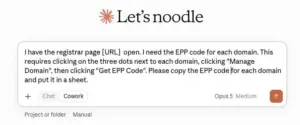
AI Automation Offers New Solution for Bulk Domain Transfer Authorization Challenges
The process of managing a large portfolio of domain names has long...
 Web Hosting & Domain Management
Woman faces changing 211 accounts after .name domain termination
The plight of Judy Johnston, a long-term registrant of a .name domain,...
 Web Hosting & Domain Management
Industry Anxiety Mounts as ICANN Withholds Critical Timeline for New gTLD Reveal Day
The global domain name industry is currently suspended in a state of...







