

For Judy Johnston, the technical sunsetting of a niche domain extension is not merely a digital inconvenience; it is a logistical catastrophe that threatens to sever her and her 97-year-old mother from twenty-five years of digital history. As the Internet Corporation for Assigned Names and Numbers (ICANN) and the registry operator Verisign move forward with the termination of third-level .name domains, a growing chorus of long-term users is sounding the alarm over the profound personal and professional disruption the decision will cause.
The .name top-level domain (TLD) was launched in the early 2000s with a specific vision: providing individuals with a permanent, personalized digital identity. Unlike .com or .net, which were intended for commercial and networking purposes, .name was marketed as a space for "digital birthrights." In its original implementation, the registry encouraged a third-level structure, such as "jane.doe.name," which allowed users to create professional-looking email addresses that mirrored their actual names. For early adopters like Johnston, who registered her domain in 2002, this was a promise of a lifelong digital home.
However, that home is now slated for demolition. Following an agreement between ICANN and Verisign, the third-level registrations within the .name TLD are being phased out. While the registry has focused on the technical and administrative reasons for the sunset—citing low registration volumes and the modernization of the TLD—the users left in the wake of this decision are finding that the "minor" technical change is resulting in a monumental burden of labor.
In a recently published reconsideration request filed with ICANN, Johnston detailed the staggering scope of the work required to migrate her digital life. After nearly a quarter-century of use, her third-level .name email address has become the primary identifier for at least 211 different online accounts. This includes everything from essential services like banking, utilities, and healthcare to social media, subscriptions, and government portals. For Johnston and her mother, the termination of the domain does not just mean losing an email address; it means losing the master key to their entire online existence.
The transition process is proving to be far more complex than simply clicking "update profile" on a few websites. Johnston noted that she and her mother are both senior citizens, a demographic that often faces unique challenges in navigating the increasingly complex security protocols of the modern internet. In an era of heightened data protection and multi-factor authentication, changing a primary email address is no longer a straightforward task. Many platforms now require users to have access to their old email address to confirm a change to a new one. If the .name domain is terminated before these changes are complete, Johnston warns that she will be forced into a manual recovery process for hundreds of accounts.
This manual recovery often involves a gauntlet of bureaucratic hurdles. Johnston reported that some service providers are already demanding multiple forms of physical identification and the completion of extensive data protection forms just to verify her identity before allowing an email update. For a 97-year-old woman, this level of technical and administrative friction is more than a nuisance; it is a barrier to accessing essential services. Johnston described the ordeal as a "full-time daily job" that has already consumed weeks of her time and is expected to continue long after the domain is officially deactivated.
The situation is further complicated by a significant breakdown in communication between the registry, ICANN, and the registrars who interface with the public. Johnston’s experience with Network Solutions, a prominent domain registrar, highlights a troubling lack of awareness within the industry regarding the .name termination. After receiving a notification about the upcoming sunset, Johnston contacted Network Solutions to explore her options for preserving her digital identity.
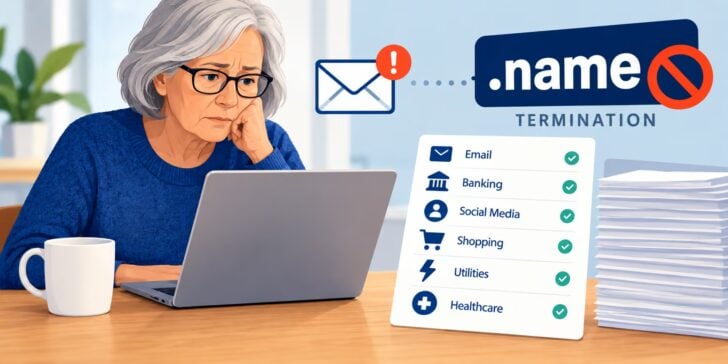
To her astonishment, multiple customer service representatives told her that the termination notice was a scam. They pointed to the fact that her domain was officially registered and paid for through 2030 as evidence that she had nothing to worry about. It was only after Johnston insisted that the representatives perform a manual search for ".name termination" that they realized the notification was legitimate. This misinformation from a major service provider suggests that many other .name users may be ignoring these critical notices, believing them to be phishing attempts, only to find themselves locked out of their accounts once the termination date arrives.
The argument for reversing the termination rests on the unique nature of the .name TLD. Unlike a standard website domain, which can often be migrated to a new TLD with a redirect and some SEO adjustments, an email address is a foundational piece of identity. When an email domain is retired, every single contact, every archived message, and every account recovery link associated with that address is jeopardized. For users who have spent two decades building a digital life on a specific platform, the registry’s decision feels like a breach of the original promise made when the TLD was launched.
Industry experts have pointed out that the technical "debt" or administrative cost of maintaining the third-level .name structure is likely minimal for a company of Verisign’s scale. Verisign, which also operates the .com and .net registries, is one of the most profitable entities in the domain name system. Critics argue that the decision to terminate these domains prioritizes registry efficiency over the stability and security of individual users. By forcing users off third-level domains, the registry may be seeking to simplify its database and reduce the complexity of its zone files, but the human cost of that simplification is being borne entirely by the registrants.
The reconsideration request filed by Johnston is part of a broader push to get ICANN and Verisign to reconsider the sunset. The core of the appeal is a request for a "grandfathering" clause—a policy that would allow existing third-level .name registrations to remain active while preventing new ones from being created. This would fulfill the registry’s goal of eventually phasing out the product without causing immediate and irreparable harm to the long-term users who have relied on the service since its inception.
The plight of Johnston and her mother also raises significant questions about the long-term reliability of the internet’s naming infrastructure. If a domain extension marketed as a "permanent" personal identifier can be retired at the whim of a registry and a regulator, it undermines trust in the entire system. Users are increasingly encouraged to move away from "walled garden" social media platforms and toward independent domains to maintain control over their digital presence. However, the .name situation suggests that even an independent domain is subject to the shifting business priorities of the entities that manage the root zone.
As the deadline for the termination approaches, the pressure on ICANN to act is mounting. The organization, which is tasked with ensuring the stability and interoperability of the internet’s naming system, is now faced with a clear case where its policy decisions are creating instability for vulnerable users. For Johnston, the stakes are personal. She is not just fighting for a domain name; she is fighting to maintain the digital thread that connects her and her mother to their doctors, their finances, and their community.
The outcome of this reconsideration request will be a bellwerther for how ICANN balances the technical evolution of the internet with the rights and needs of the people who use it. If the termination proceeds as planned, it will serve as a cautionary tale for any user considering a non-traditional domain extension for their primary digital identity. For now, Johnston remains in the trenches of a digital migration she never asked for, manually updating account after account, while hoping that the regulators who oversee the internet will recognize the human lives behind the data points they are seeking to delete.
 Web Hosting & Domain Management
Strategic Acquisitions in the European Domain Market: Nameshift Data Reveals Recent End-User Sales Trends
The secondary market for domain names remains a critical indicator of corporate...
 Web Hosting & Domain Management
The Rapid Evolution of Web Development: AI Tools Drive Unprecedented Speed in Domain Utilization and Aftermarket Demand
The secondary market for domain names has long been a barometer for...
 Web Hosting & Domain Management
Corporate Giants and Emerging Startups Secure Strategic Digital Real Estate in Latest Domain Sales Report
The secondary domain name market continues to serve as a reliable barometer...







