
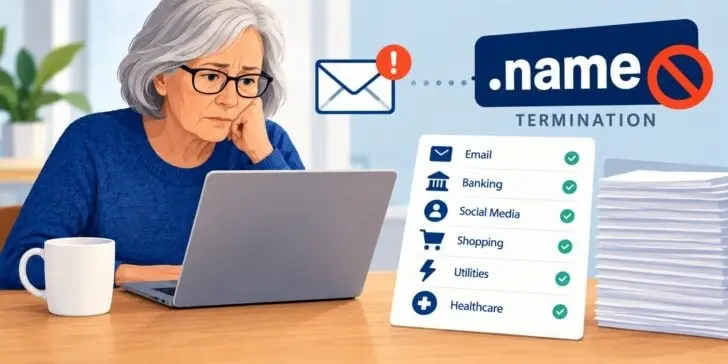
This manual recovery often involves a gauntlet of bureaucratic hurdles. Johnston reported that some service providers are already demanding multiple forms of physical identification and the completion of extensive data protection forms just to verify her identity before allowing an email update. For a 97-year-old woman, this level of technical and administrative friction is more than a nuisance; it is a barrier to accessing essential services. Johnston described the ordeal as a "full-time daily job" that has already consumed weeks of her time and is expected to continue long after the domain is officially deactivated.
The situation is further complicated by a significant breakdown in communication between the registry, ICANN, and the registrars who interface with the public. Johnston’s experience with Network Solutions, a prominent domain registrar, highlights a troubling lack of awareness within the industry regarding the .name termination. After receiving a notification about the upcoming sunset, Johnston contacted Network Solutions to explore her options for preserving her digital identity.
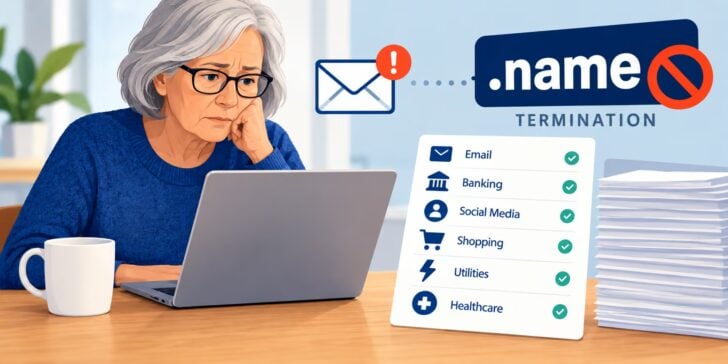
To her astonishment, multiple customer service representatives told her that the termination notice was a scam. They pointed to the fact that her domain was officially registered and paid for through 2030 as evidence that she had nothing to worry about. It was only after Johnston insisted that the representatives perform a manual search for ".name termination" that they realized the notification was legitimate. This misinformation from a major service provider suggests that many other .name users may be ignoring these critical notices, believing them to be phishing attempts, only to find themselves locked out of their accounts once the termination date arrives.
The argument for reversing the termination rests on the unique nature of the .name TLD. Unlike a standard website domain, which can often be migrated to a new TLD with a redirect and some SEO adjustments, an email address is a foundational piece of identity. When an email domain is retired, every single contact, every archived message, and every account recovery link associated with that address is jeopardized. For users who have spent two decades building a digital life on a specific platform, the registry’s decision feels like a breach of the original promise made when the TLD was launched.
Industry experts have pointed out that the technical "debt" or administrative cost of maintaining the third-level .name structure is likely minimal for a company of Verisign’s scale. Verisign, which also operates the .com and .net registries, is one of the most profitable entities in the domain name system. Critics argue that the decision to terminate these domains prioritizes registry efficiency over the stability and security of individual users. By forcing users off third-level domains, the registry may be seeking to simplify its database and reduce the complexity of its zone files, but the human cost of that simplification is being borne entirely by the registrants.
 Web Hosting & Domain Management
XYZ.com LLC Emerges as Major Contender in 2026 Domain Expansion with 139 New Applications
The landscape of the internet’s naming system is on the verge of...
 Web Hosting & Domain Management
Taylor Swift Secures Digital Frontier with Application for Proprietary .taylorswift Top-Level Domain
The landscape of the internet is poised for a significant transformation as...
 Web Hosting & Domain Management
Identity Digital Secures U.S. Government Contract to Manage .us Domain Registry
In a significant shift for the landscape of the American internet infrastructure,...







