
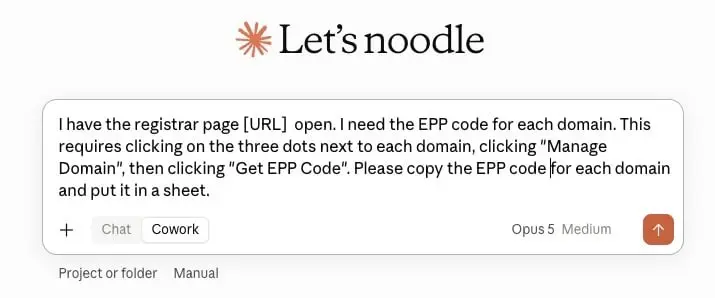
The process of managing a large portfolio of domain names has long been fraught with administrative hurdles, particularly when investors seek to migrate their assets between registrars. While the industry has moved toward more standardized protocols over the last two decades, a persistent point of friction remains: the retrieval of transfer authorization codes, commonly known as EPP (Extensible Provisioning Protocol) codes. In a recent development within the domain industry, new methodologies involving advanced artificial intelligence are providing a path forward for professionals looking to bypass the manual labor traditionally required by restrictive registrar interfaces.
For years, domain investors and IT administrators have faced a inconsistent landscape. While top-tier registrars often provide streamlined tools that allow users to export authorization codes in bulk—typically via a CSV or Excel file—many others do not. This lack of functionality is often viewed by industry veterans as a form of "artificial friction," designed to discourage users from moving their portfolios to competing services. When a registrar omits a bulk export feature, a user with hundreds or thousands of domains is forced into a grueling manual workflow: clicking into each individual domain’s management settings, requesting the code, and copying it into a local record.
However, the emergence of "agentic" AI capabilities—specifically through Anthropic’s Claude—is beginning to change the economics of these administrative tasks. By utilizing AI tools that can interact directly with web browsers, domain owners are finding they can automate the retrieval of these codes without needing custom-coded scripts or expensive API access, which many smaller registrars do not offer to the general public.
The Role of EPP Codes in Domain Portability
To understand the significance of this automation, one must consider the role of the EPP code in the global Domain Name System (DNS). The Extensible Provisioning Protocol is the standard communication bridge between registrars and registries. The EPP code acts as a unique "password" for a domain name, ensuring that only the rightful owner can authorize a move from one registrar to another. It is the primary safeguard against unauthorized domain transfers, often referred to as "domain slamming" or hijacking.
Because these codes are sensitive security credentials, registrars are required to provide them to registrants upon request. However, the ICANN (Internet Corporation for Assigned Names and Numbers) policies that govern these interactions do not strictly mandate that they be provided in a bulk format. This regulatory loophole allows certain registrars to hide the codes behind multiple layers of navigation. For a small business owner with a single domain, a three-click process is a minor inconvenience. For a professional investor managing a portfolio of 500 domains, those same three clicks represent 1,500 manual actions, a task that can consume an entire workday and introduce significant human error.
Leveraging Claude for Browser-Based Automation
The shift toward using Claude for this specific task marks a significant evolution in how generative AI is applied to professional productivity. Unlike standard chatbots that simply process text, the current generation of AI tools, when paired with specific browser extensions, can perform "computer use" tasks. This involves the AI observing the elements of a webpage—buttons, menus, and text fields—and interacting with them in the same manner a human operator would.
Andrew Allemann, a domain industry expert with over 25 years of experience and the publisher of Domain Name Wire, recently highlighted how this technology effectively eliminates the manual effort once required for these transfers. The process utilizes the Claude browser extension for Chrome and the Claude desktop application to bridge the gap between the registrar’s restricted interface and the user’s need for structured data.
 Web Hosting & Domain Management
Verisign Set to Increase .com Domain Prices on November 1, Prompting Rush for Multi-Year Renewals
Domain name registrants across the globe are facing a narrowing window of...
 Web Hosting & Domain Management
The Rise of .si: How "Super Intelligence" Rhetoric is Reshaping the Domain Secondary Market
The domain name industry has long been a mirror reflecting the rapid...
 Web Hosting & Domain Management
Slovenia’s .si Domain Experiences Unprecedented Surge Following "Super Intelligence" Executive Order
The digital landscape of Slovenia’s country-code top-level domain (ccTLD), .si, has undergone...






