
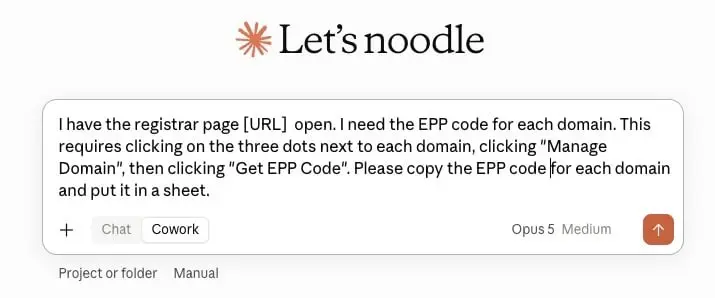
Furthermore, most registrars have security protocols that monitor for "bot-like" behavior. While Claude’s browser interactions are designed to mimic human clicking patterns, rapid-fire requests across hundreds of pages can occasionally trigger CAPTCHAs or temporary IP bans. By instructing the AI to work on a specific subset of the portfolio, users can maintain a lower profile and ensure a higher success rate for the extraction process.
The Broader Impact on the Domain Industry
The ability to use AI to circumvent registrar friction has broader implications for the domain industry as a whole. For years, the difficulty of moving portfolios has acted as a "moat" for lower-quality registrars, allowing them to maintain customer bases through sheer inertia rather than competitive pricing or superior service.
As tools like Claude make the "cost of switching" significantly lower by automating the administrative burden, registrars may be forced to compete more aggressively on value. If an investor can move a thousand domains with a few hours of supervised AI automation rather than a week of manual data entry, the barrier to seeking better deals is effectively removed.
This development also underscores a shift in the required skillset for domain name management. The value is moving away from the ability to perform repetitive tasks and toward the ability to "prompt" and oversee automated systems. For professionals like Andrew Allemann, who has been quoted by major outlets such as The Wall Street Journal and the New York Times for his expertise, the integration of AI into these workflows is a logical extension of the industry’s long-standing pursuit of efficiency.
Security and Ethical Considerations
As with any automation involving sensitive credentials, security remains a paramount concern. EPP codes are the keys to a digital kingdom; their exposure can lead to the loss of valuable intellectual property. Users employing AI extensions must ensure they are using trusted platforms and that their browser environments are secure.
The use of AI for this purpose does not bypass the need for the user to be authenticated. The AI acts as an agent for the logged-in user, meaning it operates within the existing security permissions of the account. It does not "hack" the registrar; rather, it performs the user’s intended actions with greater speed and precision.
As the domain industry continues to evolve, the intersection of AI and administrative management is likely to deepen. The retrieval of EPP codes is just one example of how agentic AI can be used to navigate the "walled gardens" of the internet. For now, it provides a much-needed relief valve for domain investors who have long been at the mercy of inefficient registrar interfaces. By turning a painstaking manual process into a streamlined automated task, AI is helping to fulfill the promise of a more fluid and competitive domain marketplace.
 Web Hosting & Domain Management
D3 Unveils Frontier: A New Pre-Order Ecosystem Designed to Gauge Demand and Streamline Next-Generation TLD Launches
In a strategic move to reshape how new top-level domains (TLDs) are...
 Web Hosting & Domain Management
ICANN Selects Adelaide for 2027 Annual General Meeting, Marking a Strategic Return to Australia
The Internet Corporation for Assigned Names and Numbers (ICANN) has officially announced...
 Web Hosting & Domain Management
Berlin-Based INWX Domains GmbH Announces Application for .crew Top-Level Domain
In a significant move within the evolving landscape of the global Domain...







