
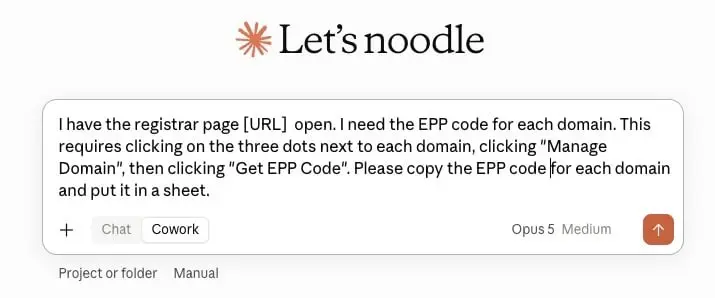
The methodology relies on a feature often referred to as "CoWork" or "Computer Use," where the user provides a natural language prompt that describes the navigational path within the registrar’s control panel. By instructing the AI to identify specific UI elements—such as the "three dots" icon for settings or the "Manage Domain" link—the user can delegate the repetitive task of navigating the site architecture.
The intelligence of the model allows it to understand context that traditional "macro" recorders might miss. For instance, if a registrar’s page layout shifts slightly or if a confirmation pop-up appears, a modern LLM (Large Language Model) can often interpret these changes and continue the task, whereas an older automated script might break.
Implementation and Prompt Logic
The core of this automation lies in the specificity of the instructions provided to the AI. According to industry observations, a successful automation session begins with the user being logged into their registrar’s secure dashboard. Once the list of domains is visible, the AI is given a descriptive command to execute the extraction.
An effective prompt for this task might specify the exact URL of the registrar’s management page and detail the sequence of actions: identifying the domain list, clicking the secondary menu, navigating to the domain management subsection, and finally triggering the "Get EPP Code" command. The AI is then tasked not just with finding the code, but with organizing the resulting data into a spreadsheet format. This transition from a visual web interface to a structured data sheet is perhaps the most valuable aspect of the workflow, as it prepares the information for immediate use in the "bulk import" tools of the gaining registrar.
This approach effectively turns a closed web interface into a makeshift API. It allows the user to treat the registrar’s website as a data source that can be scraped and organized through simple conversation rather than complex programming.
Managing Scale and Reliability
While the prospect of fully autonomous domain management is enticing, experts suggest a measured approach to using AI for these tasks. One of the primary considerations is the stability of the browser session and the potential for the AI to lose its place during extremely long sequences of actions.
In practical application, it is often recommended to batch these requests. For individuals with extensive portfolios, attempting to extract hundreds of codes in a single continuous session may lead to errors or session timeouts from the registrar’s security filters. Industry guidance suggests processing domains in groups of 40 or 50. This batching strategy serves two purposes: it ensures that if an error occurs, the user only loses a small amount of progress, and it allows the user to verify the accuracy of the extracted codes in manageable increments.
 Web Hosting & Domain Management
Corporate Giants and Emerging Startups Secure Strategic Digital Real Estate in Latest Domain Sales Report
The secondary domain name market continues to serve as a reliable barometer...
 Web Hosting & Domain Management
Deadline Approaches for .Com Domain Price Increase Scheduled for November 1
The window of opportunity for domain name owners to secure current pricing...
 Web Hosting & Domain Management
XYZ.com LLC Emerges as Major Contender in 2026 Domain Expansion with 139 New Applications
The landscape of the internet’s naming system is on the verge of...






