
The process of managing a large portfolio of domain names has long been fraught with administrative hurdles, particularly when investors seek to migrate their assets between registrars. While the industry has moved toward more standardized protocols over the last two decades, a persistent point of friction remains: the retrieval of transfer authorization codes, commonly known as EPP (Extensible Provisioning Protocol) codes. In a recent development within the domain industry, new methodologies involving advanced artificial intelligence are providing a path forward for professionals looking to bypass the manual labor traditionally required by restrictive registrar interfaces.
For years, domain investors and IT administrators have faced a inconsistent landscape. While top-tier registrars often provide streamlined tools that allow users to export authorization codes in bulk—typically via a CSV or Excel file—many others do not. This lack of functionality is often viewed by industry veterans as a form of "artificial friction," designed to discourage users from moving their portfolios to competing services. When a registrar omits a bulk export feature, a user with hundreds or thousands of domains is forced into a grueling manual workflow: clicking into each individual domain’s management settings, requesting the code, and copying it into a local record.
However, the emergence of "agentic" AI capabilities—specifically through Anthropic’s Claude—is beginning to change the economics of these administrative tasks. By utilizing AI tools that can interact directly with web browsers, domain owners are finding they can automate the retrieval of these codes without needing custom-coded scripts or expensive API access, which many smaller registrars do not offer to the general public.
The Role of EPP Codes in Domain Portability
To understand the significance of this automation, one must consider the role of the EPP code in the global Domain Name System (DNS). The Extensible Provisioning Protocol is the standard communication bridge between registrars and registries. The EPP code acts as a unique "password" for a domain name, ensuring that only the rightful owner can authorize a move from one registrar to another. It is the primary safeguard against unauthorized domain transfers, often referred to as "domain slamming" or hijacking.
Because these codes are sensitive security credentials, registrars are required to provide them to registrants upon request. However, the ICANN (Internet Corporation for Assigned Names and Numbers) policies that govern these interactions do not strictly mandate that they be provided in a bulk format. This regulatory loophole allows certain registrars to hide the codes behind multiple layers of navigation. For a small business owner with a single domain, a three-click process is a minor inconvenience. For a professional investor managing a portfolio of 500 domains, those same three clicks represent 1,500 manual actions, a task that can consume an entire workday and introduce significant human error.
Leveraging Claude for Browser-Based Automation
The shift toward using Claude for this specific task marks a significant evolution in how generative AI is applied to professional productivity. Unlike standard chatbots that simply process text, the current generation of AI tools, when paired with specific browser extensions, can perform "computer use" tasks. This involves the AI observing the elements of a webpage—buttons, menus, and text fields—and interacting with them in the same manner a human operator would.
Andrew Allemann, a domain industry expert with over 25 years of experience and the publisher of Domain Name Wire, recently highlighted how this technology effectively eliminates the manual effort once required for these transfers. The process utilizes the Claude browser extension for Chrome and the Claude desktop application to bridge the gap between the registrar’s restricted interface and the user’s need for structured data.
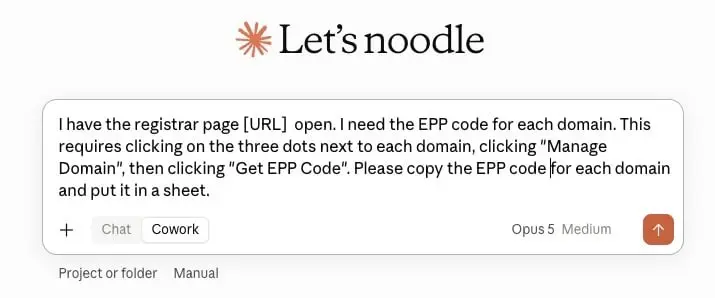
The methodology relies on a feature often referred to as "CoWork" or "Computer Use," where the user provides a natural language prompt that describes the navigational path within the registrar’s control panel. By instructing the AI to identify specific UI elements—such as the "three dots" icon for settings or the "Manage Domain" link—the user can delegate the repetitive task of navigating the site architecture.
The intelligence of the model allows it to understand context that traditional "macro" recorders might miss. For instance, if a registrar’s page layout shifts slightly or if a confirmation pop-up appears, a modern LLM (Large Language Model) can often interpret these changes and continue the task, whereas an older automated script might break.
Implementation and Prompt Logic
The core of this automation lies in the specificity of the instructions provided to the AI. According to industry observations, a successful automation session begins with the user being logged into their registrar’s secure dashboard. Once the list of domains is visible, the AI is given a descriptive command to execute the extraction.
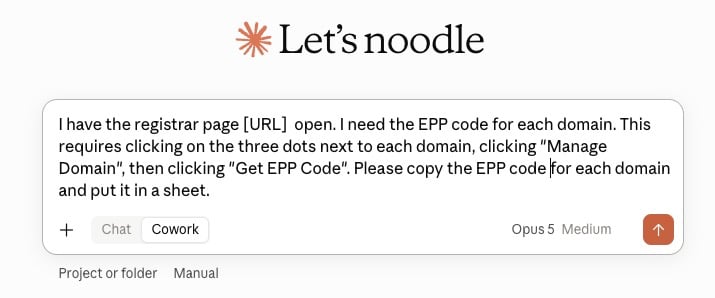
An effective prompt for this task might specify the exact URL of the registrar’s management page and detail the sequence of actions: identifying the domain list, clicking the secondary menu, navigating to the domain management subsection, and finally triggering the "Get EPP Code" command. The AI is then tasked not just with finding the code, but with organizing the resulting data into a spreadsheet format. This transition from a visual web interface to a structured data sheet is perhaps the most valuable aspect of the workflow, as it prepares the information for immediate use in the "bulk import" tools of the gaining registrar.
This approach effectively turns a closed web interface into a makeshift API. It allows the user to treat the registrar’s website as a data source that can be scraped and organized through simple conversation rather than complex programming.
Managing Scale and Reliability
While the prospect of fully autonomous domain management is enticing, experts suggest a measured approach to using AI for these tasks. One of the primary considerations is the stability of the browser session and the potential for the AI to lose its place during extremely long sequences of actions.
In practical application, it is often recommended to batch these requests. For individuals with extensive portfolios, attempting to extract hundreds of codes in a single continuous session may lead to errors or session timeouts from the registrar’s security filters. Industry guidance suggests processing domains in groups of 40 or 50. This batching strategy serves two purposes: it ensures that if an error occurs, the user only loses a small amount of progress, and it allows the user to verify the accuracy of the extracted codes in manageable increments.
Furthermore, most registrars have security protocols that monitor for "bot-like" behavior. While Claude’s browser interactions are designed to mimic human clicking patterns, rapid-fire requests across hundreds of pages can occasionally trigger CAPTCHAs or temporary IP bans. By instructing the AI to work on a specific subset of the portfolio, users can maintain a lower profile and ensure a higher success rate for the extraction process.
The Broader Impact on the Domain Industry
The ability to use AI to circumvent registrar friction has broader implications for the domain industry as a whole. For years, the difficulty of moving portfolios has acted as a "moat" for lower-quality registrars, allowing them to maintain customer bases through sheer inertia rather than competitive pricing or superior service.
As tools like Claude make the "cost of switching" significantly lower by automating the administrative burden, registrars may be forced to compete more aggressively on value. If an investor can move a thousand domains with a few hours of supervised AI automation rather than a week of manual data entry, the barrier to seeking better deals is effectively removed.
This development also underscores a shift in the required skillset for domain name management. The value is moving away from the ability to perform repetitive tasks and toward the ability to "prompt" and oversee automated systems. For professionals like Andrew Allemann, who has been quoted by major outlets such as The Wall Street Journal and the New York Times for his expertise, the integration of AI into these workflows is a logical extension of the industry’s long-standing pursuit of efficiency.
Security and Ethical Considerations
As with any automation involving sensitive credentials, security remains a paramount concern. EPP codes are the keys to a digital kingdom; their exposure can lead to the loss of valuable intellectual property. Users employing AI extensions must ensure they are using trusted platforms and that their browser environments are secure.
The use of AI for this purpose does not bypass the need for the user to be authenticated. The AI acts as an agent for the logged-in user, meaning it operates within the existing security permissions of the account. It does not "hack" the registrar; rather, it performs the user’s intended actions with greater speed and precision.
As the domain industry continues to evolve, the intersection of AI and administrative management is likely to deepen. The retrieval of EPP codes is just one example of how agentic AI can be used to navigate the "walled gardens" of the internet. For now, it provides a much-needed relief valve for domain investors who have long been at the mercy of inefficient registrar interfaces. By turning a painstaking manual process into a streamlined automated task, AI is helping to fulfill the promise of a more fluid and competitive domain marketplace.
 Web Hosting & Domain Management
Strategic Acquisitions in the European Domain Market: Nameshift Data Reveals Recent End-User Sales Trends
The secondary market for domain names remains a critical indicator of corporate...
 Web Hosting & Domain Management
Public Interest Registry Recognizes Global Excellence as TECHO Claims Top Honors at Annual .Org Impact Awards
The Public Interest Registry, the mission-based nonprofit organization responsible for managing the...
 Web Hosting & Domain Management
Major Domain Registrars Challenge auDA Over Policy Shifts Threatening Millions of .au Registrations
A coalition of ten prominent domain name registrars has formally petitioned the...







