
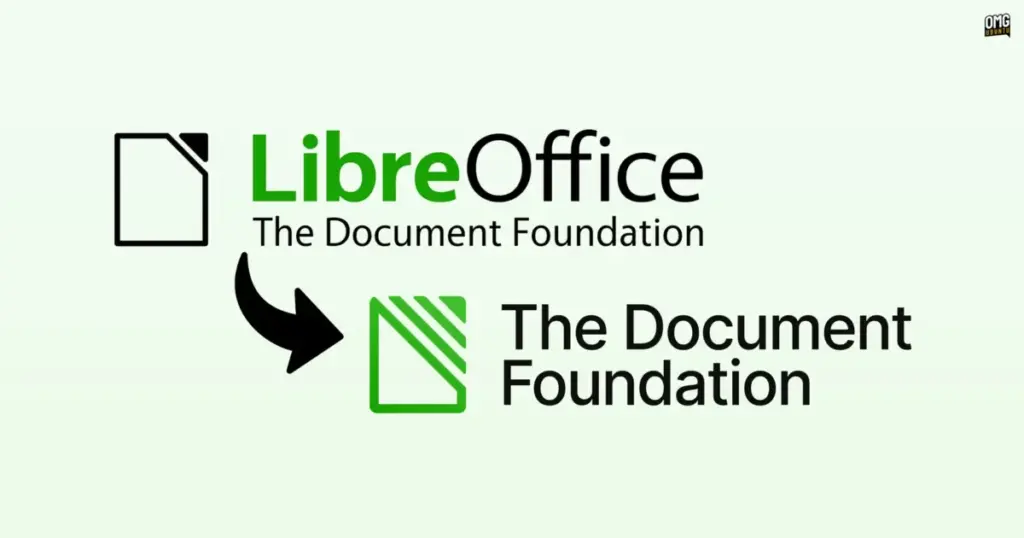
The Document Foundation, the charitable non-profit entity responsible for overseeing the development and stewardship of the LibreOffice office suite, has officially unveiled a comprehensive refresh of its visual identity. Marked by a distinct new logo, modernized typography, and an updated color palette, the change represents the first time since the foundation’s establishment in 2010 that the governing organization does not share a unified logotype and wordmark with LibreOffice itself. The move formally untangles the visual representation of the administrative body from the software application that has historically served as its most recognizable public output.
Under the new design framework, the foundation has established a standalone wordmark bearing the full name "The Document Foundation," rendered cleanly in the open-source typeface Inter. The typography is supported by an updated set of complementary brand colors, chosen to lend the organization a contemporary, cohesive, and clearly defined aesthetic. By departing from the visual motifs that have traditionally mirrored the LibreOffice brand, the foundation is taking a deliberate step toward presenting itself as an autonomous entity with a mission that stretches across the wider technology and public policy landscape.
The rationale behind the brand separation was detailed by Italo Vignoli, a founding member of The Document Foundation, who highlighted the practical necessity of giving the organization its own voice. Presenting the new visual assets, Vignoli emphasized that the foundation requires an identity suited to communicating as an established institution rather than being perceived solely as a software development project. He noted that the organization’s mandate extends well beyond the single product for which it is most widely recognized, making a clear visual distinction between the governing body and LibreOffice an essential evolution for its institutional growth.
For more than a decade, the public identity of The Document Foundation was deeply intertwined with LibreOffice, creating an environment where observers, users, and institutional partners frequently conflated the non-profit organization with the office suite it maintains. While this close association was instrumental in building credibility during the project’s formative years following its split from OpenOffice.org in 2010, the continued expansion of the foundation’s advocacy work has increasingly highlighted the limitations of sharing a singular visual brand. As the organization engages with regulatory bodies, standards committees, and public sector administrations, establishing a dedicated institutional identity has become an operational priority.
 Linux & Open Source Solutions
Canonical Releases Official Ubuntu Desktop Images for RISC-V Hardware Ahead of Ubuntu 26.10
Installing Ubuntu on RISC-V hardware is poised to become significantly more straightforward...
 Linux & Open Source Solutions
Ubuntu 26.10 Arrives with Rust Coreutils, Passkey Authentication, and Smarter Window Snapping
Canonical has officially announced the release of Ubuntu 26.10, codenamed "Stonking Stingray."...
 Linux & Open Source Solutions
Hylki Brings Modern Rust Engineering and Deep Customization to the GNOME Desktop
For years, the Linux desktop has maintained a complicated relationship with the...







