
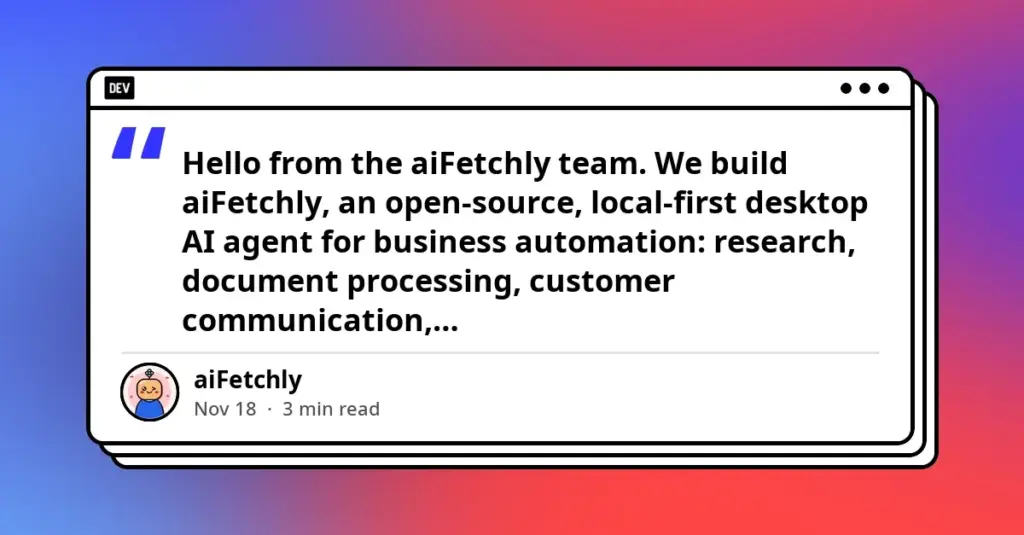
The landscape of business automation is undergoing a significant shift as small teams seek more control over their data and more structure in their daily operations. Leading this movement is the aiFetchly team, which has recently introduced its flagship product: an open-source, local-first desktop AI agent designed specifically for business automation. By focusing on research, document processing, customer communication, and scheduled workflows, aiFetchly aims to bridge the gap between the chaotic manual processes typical of growing startups and the rigid, often expensive enterprise solutions that dominate the market.
For many small organizations, the primary obstacle to growth is not necessarily a lack of market interest or a shortage of incoming leads. Instead, the challenge lies in the absence of a repeatable, scalable routine. In many offices, lead management and inbox maintenance remain fragmented activities. One team member might scan the inbox in the early hours of the morning, while another spends the afternoon manually migrating company details into a spreadsheet. Follow-ups and relationship management often depend entirely on individual memory rather than a standardized system. This lack of cohesion creates a bottleneck that prevents small teams from responding with the speed and accuracy required in a competitive digital economy.
The developers behind aiFetchly argue that the solution to this fragmentation is not just more software, but a fundamental shift in how teams approach their daily tasks. The goal is to transform scattered email and lead-related chores into scheduled workflows that a lean team can execute reliably every single day.
Shifting Focus from the Inbox to the Workflow
At the heart of the aiFetchly philosophy is the idea that professionals should start with a defined workflow rather than reacting to an overflowing inbox. In a traditional setup, the inbox dictates the team’s priorities, leading to a reactive state where employees are constantly "putting out fires" rather than building value. By establishing a useful scheduled workflow, teams can reclaim their schedules.
A robust automated workflow, as envisioned by the aiFetchly team, consists of four distinct stages. It begins with the systematic collection of data from various sources, followed by the sorting and categorization of that information. Once the data is organized, the AI agent moves into the drafting phase, where it prepares responses or updates based on the gathered information. The final and most critical step is the transition of these drafts to a human team member for review.
This "human-in-the-loop" design is a cornerstone of the aiFetchly platform. The developers have intentionally designed the system so that drafts wait for manual approval before being sent to clients or partners. The underlying principle is that automation should be utilized to eliminate the drudgery of copying, pasting, and searching for information, but it should never be used to replace human judgment. By keeping the final decision in the hands of a person, businesses can ensure that their communication remains authentic and that the nuances of a professional relationship are preserved.
The Strategic Value of Local Business Knowledge
One of the most significant features of aiFetchly is its commitment to a local-first architecture. In an era where data privacy and security are paramount, many small teams are hesitant to upload their proprietary business knowledge—such as pricing structures, delivery logistics, and internal support documents—to third-party cloud providers. aiFetchly addresses this concern by maintaining a local knowledge base and private memory.
This approach allows the AI agent to draw upon a company’s own documents and past interactions to generate responses, rather than relying on the generalized patterns of a standard language model. Small teams frequently find themselves answering the same set of questions regarding onboarding procedures, product limitations, and support scopes. By centralizing this information within a local knowledge base, the AI can provide accurate, fact-based drafts that reflect the specific realities of the business.
In practice, this local-first model means that the team retains absolute control over its intellectual property. The "local-first" designation does not imply that the tool is intended for solitary use; rather, it signifies that the team decides exactly what information the agent is permitted to access and use. This ensures that the AI’s output is not a product of "guessing" based on external data, but a reflection of the team’s established expertise and historical data.
Implementing a Sustainable Daily Routine
To help small teams of two to five people transition away from manual chaos, aiFetchly suggests a structured daily routine that integrates the AI agent into the existing work cycle. This routine is designed to provide maximum coverage with minimal oversight, allowing human employees to focus on high-value tasks.
The day typically begins with a morning triage. During this phase, the AI agent scans the incoming communications and organizes them by priority and topic, allowing the team to see at a glance what requires immediate attention. By the middle of the day, the workflow shifts toward lead organization. This involves the agent processing new inquiries, extracting relevant details, and preparing the necessary documentation or CRM updates. As the workday nears its conclusion, the focus moves to follow-ups. The agent identifies which conversations have stalled and prepares draft reminders, ensuring that no potential lead falls through the cracks due to a busy schedule.
Furthermore, the platform’s architecture allows for extensibility through plugins. These plugins enable teams to connect the AI agent to specific tools and data sources. As a business grows and adopts new communication channels or document types, the team can simply add a plugin rather than having to rebuild their entire workflow from scratch. This modularity provides the flexibility needed to adapt to a changing business environment without sacrificing the stability of the core routine.
Defining the Boundaries of Automation
While the benefits of scheduled workflows are clear, the creators of aiFetchly are careful to delineate what the technology is not meant to replace. They emphasize that automation should not be seen as a substitute for sales judgment, the cultivation of customer relationships, or the careful reading of complex documents. The most effective use of AI is in the repetitive, predictable components of a job: the collecting, sorting, and drafting of information based on known facts.
There are certain scenarios where automation is explicitly discouraged. If a message from a customer is ambiguous, expresses anger, or involves commercially sensitive information, the recommended workflow is to pause the automated process and hand the task over to a human professional. The aiFetchly team suggests a simple litmus test for any automated task: if a team member would not feel comfortable sending a draft without reading it first, then the final sending step should not be automated. This conservative approach to automation helps prevent the reputational damage that can occur when an AI misinterprets the tone or intent of a high-stakes communication.
Accessibility and the Open-Source Model
In a market often characterized by opaque pricing and "black box" algorithms, aiFetchly has opted for a more transparent model. The project offers a Community edition that is free to use, catering to the open-source community and small startups looking to experiment with local AI. For teams requiring more robust capabilities, the Plus tier is available starting at $10 per month. This paid version includes exclusive features such as the AI Content Assistant, which provides more advanced drafting and analysis tools.
By offering a free entry point, the aiFetchly team allows businesses to assess the value of the tool and the volume of their automation needs before committing to a financial investment. This approach aligns with the project’s broader goal of empowering small teams with tools that were previously only available to large corporations with significant IT budgets.
The development team also provides resources to help users understand the practical applications of the technology, including video demonstrations that show the AI agent in action—replying to emails using only local knowledge. These resources are part of an effort to demystify AI and show how it can be applied to solve the very specific, mundane problems that hinder small business efficiency.
As the conversation around AI shifts from theoretical potential to practical application, tools like aiFetchly represent a new category of "quiet" productivity software. They do not aim to replace the workforce, but to provide the structural support that allows small teams to operate with the discipline and consistency of a much larger organization. By focusing on local-first data management and human-centric workflows, aiFetchly is positioning itself as a vital utility for the modern, lean business.
 Software Development & Scripting for IT
From Hawaii to the Modern Web: How the ALOHA Protocols Defined the Efficiency of Digital Communication
The history of the modern internet is often told through the lens...
 Software Development & Scripting for IT
Unlocking Digital Visibility: How Website Owners Can Ensure Inclusion in ChatGPT Search Results
As the digital landscape undergoes a seismic shift toward artificial intelligence-driven discovery,...
 Software Development & Scripting for IT
Innovative Desk-Based Prototype "DriveSignal" Redefines Driver Monitoring Through Personalized Eye-Tracking and Explainable AI
In the rapidly evolving landscape of automotive safety, the integration of driver...







