As the digital landscape undergoes a seismic shift toward artificial intelligence-driven discovery, the mechanisms by which businesses and content creators reach their audiences are evolving. With the launch and integration of search capabilities within ChatGPT, OpenAI has positioned itself as a significant player in the search engine market, challenging the long-standing dominance of traditional platforms. However, for many website owners, a critical question has emerged: why is their content not appearing in these AI-generated answers? The answer often lies within the technical configurations of a website, specifically in how it communicates with OpenAI’s specialized web crawlers.
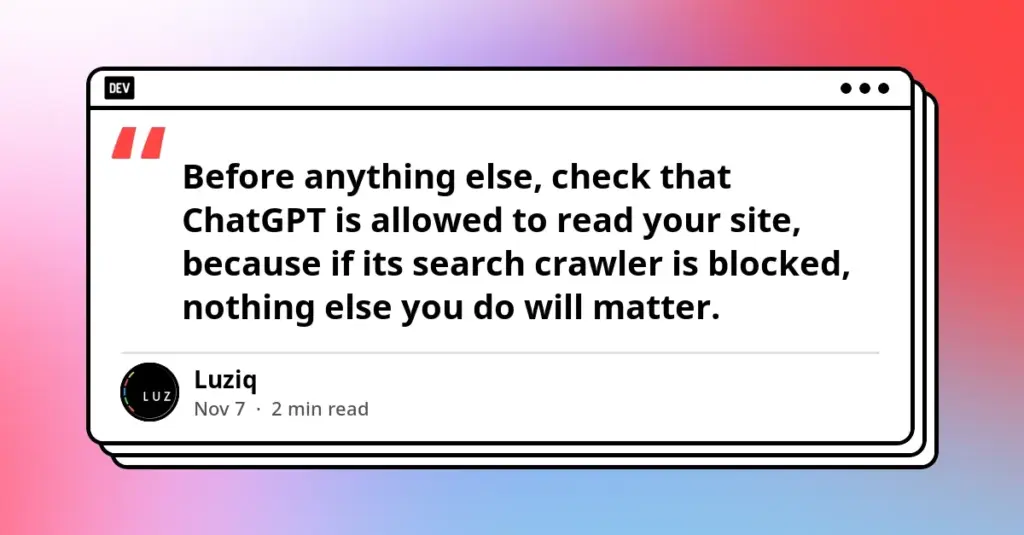
Ensuring that a website is discoverable by ChatGPT is not merely a matter of high-quality content; it is a matter of technical permission. OpenAI has made it clear that if its search crawler is blocked by a site’s internal instructions, that site will effectively remain invisible to ChatGPT search answers. This technical gatekeeping occurs primarily through a small but powerful document known as the robots.txt file, alongside server-level security settings that may inadvertently treat AI bots as malicious actors.
The Initial Diagnostic: Examining the Robots.txt File
The first and most vital step for any organization seeking to maintain its visibility in the AI era is a thorough audit of the robots.txt file. This is a public-facing text file located at the root directory of a domain. It serves as a set of instructions for automated web crawlers, telling them which parts of a site they are permitted to visit and which are off-limits. For those who are not technically inclined, checking this file is a straightforward process that requires only a standard web browser.
By navigating to a domain and appending /robots.txt to the URL—for example, https://yoursite.com/robots.txt—a site owner can see exactly what instructions are being broadcast to the world. In many instances, a browser may return a "404 Not Found" page. While this might seem like an error, in the context of crawler management, it is a neutral result. The absence of a robots.txt file generally implies that there are no specific restrictions in place, meaning that well-behaved crawlers, including those from OpenAI, are free to index the site by default. However, if a file does exist, it must be scrutinized for specific patterns that could be hindering search performance.
Identifying the Patterns of Exclusion
When reviewing a robots.txt file, there are three primary patterns that site owners should look for, each of which has a different impact on how ChatGPT interacts with the site’s data. The most direct block is one that names OpenAI’s search-specific crawler. If a file contains the "User-agent: OAI-SearchBot" directive followed by "Disallow: /", the site has explicitly told ChatGPT’s search engine to stay away. This directive is a hard stop; OpenAI has stated that it respects these instructions, and as long as they remain in place, the site’s content will not be utilized to answer user queries in the ChatGPT search interface.
A second, more sweeping pattern is the universal block. This is often represented by "User-agent: *" followed by "Disallow: /". This configuration is frequently a relic of a website’s development phase, intended to keep search engines from indexing a site before it is ready for public viewing. If this remains in place after a site goes live, it doesn’t just block OpenAI; it blocks Google, Bing, and every other reputable search engine, effectively removing the site from the global searchable web.
 Software Development & Scripting for IT
Bridging the Context Gap: TokenCap Introduces Schema Intelligence to Eliminate AI Coding Errors
In the rapidly evolving landscape of software development, the integration of Artificial...
 Software Development & Scripting for IT
Supply Chain Hijack: How a Vulnerability in Optimizely Turned Trusted Scripts into Weapons for Financial Theft and iOS Exploitation
On November 16, a sophisticated supply chain attack exploited a critical vulnerability...
 Software Development & Scripting for IT
The Connectivity Gap: Why Your Smart Lock Fails and the Technical Realities of the Three-Hop System
In the rapidly evolving landscape of the modern smart home, few devices...