
In the rapidly evolving landscape of smart home technology, the gap between powerful functionality and user-friendly accessibility has often been a significant point of friction for even the most dedicated enthusiasts. While Apple’s HomeKit ecosystem provides a robust framework for device connectivity, the process of creating intricate, multi-layered automations has traditionally required a deep understanding of logical triggers, conditions, and sequential actions. Controller for HomeKit, a long-standing favorite among power users for its deep integration and advanced management tools, is now aiming to bridge this gap with its latest update, which introduces a sophisticated AI-driven feature designed to transform the way users interact with their living spaces.
The centerpiece of this update is a new natural language processing tool that the developer is promoting under the evocative slogan, "Just say it." The premise is straightforward yet ambitious: instead of manually navigating through menus, selecting individual devices, and assigning specific states or schedules, users can simply describe what they want to happen in plain English. The underlying artificial intelligence then takes this descriptive input and automatically translates it into the technical architecture required to build a HomeKit scene, workflow, or automation.
This shift toward natural language interaction represents a significant departure from the standard "if-this-then-that" interface that has dominated smart home management for years. For many users, the primary barrier to a truly "smart" home has been the time and cognitive effort required to program complex routines. By leveraging AI to handle the heavy lifting of configuration, Controller for HomeKit is positioning itself as a bridge between human intent and digital execution. The app’s website emphasizes this simplicity, suggesting that the user’s only responsibility is to articulate the desired outcome, while the software manages the intricate backend logic.
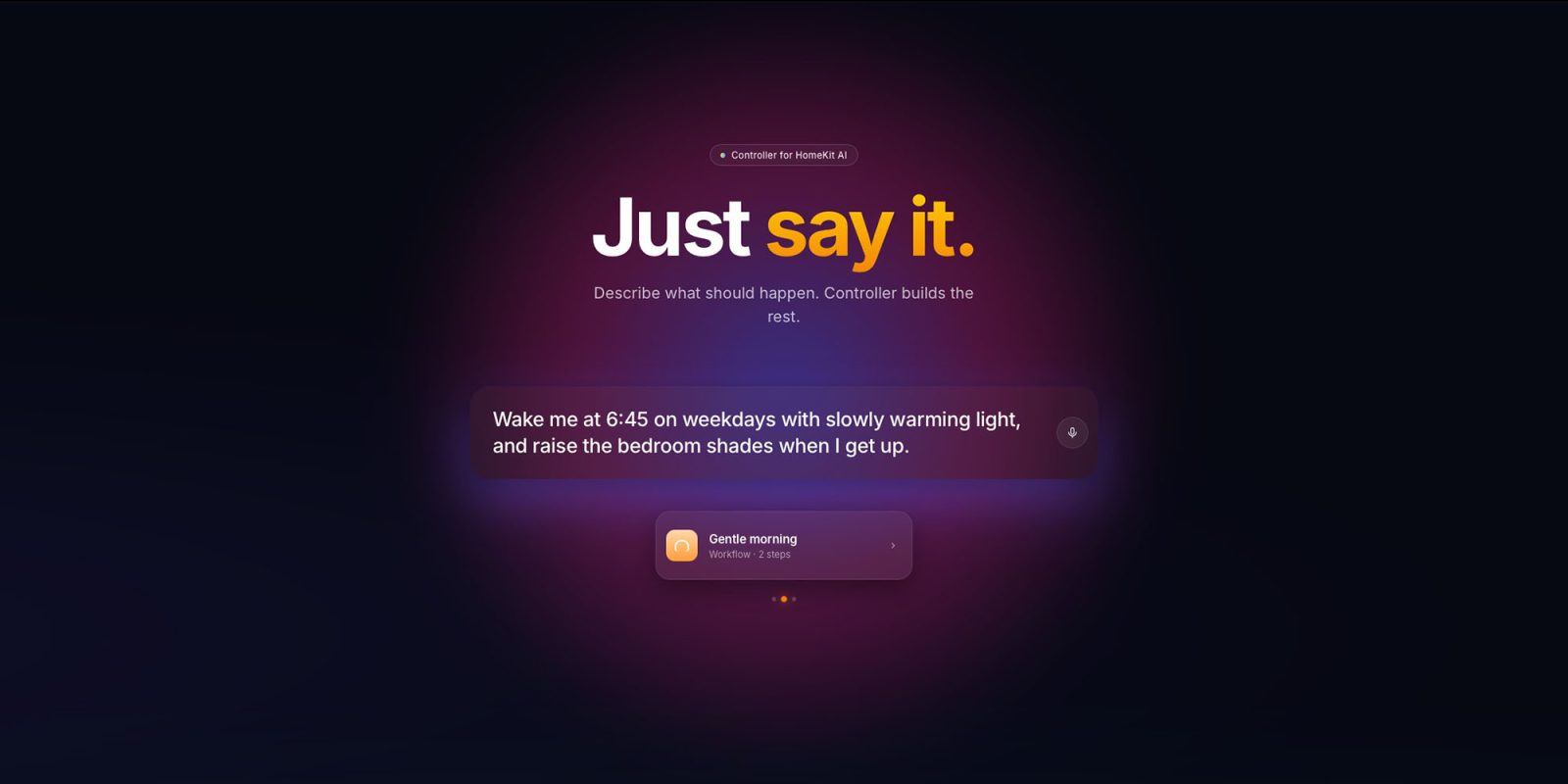
To illustrate the capabilities of the new feature, the developers have provided several examples of how varied and specific these prompts can be. One example demonstrates a morning routine: "Wake me at 6:45 on weekdays with slowly warming light, and raise the bedroom shades when I get up." This single sentence involves several distinct commands and triggers that would normally require multiple steps to program. It necessitates a time-based trigger for specific days of the week, a gradual transition of light intensity and color temperature—a feature often referred to as "adaptive lighting" or "circadian transition"—and a secondary action involving window coverings based on a "getting up" event, which might be tied to a sensor or a manual override.
Another example showcases the AI’s ability to handle environmental settings for entertainment: "Movie night: dim the living room lights to 20% and close the curtains." In traditional setups, a user would need to create a specific "Movie Night" scene, find every relevant light fixture and curtain motor, and manually set their percentages. With the new "Just say it" feature, the AI identifies the relevant categories of devices and applies the requested parameters instantly.
 Smart Home & IoT Solutions
Schlage Set to Launch Sense Pro Smart Deadbolt with Ultra Wideband Support for Apple Home Users
The landscape of the smart home security market is poised for a...
 Smart Home & IoT Solutions
Apple Prepares Major Smart Home Overhaul as Apple Intelligence Breathes New Life into Siri
For several years, Apple’s presence in the smart home market has been...
 Smart Home & IoT Solutions
The Frictionless Frontier: How the Apple Home Collection Aims to Bridge the Gap Between Tech Enthusiasts and the Mass Market
For those who consider themselves part of the global community of technology...