
The landscape of enterprise software management is undergoing a significant shift as artificial intelligence moves from simple chatbots to autonomous agents capable of handling complex administrative tasks. This week, the spotlight fell on CogniRunner, a Forge application for Jira Cloud, which demonstrated its ability to manage Atlassian licenses across sprawling organizational structures using little more than plain-language instructions. In a series of real-world drills and live deployments, the AI agent, categorized as a "Virtual Administrator," successfully audited dozens of products, proposed cost-saving measures, and operated within a strict human-in-the-loop safety framework.
Atlassian license management is traditionally a tedious, manual process or one requiring rigid, deterministic tools. CogniRunner seeks to bridge this gap by allowing administrators to describe a job in a single paragraph. During the demonstration, the agent was tasked with a specific mandate: keep every product at ten licensed users or fewer, ignore demo evaluators, protect administrative accounts, and report all findings. The results highlighted both the efficiency of AI and the necessity of granular control in modern cloud environments.

Atlassian License Management Set Up by Prompt
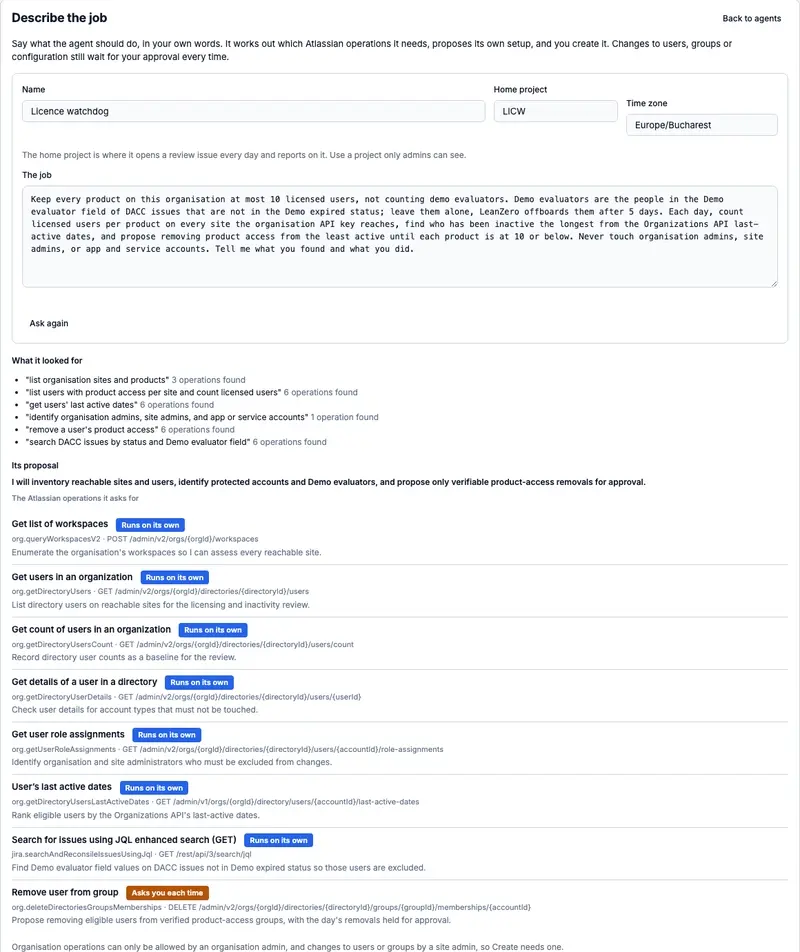
The core of the CogniRunner experience lies in its "Describe a Job" interface. Rather than configuring complex logic gates or writing scripts, an administrator provides a natural language prompt. In the latest tests, which spanned versions 1.32.0 to 1.33.1, the agent was given a detailed set of instructions to monitor an organization’s license usage. The prompt directed the agent to count licensed users per product across every site reachable via the Organization API, identify the least active users based on their last-seen dates, and propose the removal of access for those users if a product exceeded a ten-user limit.
Upon receiving these instructions, the agent does not act immediately. Instead, it searches CogniRunner’s internal catalog of Atlassian operations to build a viable execution plan. In this instance, the agent identified eight necessary operations. Seven of these were "read-only" actions, such as fetching site lists, user counts, and role assignments. The eighth operation—the actual removal of a user from a group—was automatically flagged with a requirement for human intervention. This "Asks you each time" designation ensures that while the AI does the heavy lifting of data gathering, the final decision to alter a user’s access remains with a human administrator.
The agent’s plan involved a 14-step process, including the creation of a daily review issue in Jira and a schedule to check for work every 30 minutes during business hours. This structured approach allows the AI to function as a persistent watchdog, maintaining a "Live" status where it reports findings autonomously while staging any requested changes for approval.

Counting Licensed Users Per Product via the Organizations API
The challenge of managing Atlassian licenses is compounded by the vendor’s billing logic. According to Atlassian’s user management guidelines, any user granted application access counts toward a cloud subscription, regardless of whether they have ever logged in. For organizations with multiple sites and products, keeping track of these "ghost" users is a significant administrative burden.
In the monitored organization, which consists of 17 test and demo sites, the CogniRunner agent was tasked with auditing 32 distinct product instances. These included various deployments of Jira, Confluence, and Jira Service Management. The agent successfully identified that user counts across these 32 products ranged from three to six licensed users—well below the ten-user threshold defined in the prompt. Consequently, the agent correctly proposed no removals during its standard run on October 9.
To verify the AI’s accuracy, manual scripts were run against the same Organizations REST API. The results matched perfectly, confirming that the AI could navigate complex API responses to provide a reliable snapshot of an organization’s licensing posture. Furthermore, the agent demonstrated a nuanced understanding of context by successfully excluding "demo evaluators"—temporary users whose access is managed by a separate process—proving that AI can handle exceptions that might trip up simpler automated tools.
 Software Development & Scripting for IT
The High Stakes of Autonomy: Navigating the Promise and Peril of AI in Security Operations
The modern Security Operations Center (SOC) is currently undergoing a radical transformation....
 Software Development & Scripting for IT
The Architecture of Thought: Why Modern Software Engineering Mentorship is Moving Beyond Syntax
In the modern landscape of software development, a stark divide has emerged...
 Software Development & Scripting for IT
The Crisis of the "Almost Right" Illusion: How AI-Driven Developer Burnout is Reshaping Software Engineering
The initial promise of Artificial Intelligence in software development was centered on...







