
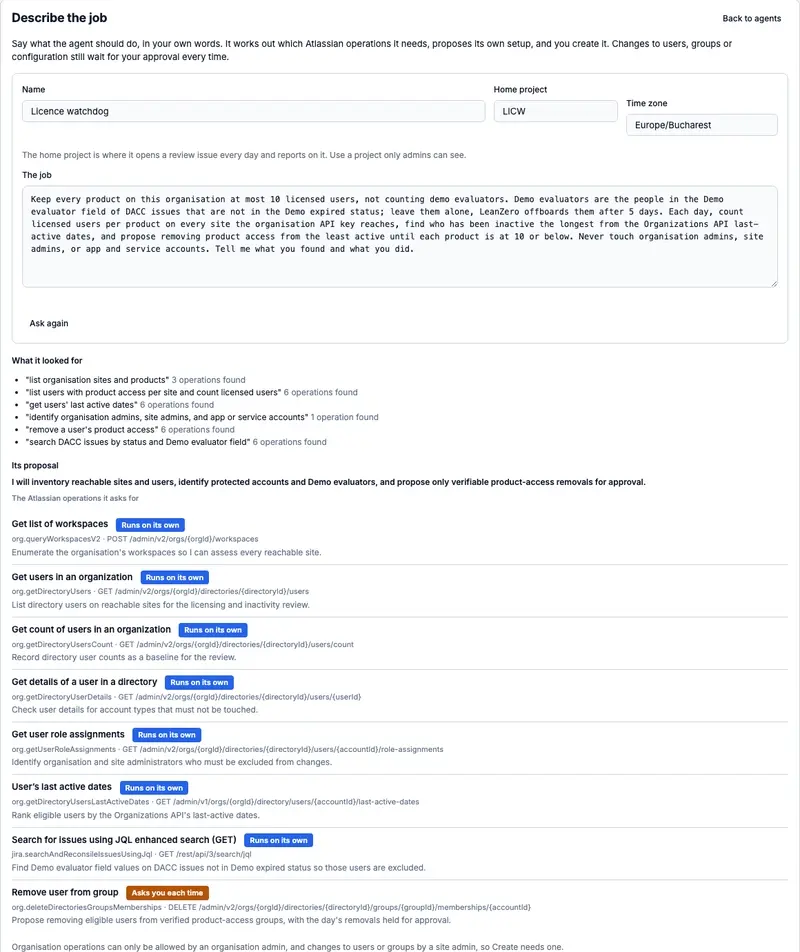
The developers of CogniRunner are transparent about when AI is the right tool for the job. For simple, repetitive license counting, deterministic tools are often more efficient and cost-effective. These tools do not require token expenditures and have no risk of misinterpreting a prompt. However, AI earns its keep when the task requires judgment or integration with unique organizational data—such as identifying demo evaluators based on specific Jira fields or interpreting complex backout plans.

To manage costs, CogniRunner includes a daily token cap per agent, typically starting at 250,000 to 500,000 tokens. This prevents unexpected bills while allowing the agent to perform its daily duties. Users can choose from various providers, including Anthropic, OpenAI, and Google Gemini, or even run local models via Ollama to eliminate token costs entirely.
AI Workflow Validation and "The Coder"
Beyond license management, CogniRunner demonstrated its utility in safeguarding workflows and assisting in software development. A notable experiment involved an AI workflow validator designed to stop unauthorized or unsafe transitions in Jira.
In a simulation involving a database change request, two AI validators were set up to review "Backout Plans" and "Staging Rehearsal Reports." The AI was instructed to block any transition to the "CAB Approval" status if the backout plan was not concrete or if the rehearsal report showed failed steps. When "Claude Code," an Anthropic coding agent, attempted to move the ticket via the REST API, the CogniRunner validator blocked the move. The AI correctly identified that the backout plan failed to account for a specific dropped column and that a row count verification had failed in the attached report.

This capability represents a significant advancement over traditional regex-based validators, which can be fooled by the presence of text but cannot judge its meaning. By providing a natural language "reason" for the failure, the AI allows both human and automated agents to correct their work and try again.
Finally, the demonstration featured "The Coder," an AI coding agent that can build and deploy Forge applications through Bitbucket Pipelines. From a single prompt, the agent created a Bitbucket repository, staged necessary files for a new Jira issue panel, and triggered a deployment to a development environment. Throughout this process, security remained paramount: the agent operated with restricted scopes and did not have access to personal API tokens or administrative credentials, adhering to Atlassian’s stringent security requirements for cloud apps.
As AI continues to integrate into the Atlassian ecosystem, tools like CogniRunner suggest a future where the role of the administrator shifts from manual execution to high-level oversight, directed by plain-language commands and secured by robust, multi-stage approval processes.
 Software Development & Scripting for IT
The High Stakes of Autonomy: Navigating the Promise and Peril of AI in Security Operations
The modern Security Operations Center (SOC) is currently undergoing a radical transformation....
 Software Development & Scripting for IT
Re-evaluating the Enterprise Test Automation Stack: Why Past Decisions Require New Scrutiny in the Age of AI
In the fast-moving world of enterprise software, a test automation tool that...
 Software Development & Scripting for IT
Bridging the Context Gap: TokenCap Introduces Schema Intelligence to Eliminate AI Coding Errors
In the rapidly evolving landscape of software development, the integration of Artificial...






