
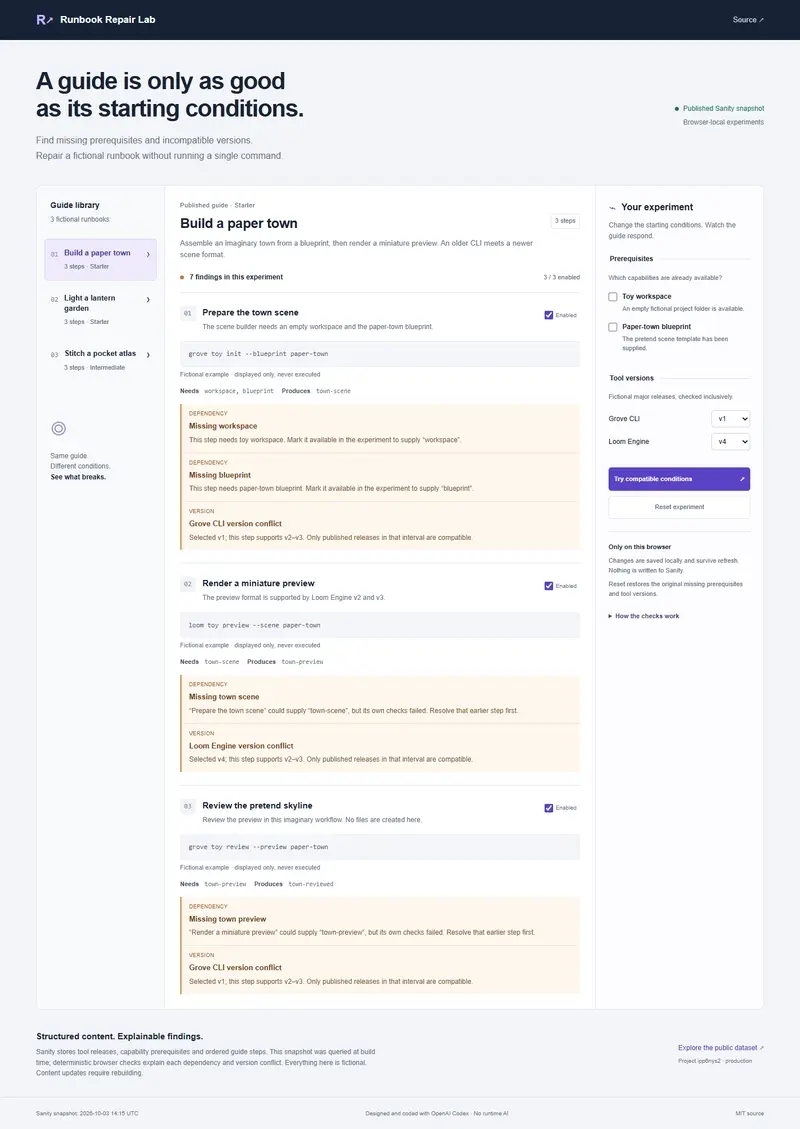
In the rapidly evolving landscape of software engineering, the "runbook"—a routine set of instructions for a technical task—is often the most fragile link in the chain. Documentation frequently suffers from "bit rot," where software versions, environment variables, and tool requirements drift away from the reality of the code they are meant to support. Addressing this systemic challenge, a new experimental project titled the Runbook Repair Lab has emerged, offering a unique sandbox for developers to diagnose and repair the hidden assumptions that cause technical guides to fail.
Developed as a submission for the Sanity Challenge under the "Vibe-Code Something Strange" category, the Runbook Repair Lab is a Next.js-based application that treats documentation not as static text, but as a series of logical dependencies. The project, spearheaded by developer Simon Levy, utilizes the Sanity content platform and OpenAI’s Codex to create an environment where fictional technical guides can be stress-tested, broken, and ultimately fixed through a rigorous understanding of their underlying prerequisites.
A New Approach to Debugging Documentation
At its core, the Runbook Repair Lab is an exploration of the "invisible" infrastructure of a technical guide. Most developers have encountered a situation where a step-by-step tutorial fails because a tool version is outdated or a prerequisite workspace was never initialized. The Lab aims to make these failures visible and predictable.
The application currently hosts three intentionally whimsical projects: the construction of a paper town, the lighting of a lantern garden, and the stitching of a pocket atlas. While the subject matter is fictional, the logical structure is highly technical. These guides utilize fictional tools and commands that, while they appear as display text, are governed by a complex set of versioning and capability rules. By changing the starting conditions—such as the version of a fictional command-line interface or the presence of a specific workspace—users can watch as specific steps in the guide fail in real-time, providing a clear visualization of how a single version mismatch can derail an entire workflow.
Unlike many modern AI applications that rely on real-time Large Language Model (LLM) processing to generate responses, the Runbook Repair Lab operates on a deterministic TypeScript checker. This ensures that the results are consistent and reproducible. The application does not execute the commands; instead, it evaluates the relationships between steps and prerequisites stored within Sanity. This architectural choice highlights a growing trend in "vibe-coding," where AI is used to design and implement the logic of an application, while the runtime execution remains grounded in traditional, reliable code.
The Architectural Foundation: Sanity and Static Freshness
The Runbook Repair Lab leverages Sanity as its primary engine for storing guides, tool releases, and prerequisite relationships. The choice of Sanity allows for a highly structured approach to content management, where each document type—be it a "Tool," a "Prerequisite," or a "Guide"—plays a specific role in the application’s ecosystem.

One of the project’s most notable technical features is its commitment to data integrity through a static, build-time Sanity snapshot. The public frontend is not a live-querying application but a static export. This decision was made to mitigate the risks associated with fetch-cache issues and runtime token dependencies. During the build process, the application performs a server-only native HTTPS read from Sanity, governed by an eight-second timeout and a strict one-megabyte response limit. This "honest" approach to static freshness means that if the data is invalid or unavailable at the time of the build, the process fails rather than substituting the data with potentially misleading sample content.
 Software Development & Scripting for IT
The Hidden Risks of DNS Drift: Why Engineering Teams are Prioritizing Reconciliation Safety over Speed
In the modern landscape of cloud-native logistics and software-as-a-service platforms, the reliability...
 Software Development & Scripting for IT
UNC6240 Exploits Critical Oracle PeopleSoft Vulnerability Through Sophisticated WAF Bypass Techniques
A sophisticated cyber-espionage and data theft campaign has been identified targeting organizations...
 Software Development & Scripting for IT
Architecting Precision: Why Staged Retrieval and Explicit Contracts are Redefining AI Insurance Claims Intake
In the rapidly evolving landscape of insurance technology, the integration of Large...







