
For the end-user, this means that content updates appear after a redeployment rather than arriving live in the browser. While this introduces a delay in content delivery, it eliminates the need for runtime AI keys, Server-Side Rendering (SSR) workers, or Cross-Origin Resource Sharing (CORS) modifications, resulting in a leaner and more secure application.
The Build Process: Insights from OpenAI Codex
The development of the Runbook Repair Lab was documented as an AI-assisted build process, utilizing OpenAI Codex on October 3, 2026. The implementation was guided by a philosophy of keeping the model "small enough to explain." By focusing on ordered steps, declared inputs and outputs, and inclusive major-version ranges, the developer was able to create a system that mirrors the complexity of real-world DevOps without becoming unmanageable.
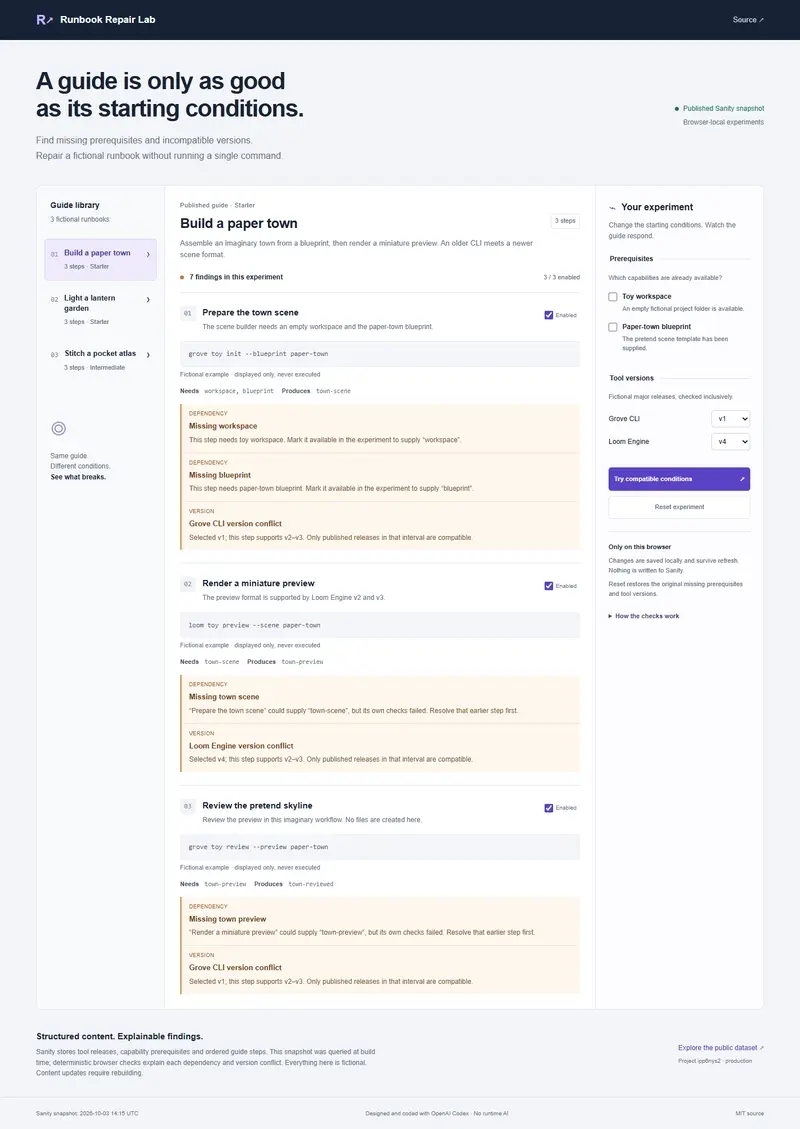
In this system, outputs from a specific step only become available once that step has passed every logical check. If a step is failed or skipped, it cannot "manufacture" the output required for subsequent actions. This creates a cascading failure effect that is common in real-world systems but rarely modeled in documentation. By making downstream failures visible, the Lab forces users to address the root cause of an issue rather than simply trying to bypass a single failing step.
A key feature of the Lab is the "Compatible Conditions" tool. This function analyzes a guide’s declared prerequisites and automatically selects published tool releases that satisfy every relevant version interval. It is important to note that this tool does not "invent" releases or rewrite the content of the guide; it simply finds the best fit within the existing data. If a conflict exists that cannot be resolved through existing tool versions, the system flags it as a "finding," requiring an author to step in and correct the documentation itself.
Verification and Data Integrity
The transition from development to a public-facing tool required a rigorous verification process. Early iterations of the Lab used synthetic fixtures—mock data used to test the interface. However, the final version was tested against a full export of the real public dataset, verifying actual Sanity document IDs and relationships.
The verification record for the project includes a suite of automated checks, such as ensuring that the local storage correctly saves experiment states and that the checker accurately identifies version mismatches. For instance, in the "Paper Town" guide, the system is designed to recognize if a user is using "Grove CLI v1" when the guide requires a version between v2 and v3. Because this data is structured, the interface can provide a clear explanation of the mismatch without needing to interpret prose or guess the user’s intent.
 Software Development & Scripting for IT
The Architecture Gap: Why AI Coding Agents Are Generating More Code but Less Software
In the modern landscape of software development, a peculiar paradox has begun...
 Software Development & Scripting for IT
Bridging the Linguistic Divide: How Word Embeddings Revolutionized Machine Understanding of Human Language
In the rapidly evolving landscape of artificial intelligence, one of the most...
 Software Development & Scripting for IT
"Outside in 20" Redefines Digital Wellness with Local AI-Driven Outdoor Encouragement
In an era where digital connectivity often feels inescapable, a new open-source...







