
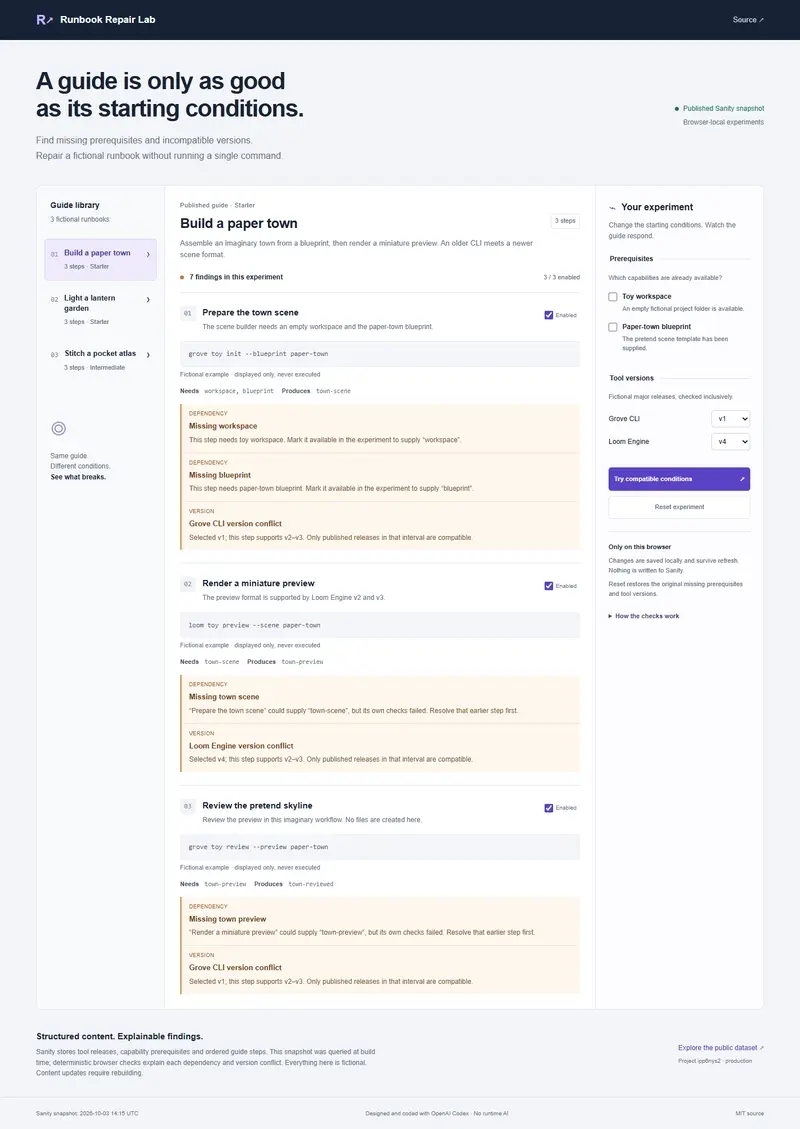
In the rapidly evolving landscape of software engineering, the "runbook"—a routine set of instructions for a technical task—is often the most fragile link in the chain. Documentation frequently suffers from "bit rot," where software versions, environment variables, and tool requirements drift away from the reality of the code they are meant to support. Addressing this systemic challenge, a new experimental project titled the Runbook Repair Lab has emerged, offering a unique sandbox for developers to diagnose and repair the hidden assumptions that cause technical guides to fail.
Developed as a submission for the Sanity Challenge under the "Vibe-Code Something Strange" category, the Runbook Repair Lab is a Next.js-based application that treats documentation not as static text, but as a series of logical dependencies. The project, spearheaded by developer Simon Levy, utilizes the Sanity content platform and OpenAI’s Codex to create an environment where fictional technical guides can be stress-tested, broken, and ultimately fixed through a rigorous understanding of their underlying prerequisites.
A New Approach to Debugging Documentation
At its core, the Runbook Repair Lab is an exploration of the "invisible" infrastructure of a technical guide. Most developers have encountered a situation where a step-by-step tutorial fails because a tool version is outdated or a prerequisite workspace was never initialized. The Lab aims to make these failures visible and predictable.
The application currently hosts three intentionally whimsical projects: the construction of a paper town, the lighting of a lantern garden, and the stitching of a pocket atlas. While the subject matter is fictional, the logical structure is highly technical. These guides utilize fictional tools and commands that, while they appear as display text, are governed by a complex set of versioning and capability rules. By changing the starting conditions—such as the version of a fictional command-line interface or the presence of a specific workspace—users can watch as specific steps in the guide fail in real-time, providing a clear visualization of how a single version mismatch can derail an entire workflow.
Unlike many modern AI applications that rely on real-time Large Language Model (LLM) processing to generate responses, the Runbook Repair Lab operates on a deterministic TypeScript checker. This ensures that the results are consistent and reproducible. The application does not execute the commands; instead, it evaluates the relationships between steps and prerequisites stored within Sanity. This architectural choice highlights a growing trend in "vibe-coding," where AI is used to design and implement the logic of an application, while the runtime execution remains grounded in traditional, reliable code.
The Architectural Foundation: Sanity and Static Freshness
The Runbook Repair Lab leverages Sanity as its primary engine for storing guides, tool releases, and prerequisite relationships. The choice of Sanity allows for a highly structured approach to content management, where each document type—be it a "Tool," a "Prerequisite," or a "Guide"—plays a specific role in the application’s ecosystem.

One of the project’s most notable technical features is its commitment to data integrity through a static, build-time Sanity snapshot. The public frontend is not a live-querying application but a static export. This decision was made to mitigate the risks associated with fetch-cache issues and runtime token dependencies. During the build process, the application performs a server-only native HTTPS read from Sanity, governed by an eight-second timeout and a strict one-megabyte response limit. This "honest" approach to static freshness means that if the data is invalid or unavailable at the time of the build, the process fails rather than substituting the data with potentially misleading sample content.
For the end-user, this means that content updates appear after a redeployment rather than arriving live in the browser. While this introduces a delay in content delivery, it eliminates the need for runtime AI keys, Server-Side Rendering (SSR) workers, or Cross-Origin Resource Sharing (CORS) modifications, resulting in a leaner and more secure application.
The Build Process: Insights from OpenAI Codex
The development of the Runbook Repair Lab was documented as an AI-assisted build process, utilizing OpenAI Codex on October 3, 2026. The implementation was guided by a philosophy of keeping the model "small enough to explain." By focusing on ordered steps, declared inputs and outputs, and inclusive major-version ranges, the developer was able to create a system that mirrors the complexity of real-world DevOps without becoming unmanageable.
In this system, outputs from a specific step only become available once that step has passed every logical check. If a step is failed or skipped, it cannot "manufacture" the output required for subsequent actions. This creates a cascading failure effect that is common in real-world systems but rarely modeled in documentation. By making downstream failures visible, the Lab forces users to address the root cause of an issue rather than simply trying to bypass a single failing step.
A key feature of the Lab is the "Compatible Conditions" tool. This function analyzes a guide’s declared prerequisites and automatically selects published tool releases that satisfy every relevant version interval. It is important to note that this tool does not "invent" releases or rewrite the content of the guide; it simply finds the best fit within the existing data. If a conflict exists that cannot be resolved through existing tool versions, the system flags it as a "finding," requiring an author to step in and correct the documentation itself.
Verification and Data Integrity
The transition from development to a public-facing tool required a rigorous verification process. Early iterations of the Lab used synthetic fixtures—mock data used to test the interface. However, the final version was tested against a full export of the real public dataset, verifying actual Sanity document IDs and relationships.
The verification record for the project includes a suite of automated checks, such as ensuring that the local storage correctly saves experiment states and that the checker accurately identifies version mismatches. For instance, in the "Paper Town" guide, the system is designed to recognize if a user is using "Grove CLI v1" when the guide requires a version between v2 and v3. Because this data is structured, the interface can provide a clear explanation of the mismatch without needing to interpret prose or guess the user’s intent.

The user interface also underwent significant refinement to improve accessibility. Mobile review led to the implementation of larger touch targets and clearer explanatory text. On narrow screens, the experiment controls were moved to appear before the steps, ensuring that the interactive elements of the Lab remain the focal point regardless of the device being used.
The Role of Fictional Content in Technical Training
While the tools and projects within the Runbook Repair Lab are fictional, their purpose is deeply practical. By removing the distraction of real-world syntax—where a user might get stuck on a missing semicolon or a typo in a file path—the Lab allows the user to focus entirely on the logic of dependencies and versioning.
The schema designed for the project reflects this focus. The "Tool" document type tracks major-version releases and capabilities, while the "Prerequisite" type identifies the workspaces or previews needed to begin a task. The "Guide" type then assembles these elements into a series of steps, each with its own requirements. Through GROQ (Graph-Relational Object Queries), these references are resolved into a flat, digestible format for the TypeScript checker.
This structured content approach allows the application to remain within its tested scope. It does not attempt to parse command syntax or infer compatibility between real-world software packages. Instead, it establishes a framework for understanding how modeled capabilities and version intervals interact. It is a tool for logic, not for syntax.
A Sanitized Record of Development
In an era where AI-generated content is often opaque, the Runbook Repair Lab stands out for its transparency. The project includes a sanitized build log and a verification record that documents every decision, failure, and correction made during the development process. By avoiding the publication of raw agent sessions or private credentials, the developer has provided a blueprint for how AI can be used as a collaborative partner in software creation while maintaining professional standards of documentation.
The Runbook Repair Lab is currently available for public exploration, requiring no login. It remains a static build, a snapshot of a specific moment in the intersection of AI, structured content, and technical education. As the industry continues to grapple with the challenges of maintaining accurate documentation, projects like the Lab provide a glimpse into a future where guides are not just read, but are verified, tested, and repaired with the same rigor as the code they describe.
 Software Development & Scripting for IT
Bridging the Gap Between Canvas and Cafe: Developer Builds Local AI Suite to Help Madrid Artist Manage Exhibitions
In the bustling cultural landscape of Madrid, where neighborhood cafes and local...
 Software Development & Scripting for IT
UNC6240 Exploits Critical Oracle PeopleSoft Vulnerability Through Sophisticated WAF Bypass Techniques
A sophisticated cyber-espionage and data theft campaign has been identified targeting organizations...
 Software Development & Scripting for IT
The Architecture of Thought: Why Modern Software Engineering Mentorship is Moving Beyond Syntax
In the modern landscape of software development, a stark divide has emerged...







