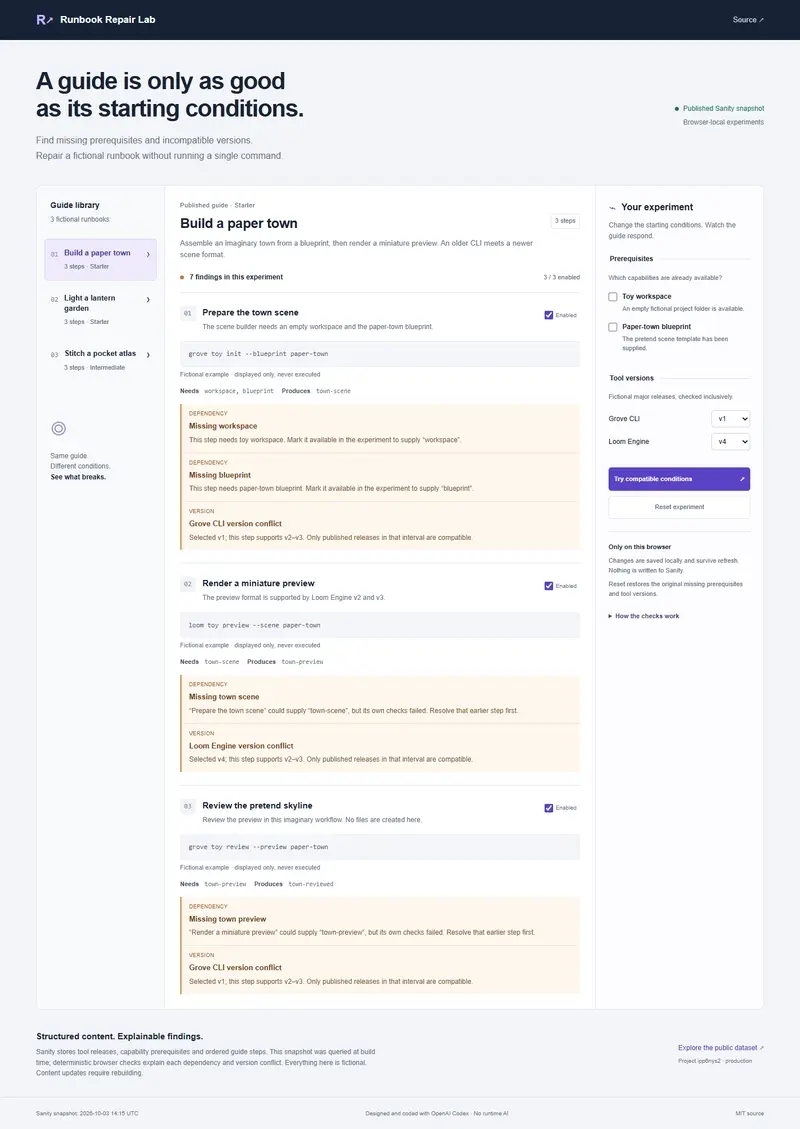

The user interface also underwent significant refinement to improve accessibility. Mobile review led to the implementation of larger touch targets and clearer explanatory text. On narrow screens, the experiment controls were moved to appear before the steps, ensuring that the interactive elements of the Lab remain the focal point regardless of the device being used.
The Role of Fictional Content in Technical Training
While the tools and projects within the Runbook Repair Lab are fictional, their purpose is deeply practical. By removing the distraction of real-world syntax—where a user might get stuck on a missing semicolon or a typo in a file path—the Lab allows the user to focus entirely on the logic of dependencies and versioning.
The schema designed for the project reflects this focus. The "Tool" document type tracks major-version releases and capabilities, while the "Prerequisite" type identifies the workspaces or previews needed to begin a task. The "Guide" type then assembles these elements into a series of steps, each with its own requirements. Through GROQ (Graph-Relational Object Queries), these references are resolved into a flat, digestible format for the TypeScript checker.
This structured content approach allows the application to remain within its tested scope. It does not attempt to parse command syntax or infer compatibility between real-world software packages. Instead, it establishes a framework for understanding how modeled capabilities and version intervals interact. It is a tool for logic, not for syntax.
A Sanitized Record of Development
In an era where AI-generated content is often opaque, the Runbook Repair Lab stands out for its transparency. The project includes a sanitized build log and a verification record that documents every decision, failure, and correction made during the development process. By avoiding the publication of raw agent sessions or private credentials, the developer has provided a blueprint for how AI can be used as a collaborative partner in software creation while maintaining professional standards of documentation.
The Runbook Repair Lab is currently available for public exploration, requiring no login. It remains a static build, a snapshot of a specific moment in the intersection of AI, structured content, and technical education. As the industry continues to grapple with the challenges of maintaining accurate documentation, projects like the Lab provide a glimpse into a future where guides are not just read, but are verified, tested, and repaired with the same rigor as the code they describe.
 Software Development & Scripting for IT
AI That Urges You to Unplug: Pranav Suryawanshi Unveils TouchCall Voice Assistant for the Hacktoberfest AI Challenge
In an era where digital wellness applications often paradoxically demand more of...
 Software Development & Scripting for IT
UNC6240 Exploits Critical Oracle PeopleSoft Vulnerability Through Sophisticated WAF Bypass Techniques
A sophisticated cyber-espionage and data theft campaign has been identified targeting organizations...
 Software Development & Scripting for IT
The Crisis of the "Almost Right" Illusion: How AI-Driven Developer Burnout is Reshaping Software Engineering
The initial promise of Artificial Intelligence in software development was centered on...