
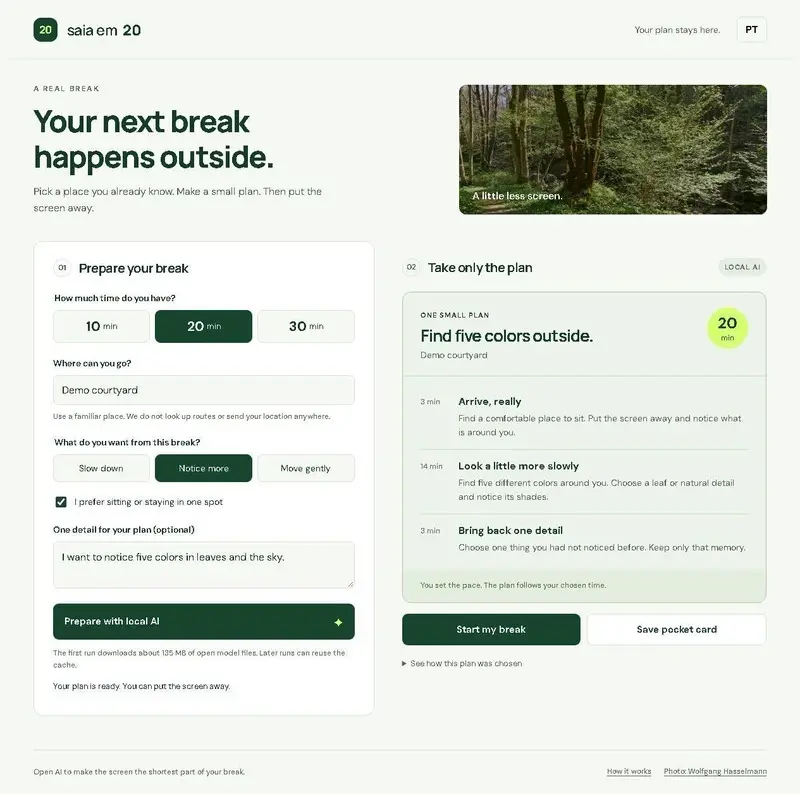
In an era where digital connectivity often feels inescapable, a new open-source project is leveraging the very technology that anchors us to our screens to help us disconnect. Developed as a primary entry for the Hacktoberfest Open-Source AI Challenge, specifically for the "Touch Grass" week, a new application titled "Outside in 20"—or "Saia em 20" in Portuguese—proposes a solution to the modern dilemma of choice paralysis. The project aims to transform the twenty-minute window of free time into a meaningful outdoor experience, ensuring that the act of deciding what to do does not consume the time meant for the activity itself.
The premise of the application is rooted in a common urban experience: having a short break and a familiar outdoor space nearby—be it a courtyard, a local park, or a well-known neighborhood corner—but falling into the trap of "doomscrolling" while trying to decide how to spend those minutes. By the time a decision is made, the window of opportunity has often closed. "Outside in 20" seeks to provide a definitive stopping point for that digital interaction, moving the user from the screen to the physical world with minimal friction.
What I Built
The core functionality of "Outside in 20" is designed around intentionality and speed. Upon launching the application, users are prompted to enter their specific preferences, any mobility constraints they might have, and the name of a familiar location. Rather than providing an exhaustive list of possibilities that could lead to further indecision, the app generates a singular, concise outdoor activity. This recommendation is accompanied by a digital instruction card and a countdown timer.
The workflow is intentionally brief. Once the activity is presented, the user is encouraged to prepare the card, put their phone away, and engage with their surroundings. The application even includes a post-activity reflection feature, which remains strictly on the user’s device to ensure privacy. This reflection serves as a mental bookend to the experience, allowing the user to process their time outdoors before returning to their digital responsibilities.
One of the most striking features of "Outside in 20" is its commitment to privacy and data sovereignty. Unlike many contemporary "discovery" apps, it does not request GPS access and makes no attempt to track the user’s location or suggest new destinations. It relies entirely on the user’s existing knowledge of their environment. Furthermore, the application is bilingual, offering curated instruction catalogues in both English and Portuguese. The integration of open AI ensures that the user’s specific preferences are matched against the most eligible activities within those catalogues.
Demo
The application is currently available for public interaction through a browser-based demonstration. The user interface is streamlined to facilitate quick decision-making. For example, a user might enter a preference for "noticing colors," "listening to bird songs," or simply taking a "gentle walk." The AI then processes these inputs to find the best fit from its internal database.
Once a match is found, users can inspect the specific details of the recommendation. A unique feature of the app is the ability to save a "pocket card"—a self-contained HTML file that includes the activity instructions but contains no scripts or external assets. This allows the user to carry the instructions offline without needing an active data connection or further phone interaction. The application also demonstrates technical robustness through its persistence logic; if a user reloads the page, the selected plan and its original end time are restored, preventing the frustration of losing progress during a brief outdoor excursion.
 Software Development & Scripting for IT
Re-evaluating the Enterprise Test Automation Stack: Why Past Decisions Require New Scrutiny in the Age of AI
In the fast-moving world of enterprise software, a test automation tool that...
 Software Development & Scripting for IT
Bridging the Context Gap: TokenCap Introduces Schema Intelligence to Eliminate AI Coding Errors
In the rapidly evolving landscape of software development, the integration of Artificial...
 Software Development & Scripting for IT
The Crisis of the "Almost Right" Illusion: How AI-Driven Developer Burnout is Reshaping Software Engineering
The initial promise of Artificial Intelligence in software development was centered on...







