In the rapidly evolving landscape of automotive safety, the integration of driver monitoring systems (DMS) has become a focal point for researchers and developers seeking to mitigate the risks associated with fatigue and distraction. A new entry into this field, a project titled "DriveSignal," has emerged as a sophisticated desk-based prototype designed to bridge the gap between complex biometric data and real-world driver safety applications. Developed as a submission for the Presage SmartSpectra SDK Challenge, DriveSignal offers a comprehensive simulation of a vehicle cockpit, utilizing advanced face-tracking technology to monitor driver attention and execute safety protocols in a controlled environment.
The project, which was conceptualized and executed within a rigorous three-day development cycle, serves as a proof of concept for how software-based monitoring can be personalized to individual users. Unlike traditional systems that may rely on generic averages for blink rates or eye-closure durations, DriveSignal emphasizes a calibration-heavy approach, ensuring that the system understands the unique physiological baselines of each participant before making critical safety decisions.
A New Vision for the Driver’s Cockpit
DriveSignal is structured as a virtual vehicle dashboard that consolidates several high-level metrics into a single, intuitive view. The prototype displays a virtual vehicle’s current speed, the status of hazard lights, and real-time eye signals. By integrating these elements, the system allows reviewers and developers to witness the immediate relationship between biometric input and vehicle response.
One of the most notable features of the DriveSignal dashboard is its ability to plot eye measurements over a rolling eight-second window. This temporal visualization provides a granular look at how a driver’s attention may wax and wane. Even after the camera is deactivated, the system maintains a visible count of triggers and the timestamp of the last alert, ensuring that data remains accessible for post-run analysis.
To enhance transparency, the developer integrated "Decision Cards" into the interface. these cards serve an educational and functional purpose, explaining which specific biometric signals—such as sustained eye closure—can trigger an alert, and which signals—such as mouth movements—are used merely for contextual analysis. This approach moves the project toward the realm of "explainable AI," where the logic behind a machine-driven decision is made clear to the human user.
The Mechanics of Personalized Calibration and Alert Escalation
At the heart of DriveSignal lies the Presage SmartSpectra SDK, a toolset that allows the application to decode live blink events and analyze face landmarks with high precision. The system’s logic is built upon a foundation of personal eye calibration. Before a monitoring session begins, the participant provides consented camera measurements to establish separate thresholds for their open and closed eye states.
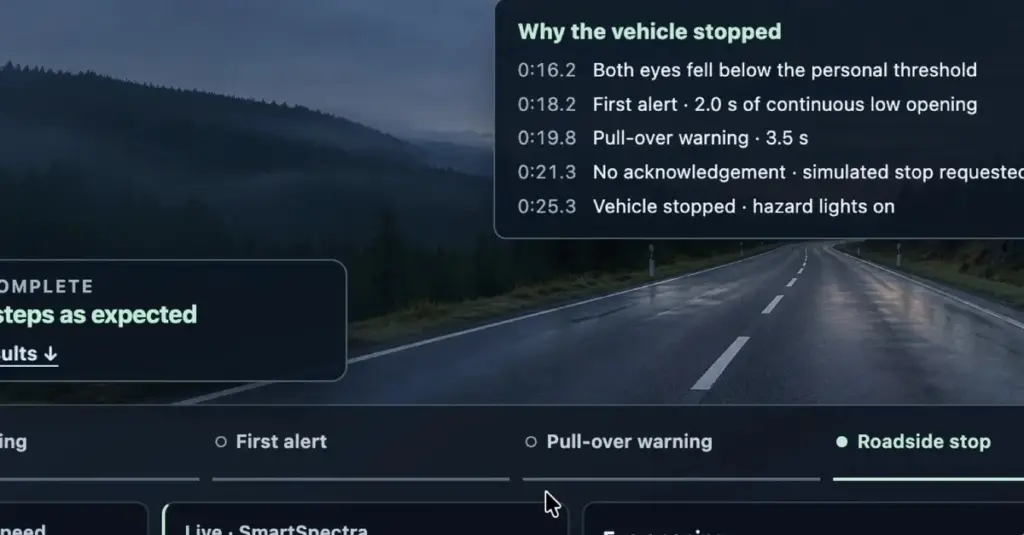
The importance of this personalization cannot be overstated in a journalistic or safety context. By estimating a threshold for each eye based on individual samples, DriveSignal minimizes the risk of "false positives" that can occur in systems with one-size-fits-all settings. Once the calibration is complete and the demo is engaged, the system monitors for a specific condition: two continuous seconds where eye opening falls below both personal thresholds.
The escalation of alerts within DriveSignal follows a strict, time-based protocol designed to simulate the urgency of a real-world fatigue event. In a recent live cockpit test, the system recorded its first warning at precisely 2.03 seconds of sustained low eye opening. If the condition persists, the system escalates to a more prominent warning at 3.52 seconds, accompanied by a distinct auditory tone and a vibration request for supported devices.
 Software Development & Scripting for IT
The Evolution of Polymorphic Serialization: Why System.Text.Json Offers a Safer Path for Obfuscated .NET Applications
In the landscape of .NET development, maintaining the integrity of serialized data...
 Software Development & Scripting for IT
"Outside in 20" Redefines Digital Wellness with Local AI-Driven Outdoor Encouragement
In an era where digital connectivity often feels inescapable, a new open-source...
 Software Development & Scripting for IT
AI-Driven Development Reaches New Milestone as Formal Verification and Statecharts Detect Elusive Edge Cases
In the rapidly evolving landscape of software engineering, the integration of artificial...