In the rapidly evolving landscape of software engineering, the integration of artificial intelligence into the development lifecycle has transitioned from simple code completion to autonomous agentic workflows. As developers increasingly rely on coding agents like Claude Code to architect and implement complex systems, a critical question has emerged: how can we ensure the reliability of logic that neither the human nor the AI explicitly planned? While traditional testing methodologies—including unit, integration, and end-to-end tests—are designed to protect against regressions and known bug patterns, they often fail to capture the "implicit" errors that hide within complex state transitions.

The challenge of "not knowing what we don’t know" has long been the bane of distributed systems. Edge cases often remain dormant until they are triggered by a specific, unforeseen sequence of events in a production environment. However, a new methodology combining formal verification through TLA+ (Temporal Logic of Actions) and AI-driven statechart visualization is beginning to change that narrative. By forcing coding agents to explore the implicit state machines within an application, developers are now finding and fixing critical logic flaws during the implementation phase, long before the first line of code reaches a user.
The Rise of the Implicit State Machine
The catalyst for this shift in perspective came in late October 2026, when a viral insight from technologist Steve Ruiz began circulating within the developer community. Ruiz proposed a deceptively simple yet profound prompt designed to challenge AI coding agents: "find all of the implicit state machines in my app." This instruction moves beyond checking if a function returns the correct value; it demands that the AI analyze the application as a holistic system of states and transitions.

Most modern applications, particularly those involving complex user interactions or multi-agent architectures, operate as state machines. Some of these states are explicit, defined clearly in the code through enums or dedicated state management libraries. Others, however, are implicit—emerging from the interaction of various boolean flags, conditional branches, and asynchronous callbacks. These implicit flows are where edge cases thrive, as the complexity of the state space quickly exceeds what a human developer can mentally model.
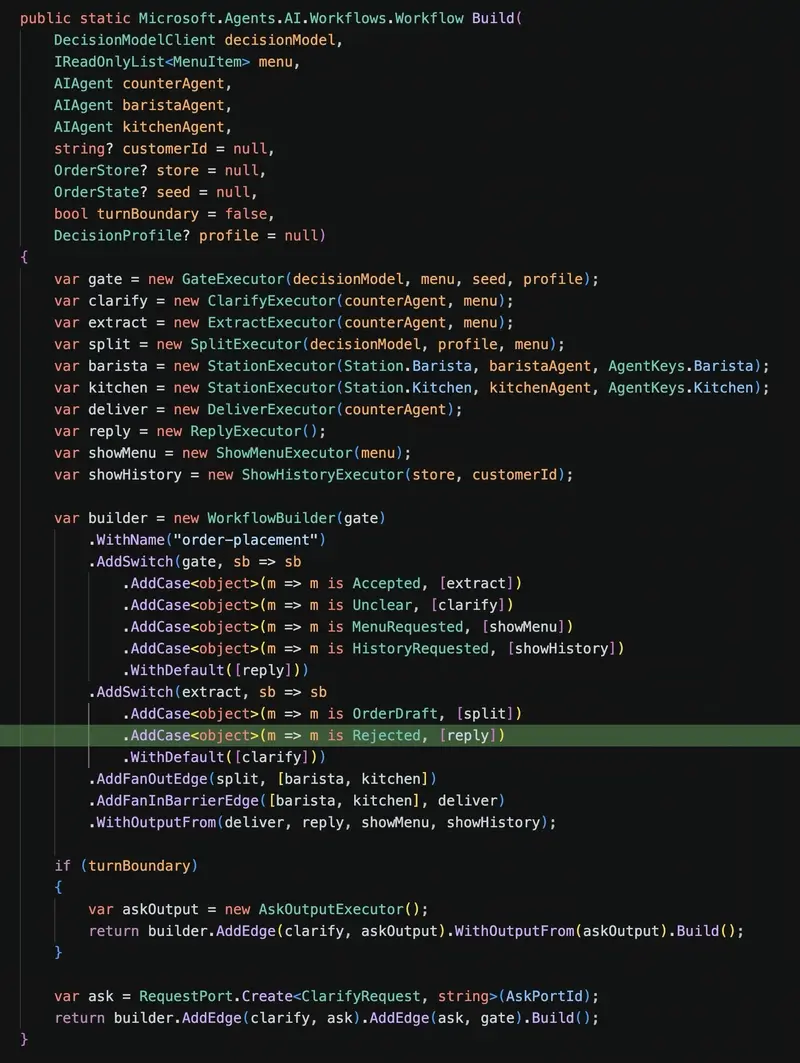
The effectiveness of this approach was recently put to the test during the development of "coffeeshop-jev," an experimental application built on the Microsoft Agent Framework. The project utilizes a multi-agent architecture to simulate a high-traffic coffee shop environment. In this system, a counter agent interacts with human customers to take orders, while specialized barista and kitchen agents process drinks and food items. The entire workflow is managed through a sophisticated conversation-driven logic that allows agents and humans to negotiate orders in real-time.

Despite the application passing initial manual tests and appearing to follow its intended design diagrams, the developer suspected that the underlying complexity of the multi-agent communication could be masking subtle bugs. By utilizing the Claude Code terminal and the "implicit state machine" prompt, the AI began a deep-scan of the codebase, looking not for syntax errors, but for logical inconsistencies in how the system handled state transitions.
 Software Development & Scripting for IT
The Efficiency Era: Compressed Models Dominate as VIDraft and LG Lead the 2026 Korean AI Download Charts
As the global landscape for artificial intelligence continues to shift toward practical...
 Software Development & Scripting for IT
Afterlight: Bridging the Supernatural and Open-Source AI in a New Browser-Based Storytelling Studio
As the final week of Hacktoberfest 2024 unfolds, the global developer community...
 Software Development & Scripting for IT
Microsoft Unveils C# 15: A Deep Dive into Union Types, Enhanced Memory Safety, and Language Refinements
As the annual release cycle for the .NET ecosystem approaches, Microsoft has...