
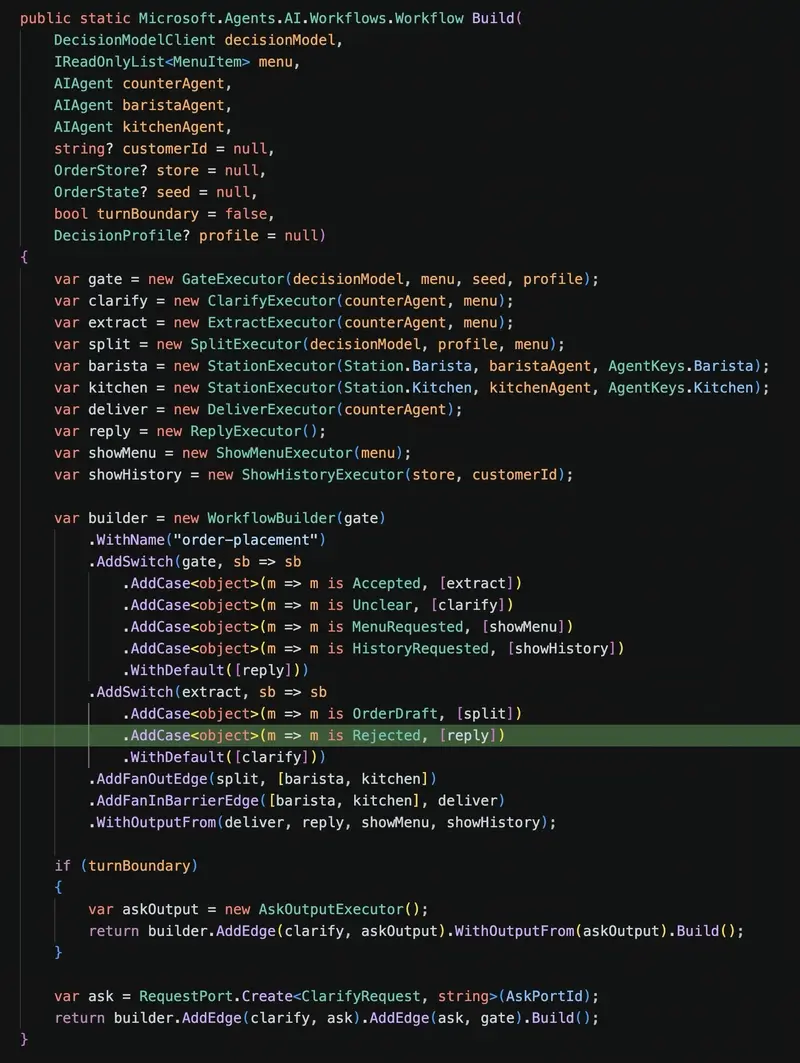
Seeing the bug represented visually changed the nature of the debugging process. Rather than digging through logs or trying to reproduce a race condition manually, the developer could see the "broken" path in the state machine. This level of clarity is particularly vital in multi-agent systems, where the "state" of the application is distributed across multiple autonomous entities.

The Fix and the Future of Verification
With the bug clearly identified and visualized, the resolution process became straightforward. Using the command fix finding 1, the developer instructed Claude Code to refactor the handling of the ClarifyRequest logic. The AI corrected the counter logic in the Finish handler, ensuring that extract failures were handled consistently across both the automated and UI-driven paths of the application.
To ensure the fix was successful, the developer leveraged the .NET Aspire framework to run the updated coffee shop application. By simulating a complex order—such as a request for multiple drinks with specific modifications—the developer verified that the "Ask Loop" now handled clarifications correctly, without hitting the artificial caps that had previously plagued the implicit logic.

The success of this experiment highlights a significant shift in the role of the software developer. As AI agents take over more of the "heavy lifting" of coding, the human developer’s primary responsibility is shifting toward verification and architectural oversight. The ability to use AI to generate formal specifications and visual statecharts allows developers to operate at a higher level of abstraction, focusing on the systemic integrity of the application rather than the minutiae of syntax.
The integration of TLA+ into the daily development cycle, facilitated by AI, democratizes formal methods that were once considered too complex for general application development. It suggests a future where "bug-free" code is not just an aspirational goal but a verifiable reality. By exploring the implicit flows of our applications before they reach production, we can catch the edge cases that have traditionally defined the limits of software reliability.

As the industry moves forward, the combination of agentic coding, formal verification, and visual state management is likely to become a standard part of the professional toolkit. For the developers of the "coffeeshop-jev" app, and many others watching the viral spread of these techniques, the lesson is clear: in the age of AI, the most important code you write might be the code that verifies the rest.
 Software Development & Scripting for IT
Unlocking Digital Visibility: How Website Owners Can Ensure Inclusion in ChatGPT Search Results
As the digital landscape undergoes a seismic shift toward artificial intelligence-driven discovery,...
 Software Development & Scripting for IT
Navigating the "Lakh and Crore" Divide: New AI Benchmark Exposes Significant Errors in Indian Real Estate Mathematics
The dream of homeownership in India is often a complex journey through...
 Software Development & Scripting for IT
The Invisible Battlefield: Analyzing the Technical Architecture of PUBG Anti-Cheat Systems
In the contemporary landscape of online multiplayer gaming, the complexity of the...







