
In the rapidly evolving landscape of software engineering, the integration of artificial intelligence into the development lifecycle has transitioned from simple code completion to autonomous agentic workflows. As developers increasingly rely on coding agents like Claude Code to architect and implement complex systems, a critical question has emerged: how can we ensure the reliability of logic that neither the human nor the AI explicitly planned? While traditional testing methodologies—including unit, integration, and end-to-end tests—are designed to protect against regressions and known bug patterns, they often fail to capture the "implicit" errors that hide within complex state transitions.

The challenge of "not knowing what we don’t know" has long been the bane of distributed systems. Edge cases often remain dormant until they are triggered by a specific, unforeseen sequence of events in a production environment. However, a new methodology combining formal verification through TLA+ (Temporal Logic of Actions) and AI-driven statechart visualization is beginning to change that narrative. By forcing coding agents to explore the implicit state machines within an application, developers are now finding and fixing critical logic flaws during the implementation phase, long before the first line of code reaches a user.
The Rise of the Implicit State Machine
The catalyst for this shift in perspective came in late October 2026, when a viral insight from technologist Steve Ruiz began circulating within the developer community. Ruiz proposed a deceptively simple yet profound prompt designed to challenge AI coding agents: "find all of the implicit state machines in my app." This instruction moves beyond checking if a function returns the correct value; it demands that the AI analyze the application as a holistic system of states and transitions.

Most modern applications, particularly those involving complex user interactions or multi-agent architectures, operate as state machines. Some of these states are explicit, defined clearly in the code through enums or dedicated state management libraries. Others, however, are implicit—emerging from the interaction of various boolean flags, conditional branches, and asynchronous callbacks. These implicit flows are where edge cases thrive, as the complexity of the state space quickly exceeds what a human developer can mentally model.
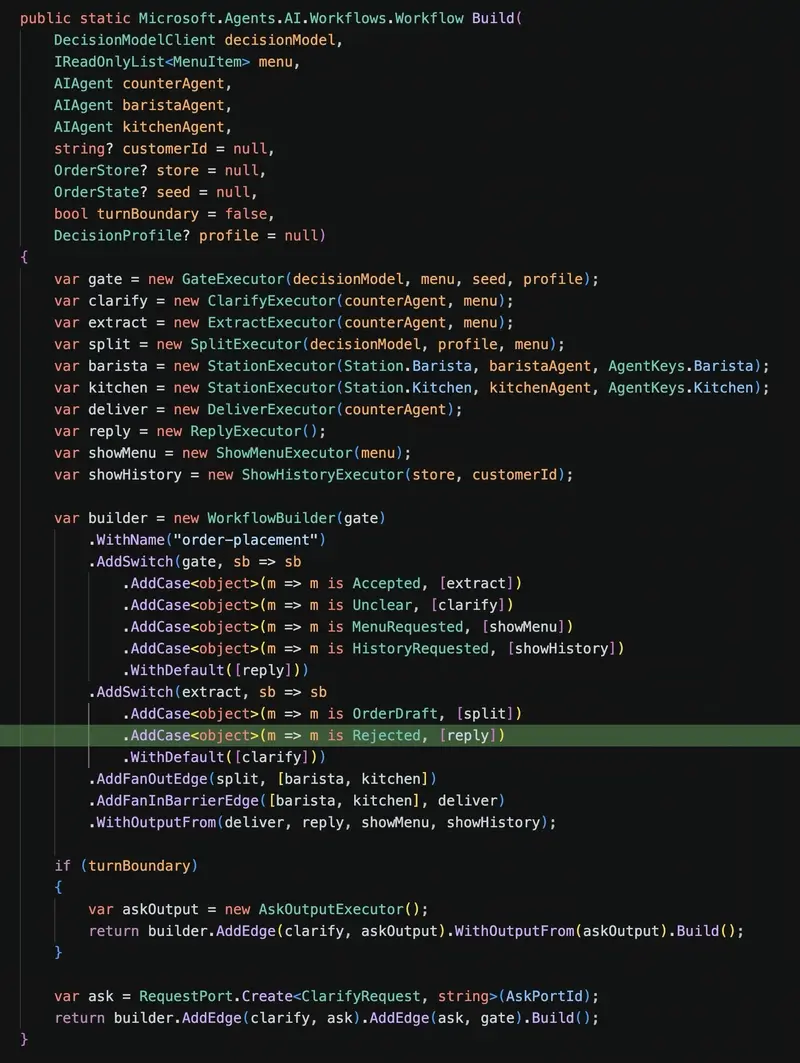
The effectiveness of this approach was recently put to the test during the development of "coffeeshop-jev," an experimental application built on the Microsoft Agent Framework. The project utilizes a multi-agent architecture to simulate a high-traffic coffee shop environment. In this system, a counter agent interacts with human customers to take orders, while specialized barista and kitchen agents process drinks and food items. The entire workflow is managed through a sophisticated conversation-driven logic that allows agents and humans to negotiate orders in real-time.

Despite the application passing initial manual tests and appearing to follow its intended design diagrams, the developer suspected that the underlying complexity of the multi-agent communication could be masking subtle bugs. By utilizing the Claude Code terminal and the "implicit state machine" prompt, the AI began a deep-scan of the codebase, looking not for syntax errors, but for logical inconsistencies in how the system handled state transitions.
Bridging the Gap with TLA+ and Formal Verification
The search for implicit states quickly bore fruit, identifying several areas where the application’s behavior was ambiguous. However, identifying a potential bug in a text-based terminal is only the first step; understanding the "why" and "how" of a failure requires a more rigorous framework. This is where TLA+ enters the development workflow.

TLA+, a formal specification language developed by Turing Award winner Leslie Lamport, is designed for modeling and verifying concurrent and distributed systems. Unlike standard programming languages that describe how a system should perform an action, TLA+ describes what the system is allowed to do. It treats a program as a mathematical object, allowing for the exhaustive verification of every possible state the system can enter. Historically, TLA+ has been the domain of specialized engineers at firms like Amazon and Microsoft, used to verify the core logic of cloud databases and consensus algorithms.
The breakthrough in the "coffeeshop-jev" project was the use of the coding agent to bridge the gap between practical C# code and formal TLA+ specifications. By utilizing specialized skills such as /create-formal-verification-skill, the agent was able to model the application’s subsystems into formal specifications. This process resulted in the creation of three distinct verification models: verify-ask-loop, verify-answer-channel, and verify-fulfilment.

Through this formal modeling, the AI identified a specific logical failure in the "Ask Loop"—the mechanism that governs how the agent clarifies an order with a customer. The verification process revealed that in the UI path, certain "Extract" failures were being counted toward the maximum attempt cap improperly. A comment in the code even suggested that previous attempts to fix this had introduced a new bug, where "Gate-only counting" was causing the system to miscalculate when to terminate a request.
Visualizing Logic Failures Through Statecharts
While TLA+ provides the mathematical proof of a bug, it can be difficult for developers to grasp the specific sequence of events leading to a failure. To solve this, the workflow incorporated statecharts to visualize the most important user flows. Following a methodology popularized by Lauren Tan, the developer integrated "pstack" and statechart visualization commands to generate Mermaid diagrams directly from the verified models.

The resulting visualization for the ask-loop subsystem was revealing. In the statechart, the AI highlighted specific transitions in red and yellow, marking the exact points where the logic could fail. The diagram showed that the system could enter a state where it reached its MaxAsks threshold prematurely or failed to reset counters correctly after a specific type of user error.
Seeing the bug represented visually changed the nature of the debugging process. Rather than digging through logs or trying to reproduce a race condition manually, the developer could see the "broken" path in the state machine. This level of clarity is particularly vital in multi-agent systems, where the "state" of the application is distributed across multiple autonomous entities.

The Fix and the Future of Verification
With the bug clearly identified and visualized, the resolution process became straightforward. Using the command fix finding 1, the developer instructed Claude Code to refactor the handling of the ClarifyRequest logic. The AI corrected the counter logic in the Finish handler, ensuring that extract failures were handled consistently across both the automated and UI-driven paths of the application.
To ensure the fix was successful, the developer leveraged the .NET Aspire framework to run the updated coffee shop application. By simulating a complex order—such as a request for multiple drinks with specific modifications—the developer verified that the "Ask Loop" now handled clarifications correctly, without hitting the artificial caps that had previously plagued the implicit logic.

The success of this experiment highlights a significant shift in the role of the software developer. As AI agents take over more of the "heavy lifting" of coding, the human developer’s primary responsibility is shifting toward verification and architectural oversight. The ability to use AI to generate formal specifications and visual statecharts allows developers to operate at a higher level of abstraction, focusing on the systemic integrity of the application rather than the minutiae of syntax.
The integration of TLA+ into the daily development cycle, facilitated by AI, democratizes formal methods that were once considered too complex for general application development. It suggests a future where "bug-free" code is not just an aspirational goal but a verifiable reality. By exploring the implicit flows of our applications before they reach production, we can catch the edge cases that have traditionally defined the limits of software reliability.

As the industry moves forward, the combination of agentic coding, formal verification, and visual state management is likely to become a standard part of the professional toolkit. For the developers of the "coffeeshop-jev" app, and many others watching the viral spread of these techniques, the lesson is clear: in the age of AI, the most important code you write might be the code that verifies the rest.
 Software Development & Scripting for IT
Decoding the Silent Failure: Why WordPress Image Uploads Trigger the Persistent HTTP Error
In the modern landscape of digital publishing, WordPress remains the dominant force,...
 Software Development & Scripting for IT
Unmasking Node2Shell: The Critical Brotli Vulnerability That Blinded Security Scanners
The cybersecurity landscape shifted significantly this week as a major vulnerability in...
 Software Development & Scripting for IT
Navigating the Choice Between Legged and Wheeled Robotics for Industrial Inspection
In the rapidly evolving landscape of industrial automation, the deployment of autonomous...







