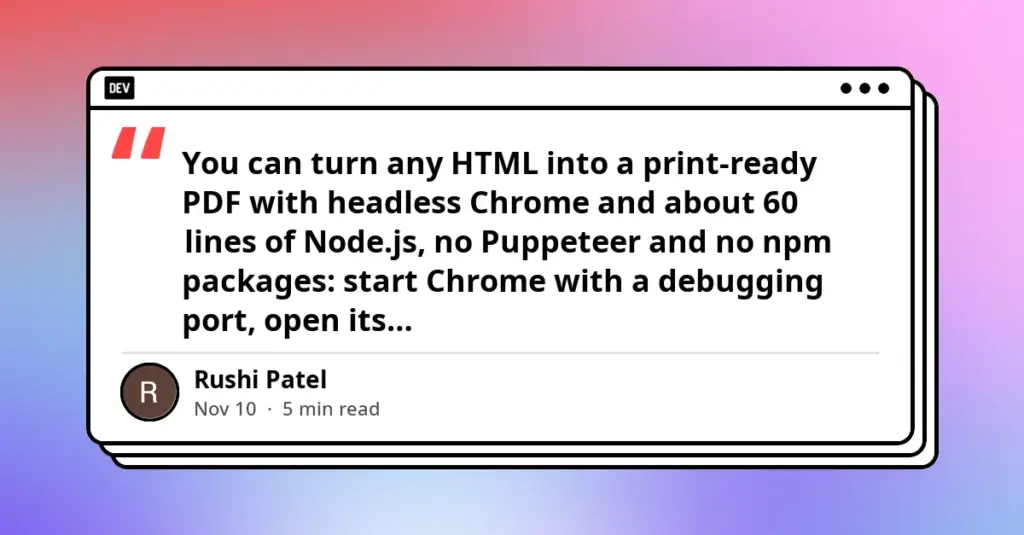
In the modern landscape of web development, the demand for high-fidelity document generation has never been higher. From automated travel itineraries to digital receipts and professional invoices, the ability to transform dynamic HTML content into a static, print-ready PDF is a cornerstone of digital service delivery. For years, developers have relied on heavy-duty libraries and abstraction layers to bridge the gap between the browser and the printed page. However, a growing movement toward "vanilla" architectural patterns is challenging the status quo, suggesting that the most efficient way to handle these tasks may involve stripping away the third-party dependencies that have long been considered essential.
The emergence of Node.js 22 has acted as a significant catalyst in this shift. By introducing a global, native WebSocket implementation, the runtime has removed one of the last remaining hurdles for developers seeking to communicate directly with the Chrome DevTools Protocol (CDP). This development allows for the generation of complex PDFs using approximately 60 lines of native code, bypassing the need for massive npm packages like Puppeteer or Playwright. The implications for build performance, security, and long-term maintenance are driving a re-evaluation of how engineering teams approach automated document production.
The Evolution of the Headless Browser Strategy
To understand the significance of direct CDP integration, one must look at the history of PDF generation in web environments. Early solutions often relied on server-side libraries that attempted to recreate HTML layouts using custom rendering engines. These tools frequently struggled with modern CSS, leading to discrepancies between what a user saw on their screen and what appeared in the final document. The industry eventually moved toward headless browsers—versions of web browsers that run without a graphical user interface—which ensured that the PDF would be rendered using the same engine as the live website.
Puppeteer quickly became the standard-bearer for this approach. By providing a high-level API over the Chrome DevTools Protocol, it simplified the process of controlling a browser via script. Yet, Puppeteer comes with significant overhead. Upon installation, it typically downloads a dedicated version of Chromium, adding hundreds of megabytes to a project’s footprint. For developers working on specialized build scripts or lightweight microservices, this "black box" approach can introduce unnecessary complexity, particularly when a version of Chrome is already present on the host machine.
The alternative—connecting directly to Chrome via its native debugging port—offers a more surgical approach. By leveraging the built-in capabilities of Node.js to manage child processes and WebSocket communications, developers can command the browser to navigate to a page and trigger the Page.printToPDF command with surgical precision. This method ensures that the toolchain remains small, transparent, and devoid of the "dependency rot" that often plagues long-lived software projects.
Real-World Implementation: The Triplli Use Case
The practical benefits of this minimalist approach are perhaps best illustrated by Triplli, a specialized platform designed for travel agencies. The service provides essential documentation tools, including blank and pre-filled itinerary formats and payment receipt templates. For a travel agency, the professional appearance of these documents is paramount; any layout shift or font error during the conversion from HTML to PDF could undermine the agency’s credibility.
By using a direct Node.js-to-Chrome bridge, Triplli ensures that the document is drawn exactly once in HTML. This "single source of truth" philosophy means that the live web view, the generated PDF download, and the preview images can never disagree. When a travel agent updates a client’s itinerary on the web interface, the same CSS and layout logic are applied to the PDF generation process. This consistency is achieved without the overhead of a massive automation framework, allowing the platform to remain agile and cost-effective.
 Software Development & Scripting for IT
Haunting the Terminal: Developer Unveils ‘Ghost in the Machine’ AI Project for Hacktoberfest Challenge
As the annual Hacktoberfest celebrations reach their final stages, a new project...
 Software Development & Scripting for IT
AI-Driven Development Reaches New Milestone as Formal Verification and Statecharts Detect Elusive Edge Cases
In the rapidly evolving landscape of software engineering, the integration of artificial...
 Software Development & Scripting for IT
Formalizing API Quality: How Postman Collections are Evolving into Reliable CI-Driven Regression Suites
In the fast-paced landscape of modern software development, the gap between a...