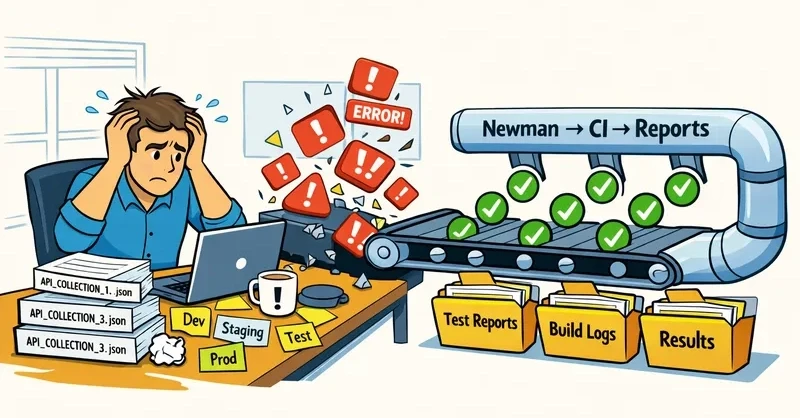
In the fast-paced landscape of modern software development, the gap between a functional API and a reliable one is often bridged by the quality of its testing suite. For years, Postman collections have served as the go-to tool for developers to explore endpoints and verify basic functionality. However, a growing sentiment among engineering leaders suggests that when these collections are left as informal "workspace junk," they generate more noise than confidence. The industry is currently seeing a significant shift toward formalizing these artifacts into versioned, CI-driven API regression suites, transforming them from ad-hoc checks into reliable quality gates that teams can measure and trust.
The necessity for this transformation stems from two recurring patterns that plague development teams: flaky manual runs and invisible drift. In many organizations, tests live exclusively in an individual developer’s workspace, leading to a "works on my machine" syndrome. Environments often differ by hard-coded URLs and exposed secrets, and most critically, runs frequently occur only after code has already landed in production. This "too late" approach results in long debug loops, duplicate fixes, and a gradual erosion of trust in automated checks as they begin to fail unpredictably.
Why Postman Collections Deserve Formal Regression Status
The push to treat Postman collections as first-class regression assets is rooted in three practical advantages: reproducibility, measurability, and a clear ownership surface for maintenance. By moving beyond the graphical user interface and utilizing Newman—the command-line companion for Postman—teams can achieve deterministic runs. These runs provide machine-readable exit codes and pluggable reporters that allow for seamless integration into broader automation frameworks.
Operational experts are increasingly advocating for a "smaller is better" philosophy regarding test design. A common rule of thumb emerging in high-performing teams is the preference for numerous small, stable tests over a single, massive end-to-end collection. This modular approach significantly reduces the "blast radius" of a failure, making the underlying cause of a breakdown immediately obvious to the engineering team. When a collection is focused on a specific microservice or a narrow functional area, the feedback loop is tightened, allowing for faster remediation.
Designing Collections and Environments for Reliable Automation
To achieve reliability within a Continuous Integration (CI) environment, developers are focusing on three primary levers: structure, variable scoping, and test independence. A formalized repository layout is becoming the standard for teams looking to institutionalize their testing. This typically involves a dedicated directory structure where collections, environment configurations, data files (such as CSVs for regression users), and CI-specific scripts are stored alongside the application code.
A standard repository layout often places Postman artifacts in a dedicated directory, separating "smoke tests"—which verify basic connectivity—from comprehensive "regression tests" that validate deep business logic. This organization ensures that the right tests are run at the right time in the development lifecycle.
 Software Development & Scripting for IT
The Streaming Paradox: Resolving the Single-Blob Bottleneck in Next.js Server-Sent Events
In the rapidly evolving landscape of generative artificial intelligence and real-time web...
 Software Development & Scripting for IT
Troubleshooting the "Silent" Failure: Why Zoho CRM Workflows Stop Triggering and How to Restore Automation Integrity
For many modern enterprises, the CRM is no longer just a digital...
 Software Development & Scripting for IT
Modernizing Authentication: A Comprehensive Approach to Passkey Implementation in Symfony 8.1
The digital authentication landscape is undergoing a fundamental shift as the industry...