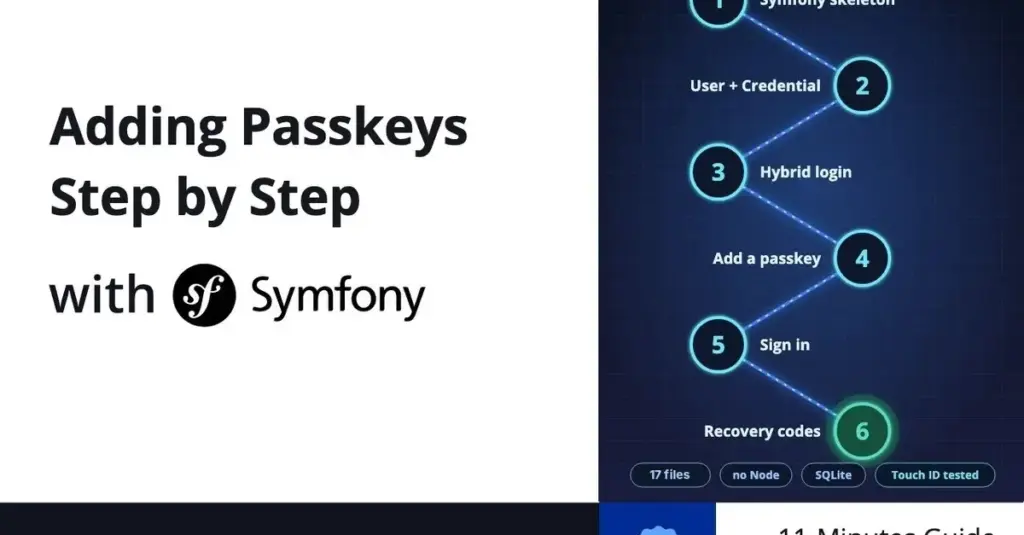
The digital authentication landscape is undergoing a fundamental shift as the industry moves away from the inherent vulnerabilities of traditional passwords toward the cryptographic security of passkeys. While the promise of a passwordless future is compelling, the transition for developers often involves navigating a complex web of FIDO2 ceremonies and user experience challenges. A new technical framework for Symfony 8.1 aims to bridge the gap between basic proof-of-concept tutorials and the robust requirements of production environments, offering a streamlined path for integrating WebAuthn into modern web applications.
For most developers, the journey into passkeys begins with tutorials that conclude prematurely once a browser prompt appears. However, in a professional production setting, that prompt is merely the beginning of a complex lifecycle. Real-world users require a comprehensive suite of features: the ability to add passkeys from an existing account, the option to choose between passwords and passkeys at login, visibility into when specific keys were last utilized, and critically, a secure method for account recovery when a physical device is lost or replaced.
Addressing these needs requires a sophisticated orchestration of tools. The latest methodology centers on Symfony 8.1, leveraging a combination of established and specialized libraries. The web-auth/webauthn-symfony-bundle serves as the foundational engine, managing the intricate FIDO2 ceremonies, while the mattleads/passkeys-bundle provides the essential product layer. This secondary layer handles the nuances of the login flow, recovery code generation, usage tracking, and the management interfaces necessary for a user-friendly implementation.
Foundations and the Modern Symfony Stack
The implementation process begins with the establishment of a robust skeleton using Symfony 8.1. This version of the framework is particularly well-suited for such integrations due to its refined handling of security components and its movement toward a leaner frontend architecture. By utilizing Symfony’s Flex recipes, developers can automate much of the initial configuration, allowing them to focus on the custom logic required for their specific application.
The selection of supporting packages is a deliberate exercise in security best practices. Beyond the core WebAuthn bundles, the integration relies on symfony/security-bundle and symfony/rate-limiter. The inclusion of the rate-limiter is a critical production detail; because recovery codes are designed to be short and user-friendly, they can become targets for brute-force attacks. Implementing login throttling from the outset ensures that the convenience of recovery does not come at the expense of system integrity.
Furthermore, the shift away from heavy JavaScript build pipelines is evident in this modern approach. By using symfony/asset-mapper and symfony/stimulus-bundle, developers can manage the frontend requirements of WebAuthn—such as communicating with the browser’s navigator.credentials API—without the overhead of Node.js. The use of the @simplewebauthn/browser library provides a lightweight bridge for these client-side ceremonies, ensuring that the user experience remains fast and responsive.
Environmental Security and the Relying Party Identity
One of the most frequent hurdles in WebAuthn implementation is the strict requirement for a secure context. Browsers mandate that WebAuthn ceremonies occur over HTTPS, with a notable exception made for development on localhost. This nuance is central to the configuration of the environment.
Developers must carefully define the "Relying Party" (RP) identity, which acts as the unique identifier for the application within the passkey ecosystem. The RP ID and the allowed origins must be precisely aligned. A common point of failure occurs when a developer attempts to access an application via an IP address like 127.0.0.1 rather than the localhost hostname, or when a port mismatch occurs between the server configuration and the WebAuthn settings. Such discrepancies lead to immediate ceremony failures, as the browser’s security model detects an origin mismatch and halts the process to prevent phishing.
 Software Development & Scripting for IT
New Tool and Audit Reveal Common Structural Failures in the Emerging llms.txt Standard
As artificial intelligence agents and large language models increasingly become the primary...
 Software Development & Scripting for IT
Bridging the Gap Between Logic and Instruction: An In-Depth Look at the Runbook Repair Lab
In the rapidly evolving landscape of software engineering, the "runbook"—a routine set...
 Software Development & Scripting for IT
Troubleshooting the "Silent" Failure: Why Zoho CRM Workflows Stop Triggering and How to Restore Automation Integrity
For many modern enterprises, the CRM is no longer just a digital...