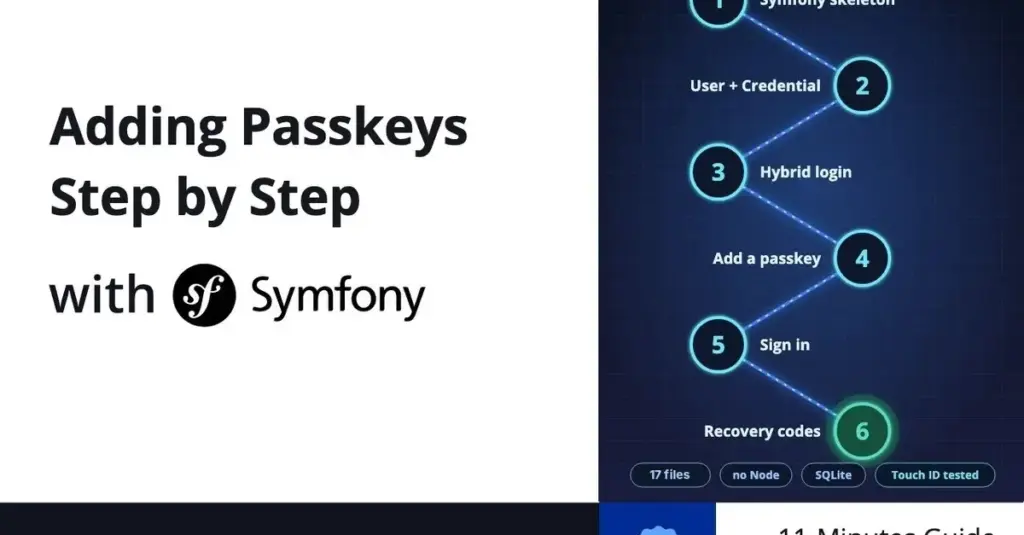
The digital authentication landscape is undergoing a fundamental shift as the industry moves away from the inherent vulnerabilities of traditional passwords toward the cryptographic security of passkeys. While the promise of a passwordless future is compelling, the transition for developers often involves navigating a complex web of FIDO2 ceremonies and user experience challenges. A new technical framework for Symfony 8.1 aims to bridge the gap between basic proof-of-concept tutorials and the robust requirements of production environments, offering a streamlined path for integrating WebAuthn into modern web applications.
For most developers, the journey into passkeys begins with tutorials that conclude prematurely once a browser prompt appears. However, in a professional production setting, that prompt is merely the beginning of a complex lifecycle. Real-world users require a comprehensive suite of features: the ability to add passkeys from an existing account, the option to choose between passwords and passkeys at login, visibility into when specific keys were last utilized, and critically, a secure method for account recovery when a physical device is lost or replaced.
Addressing these needs requires a sophisticated orchestration of tools. The latest methodology centers on Symfony 8.1, leveraging a combination of established and specialized libraries. The web-auth/webauthn-symfony-bundle serves as the foundational engine, managing the intricate FIDO2 ceremonies, while the mattleads/passkeys-bundle provides the essential product layer. This secondary layer handles the nuances of the login flow, recovery code generation, usage tracking, and the management interfaces necessary for a user-friendly implementation.
Foundations and the Modern Symfony Stack
The implementation process begins with the establishment of a robust skeleton using Symfony 8.1. This version of the framework is particularly well-suited for such integrations due to its refined handling of security components and its movement toward a leaner frontend architecture. By utilizing Symfony’s Flex recipes, developers can automate much of the initial configuration, allowing them to focus on the custom logic required for their specific application.
The selection of supporting packages is a deliberate exercise in security best practices. Beyond the core WebAuthn bundles, the integration relies on symfony/security-bundle and symfony/rate-limiter. The inclusion of the rate-limiter is a critical production detail; because recovery codes are designed to be short and user-friendly, they can become targets for brute-force attacks. Implementing login throttling from the outset ensures that the convenience of recovery does not come at the expense of system integrity.
Furthermore, the shift away from heavy JavaScript build pipelines is evident in this modern approach. By using symfony/asset-mapper and symfony/stimulus-bundle, developers can manage the frontend requirements of WebAuthn—such as communicating with the browser’s navigator.credentials API—without the overhead of Node.js. The use of the @simplewebauthn/browser library provides a lightweight bridge for these client-side ceremonies, ensuring that the user experience remains fast and responsive.
Environmental Security and the Relying Party Identity
One of the most frequent hurdles in WebAuthn implementation is the strict requirement for a secure context. Browsers mandate that WebAuthn ceremonies occur over HTTPS, with a notable exception made for development on localhost. This nuance is central to the configuration of the environment.
Developers must carefully define the "Relying Party" (RP) identity, which acts as the unique identifier for the application within the passkey ecosystem. The RP ID and the allowed origins must be precisely aligned. A common point of failure occurs when a developer attempts to access an application via an IP address like 127.0.0.1 rather than the localhost hostname, or when a port mismatch occurs between the server configuration and the WebAuthn settings. Such discrepancies lead to immediate ceremony failures, as the browser’s security model detects an origin mismatch and halts the process to prevent phishing.
Data Modeling for a Decoupled Identity
The architectural heart of a passkey-enabled system lies in its data entities. A significant departure from traditional systems is the decoupling of the user’s email address from their WebAuthn identity. In a production-ready Symfony implementation, the User entity carries an opaque "user handle"—often a ULID or UUID—rather than using the email as the primary identifier for WebAuthn.
This design choice is vital for long-term flexibility. By using a permanent, internal handle, the system allows users to change their email addresses without breaking the cryptographic link to their existing passkeys. The User entity must implement the UserInterface and PasswordAuthenticatedUserInterface, maintaining compatibility with existing password systems while preparing for a hybrid or fully passwordless future.
Parallel to the user model is the Credential entity, which extends the base CredentialRecord. In a production environment, this entity does more than just store public keys; it acts as an audit log. By implementing interfaces to track usage, the system can record exactly when a passkey was last used. This transparency is a key feature for security-conscious users, allowing them to identify unauthorized access or simply manage a growing list of devices.
Bridging Validators and Persistence
A technical nuance that often catches developers off guard is the translation between the WebAuthn validator’s output and the database’s persistence layer. When a user registers a new passkey or logs in, the validators typically return a generic CredentialRecord. However, because most Symfony applications use a custom subclass with its own database mapping and identity strategy, a direct attempt to persist the validator’s output will result in errors.
To resolve this, the repository layer must act as a sophisticated translator. During registration, the repository converts the raw record into a local entity. During login, it must find the existing entity and synchronize updated metadata, such as the signature counter and backup status. This synchronization is not merely a bookkeeping task; it is a security requirement of the WebAuthn specification designed to detect cloned authenticators.
The Security Firewall and the Hybrid Login Strategy
The integration of passkeys into Symfony’s security component involves a sophisticated firewall configuration. In a hybrid environment—where passwords and passkeys coexist—the firewall must manage multiple authenticators simultaneously. This includes the traditional password form, the WebAuthn assertion authenticator, and the recovery code authenticator.
A critical configuration detail is the definition of an entry_point. When multiple authenticators are present, Symfony requires explicit instruction on where to redirect unauthenticated users. Failure to define this results in a container compilation error, a safeguard that prevents ambiguous security states.
The strategy for passkey adoption often favors a "progressive" approach. Rather than forcing a passwordless sign-up, many organizations find success by allowing logged-in users to add passkeys to their accounts via a management page. This is facilitated by standalone creation controllers that use a "Current User Entity Guesser." This ensures that the passkey is securely bound to the authenticated session, providing a seamless upgrade path for the existing user base.
Frontend Integration and the "No-Node" Philosophy
The user interface for passkeys requires careful handling of asynchronous browser APIs. The modern Symfony approach utilizes Stimulus controllers to manage these interactions. By enabling specific controllers for hybrid login and passkey management, developers can integrate complex cryptographic flows into their Twig templates with minimal effort.
This "No-Node" philosophy, powered by AssetMapper, allows the browser to import necessary libraries directly from the importmap. This significantly reduces the complexity of the development environment and ensures that the frontend logic remains closely coupled with the backend Symfony application. The result is a cohesive system where the login form can automatically trigger a passkey "conditional UI" prompt—often referred to as autofill—allowing users to sign in with a biometric touch as easily as they would select a saved password.
Navigating Common Implementation Pitfalls
Even with a structured approach, developers often encounter specific hurdles during the implementation of WebAuthn. Understanding these pitfalls is essential for a successful rollout.
The most frequent error involves the aforementioned identity mapping. If the repository does not correctly convert the validator’s record into the application’s specific entity, Doctrine will fail to persist the data, citing missing identity values. This is a direct result of the abstraction layers used in the WebAuthn bundles and requires a deliberate conversion step in the repository’s save logic.
Another common issue arises during the "Add a Passkey" flow. If a developer mistakenly uses the standard registration block intended for new, passwordless users, the system will attempt to read a username from the request body. For an already-logged-in user, this is redundant and often leads to "User Not Found" errors. The correct approach is to use the creation controllers designed to recognize the current session’s user.
Finally, the issue of "orphaned" passkeys remains a characteristic of the current ecosystem. When a user revokes a passkey on the server, the cryptographic credential is deleted from the application’s database, but the physical key may still reside in the user’s cloud keychain (such as iCloud or Google Password Manager). While platform vendors are working on signal APIs to address this, developers must currently manage user expectations regarding the difference between server-side revocation and client-side deletion.
The Strategic Outlook for Authentication
As the industry moves forward, the choice between a hybrid flow and a purely passwordless system will depend largely on the target user base. For existing applications with established user habits, the hybrid flow offers a path of least resistance, allowing passkeys to gain traction one account at a time. For new ventures, starting with a passwordless-first approach can eliminate the risks associated with password storage from day one.
Regardless of the chosen path, the integration of recovery codes and robust rate-limiting remains non-negotiable. As the Symfony ecosystem continues to mature, these tools provide a standardized, secure, and developer-friendly framework for adopting the next generation of web authentication. The availability of comprehensive bundles and demo implementations ensures that the transition to passkeys is no longer a luxury for large-scale enterprises, but a practical reality for all Symfony developers.
 Software Development & Scripting for IT
Formalizing API Quality: How Postman Collections are Evolving into Reliable CI-Driven Regression Suites
In the fast-paced landscape of modern software development, the gap between a...
 Software Development & Scripting for IT
Navigating the Choice Between Legged and Wheeled Robotics for Industrial Inspection
In the rapidly evolving landscape of industrial automation, the deployment of autonomous...
 Software Development & Scripting for IT
Afterlight: Bridging the Supernatural and Open-Source AI in a New Browser-Based Storytelling Studio
As the final week of Hacktoberfest 2024 unfolds, the global developer community...