
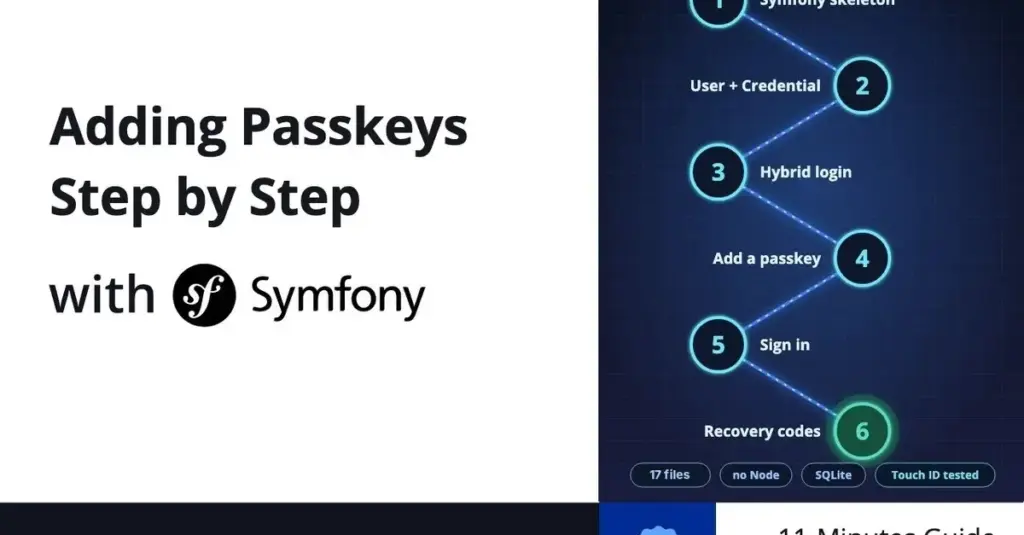
Frontend Integration and the "No-Node" Philosophy
The user interface for passkeys requires careful handling of asynchronous browser APIs. The modern Symfony approach utilizes Stimulus controllers to manage these interactions. By enabling specific controllers for hybrid login and passkey management, developers can integrate complex cryptographic flows into their Twig templates with minimal effort.
This "No-Node" philosophy, powered by AssetMapper, allows the browser to import necessary libraries directly from the importmap. This significantly reduces the complexity of the development environment and ensures that the frontend logic remains closely coupled with the backend Symfony application. The result is a cohesive system where the login form can automatically trigger a passkey "conditional UI" prompt—often referred to as autofill—allowing users to sign in with a biometric touch as easily as they would select a saved password.
Navigating Common Implementation Pitfalls
Even with a structured approach, developers often encounter specific hurdles during the implementation of WebAuthn. Understanding these pitfalls is essential for a successful rollout.
The most frequent error involves the aforementioned identity mapping. If the repository does not correctly convert the validator’s record into the application’s specific entity, Doctrine will fail to persist the data, citing missing identity values. This is a direct result of the abstraction layers used in the WebAuthn bundles and requires a deliberate conversion step in the repository’s save logic.
Another common issue arises during the "Add a Passkey" flow. If a developer mistakenly uses the standard registration block intended for new, passwordless users, the system will attempt to read a username from the request body. For an already-logged-in user, this is redundant and often leads to "User Not Found" errors. The correct approach is to use the creation controllers designed to recognize the current session’s user.
Finally, the issue of "orphaned" passkeys remains a characteristic of the current ecosystem. When a user revokes a passkey on the server, the cryptographic credential is deleted from the application’s database, but the physical key may still reside in the user’s cloud keychain (such as iCloud or Google Password Manager). While platform vendors are working on signal APIs to address this, developers must currently manage user expectations regarding the difference between server-side revocation and client-side deletion.
The Strategic Outlook for Authentication
As the industry moves forward, the choice between a hybrid flow and a purely passwordless system will depend largely on the target user base. For existing applications with established user habits, the hybrid flow offers a path of least resistance, allowing passkeys to gain traction one account at a time. For new ventures, starting with a passwordless-first approach can eliminate the risks associated with password storage from day one.
Regardless of the chosen path, the integration of recovery codes and robust rate-limiting remains non-negotiable. As the Symfony ecosystem continues to mature, these tools provide a standardized, secure, and developer-friendly framework for adopting the next generation of web authentication. The availability of comprehensive bundles and demo implementations ensures that the transition to passkeys is no longer a luxury for large-scale enterprises, but a practical reality for all Symfony developers.
 Software Development & Scripting for IT
The Performance Paradox: Why Cross-Origin Isolation Remains a Strategic Trade-off for In-Browser Machine Learning
In the rapidly evolving landscape of web development, the push to move...
 Software Development & Scripting for IT
Bridging the Context Gap: TokenCap Introduces Schema Intelligence to Eliminate AI Coding Errors
In the rapidly evolving landscape of software development, the integration of Artificial...
 Software Development & Scripting for IT
The Crisis of the "Almost Right" Illusion: How AI-Driven Developer Burnout is Reshaping Software Engineering
The initial promise of Artificial Intelligence in software development was centered on...







