
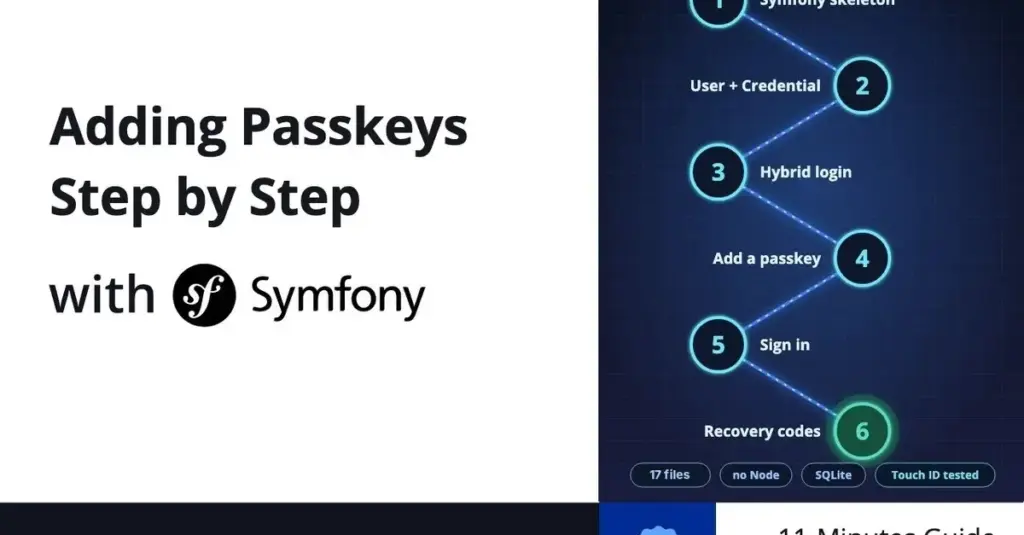
Data Modeling for a Decoupled Identity
The architectural heart of a passkey-enabled system lies in its data entities. A significant departure from traditional systems is the decoupling of the user’s email address from their WebAuthn identity. In a production-ready Symfony implementation, the User entity carries an opaque "user handle"—often a ULID or UUID—rather than using the email as the primary identifier for WebAuthn.
This design choice is vital for long-term flexibility. By using a permanent, internal handle, the system allows users to change their email addresses without breaking the cryptographic link to their existing passkeys. The User entity must implement the UserInterface and PasswordAuthenticatedUserInterface, maintaining compatibility with existing password systems while preparing for a hybrid or fully passwordless future.
Parallel to the user model is the Credential entity, which extends the base CredentialRecord. In a production environment, this entity does more than just store public keys; it acts as an audit log. By implementing interfaces to track usage, the system can record exactly when a passkey was last used. This transparency is a key feature for security-conscious users, allowing them to identify unauthorized access or simply manage a growing list of devices.
Bridging Validators and Persistence
A technical nuance that often catches developers off guard is the translation between the WebAuthn validator’s output and the database’s persistence layer. When a user registers a new passkey or logs in, the validators typically return a generic CredentialRecord. However, because most Symfony applications use a custom subclass with its own database mapping and identity strategy, a direct attempt to persist the validator’s output will result in errors.
To resolve this, the repository layer must act as a sophisticated translator. During registration, the repository converts the raw record into a local entity. During login, it must find the existing entity and synchronize updated metadata, such as the signature counter and backup status. This synchronization is not merely a bookkeeping task; it is a security requirement of the WebAuthn specification designed to detect cloned authenticators.
The Security Firewall and the Hybrid Login Strategy
The integration of passkeys into Symfony’s security component involves a sophisticated firewall configuration. In a hybrid environment—where passwords and passkeys coexist—the firewall must manage multiple authenticators simultaneously. This includes the traditional password form, the WebAuthn assertion authenticator, and the recovery code authenticator.
A critical configuration detail is the definition of an entry_point. When multiple authenticators are present, Symfony requires explicit instruction on where to redirect unauthenticated users. Failure to define this results in a container compilation error, a safeguard that prevents ambiguous security states.
The strategy for passkey adoption often favors a "progressive" approach. Rather than forcing a passwordless sign-up, many organizations find success by allowing logged-in users to add passkeys to their accounts via a management page. This is facilitated by standalone creation controllers that use a "Current User Entity Guesser." This ensures that the passkey is securely bound to the authenticated session, providing a seamless upgrade path for the existing user base.
 Software Development & Scripting for IT
The Streaming Paradox: Resolving the Single-Blob Bottleneck in Next.js Server-Sent Events
In the rapidly evolving landscape of generative artificial intelligence and real-time web...
 Software Development & Scripting for IT
Bridging the Linguistic Divide: How Word Embeddings Revolutionized Machine Understanding of Human Language
In the rapidly evolving landscape of artificial intelligence, one of the most...
 Software Development & Scripting for IT
Ensuring Operational Integrity in Data Engineering: A New Framework for Spark Pipeline Monitoring
In the complex ecosystem of modern data engineering, the successful completion of...







