In the modern landscape of software development, the Electron framework has long reigned as the industry standard for building cross-platform desktop applications. By allowing developers to package web technologies—HTML, CSS, and JavaScript—into a desktop environment, it has powered everything from VS Code to Discord. However, this convenience comes at a well-documented cost: "bloat." Because every Electron app must bundle its own version of the Chromium browser and the Node.js runtime, even the simplest utility often results in an installer exceeding 100MB and a significant memory footprint.
Developer ESeungJun recently challenged this status quo, documenting a comprehensive migration of several personal projects from Electron to Tauri. Tauri, a rising competitor in the desktop space, swaps out the heavy Chromium engine for the user’s native system webview and replaces the Node.js backend with Rust. The results of this transition highlight a dramatic shift in efficiency, with application sizes shrinking by over 95% and memory usage being cut by more than half.
The numbers behind the migration
The primary motivation for the migration was the sheer physical size of the applications being distributed. ESeungJun noted that throughout the year, every Electron-based installer they produced ended up surpassing the 100MB threshold. Smash!, a utility designed to organize and "tidy" a user’s Downloads folder, weighed in at 114MB. A desktop pet application designed to assist with user focus reached a staggering 198MB.
In contrast, a weather widget built from the ground up using Tauri demonstrated what was possible, totaling only 17MB despite the inclusion of 3D assets. This discrepancy prompted a full-scale port of the existing Electron suite.
The final statistics for the migrated apps are startling. On macOS, the focus-timer pet app plummeted from 198.7MB to a mere 5.6MB. Smash! saw a similar reduction, moving from 114MB to 6.2MB. Furthermore, while the Electron version of Smash! required separate builds for Apple Silicon and Intel processors to manage size, the Tauri version achieved a "universal" build—compatible with both architectures—at that same 6.2MB mark. Windows users saw even greater gains, with installers that once hovered around 115MB shrinking to approximately 2MB.
Efficiency gains extended beyond disk space into active system memory. For Smash!, the Electron version typically consumed 244MB of RAM distributed across eight different processes. The Tauri version reduced this to 88MB. ESeungJun noted that this 88MB figure is an "honest" measurement; while the core app process only uses 48MB, the total includes the three WebKit processes managed by the macOS system to render the UI. Even with these external processes accounted for, the resource savings remain profound.

Determining the migration order
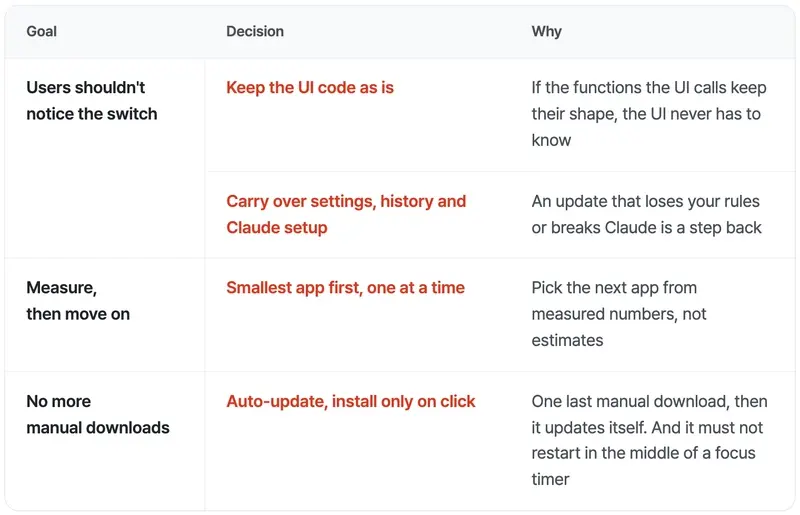
Porting an application from Electron to Tauri is often perceived as a daunting rewrite, primarily because it requires moving from the JavaScript-heavy Node.js environment to the more rigorous, memory-safe world of Rust. To manage this transition, ESeungJun adopted a methodical approach, evaluating each application based on the complexity of its "main process"—the backend logic that handles system-level tasks.
The strategy involved a careful audit of the existing codebase. The developer analyzed the number of lines of code in each app’s main process and identified which specific Electron features were being utilized, such as system tray integration, transparent windows, or "always-on-top" functionality.
 Software Development & Scripting for IT
The Connectivity Gap: Why Your Smart Lock Fails and the Technical Realities of the Three-Hop System
In the rapidly evolving landscape of the modern smart home, few devices...
 Software Development & Scripting for IT
Bridging the Linguistic Divide: How Word Embeddings Revolutionized Machine Understanding of Human Language
In the rapidly evolving landscape of artificial intelligence, one of the most...
 Software Development & Scripting for IT
Microsoft Unveils C# 15: A Deep Dive into Union Types, Enhanced Memory Safety, and Language Refinements
As the annual release cycle for the .NET ecosystem approaches, Microsoft has...