
In the modern landscape of software development, the Electron framework has long reigned as the industry standard for building cross-platform desktop applications. By allowing developers to package web technologies—HTML, CSS, and JavaScript—into a desktop environment, it has powered everything from VS Code to Discord. However, this convenience comes at a well-documented cost: "bloat." Because every Electron app must bundle its own version of the Chromium browser and the Node.js runtime, even the simplest utility often results in an installer exceeding 100MB and a significant memory footprint.
Developer ESeungJun recently challenged this status quo, documenting a comprehensive migration of several personal projects from Electron to Tauri. Tauri, a rising competitor in the desktop space, swaps out the heavy Chromium engine for the user’s native system webview and replaces the Node.js backend with Rust. The results of this transition highlight a dramatic shift in efficiency, with application sizes shrinking by over 95% and memory usage being cut by more than half.
The numbers behind the migration
The primary motivation for the migration was the sheer physical size of the applications being distributed. ESeungJun noted that throughout the year, every Electron-based installer they produced ended up surpassing the 100MB threshold. Smash!, a utility designed to organize and "tidy" a user’s Downloads folder, weighed in at 114MB. A desktop pet application designed to assist with user focus reached a staggering 198MB.
In contrast, a weather widget built from the ground up using Tauri demonstrated what was possible, totaling only 17MB despite the inclusion of 3D assets. This discrepancy prompted a full-scale port of the existing Electron suite.
The final statistics for the migrated apps are startling. On macOS, the focus-timer pet app plummeted from 198.7MB to a mere 5.6MB. Smash! saw a similar reduction, moving from 114MB to 6.2MB. Furthermore, while the Electron version of Smash! required separate builds for Apple Silicon and Intel processors to manage size, the Tauri version achieved a "universal" build—compatible with both architectures—at that same 6.2MB mark. Windows users saw even greater gains, with installers that once hovered around 115MB shrinking to approximately 2MB.
Efficiency gains extended beyond disk space into active system memory. For Smash!, the Electron version typically consumed 244MB of RAM distributed across eight different processes. The Tauri version reduced this to 88MB. ESeungJun noted that this 88MB figure is an "honest" measurement; while the core app process only uses 48MB, the total includes the three WebKit processes managed by the macOS system to render the UI. Even with these external processes accounted for, the resource savings remain profound.

Determining the migration order
Porting an application from Electron to Tauri is often perceived as a daunting rewrite, primarily because it requires moving from the JavaScript-heavy Node.js environment to the more rigorous, memory-safe world of Rust. To manage this transition, ESeungJun adopted a methodical approach, evaluating each application based on the complexity of its "main process"—the backend logic that handles system-level tasks.
The strategy involved a careful audit of the existing codebase. The developer analyzed the number of lines of code in each app’s main process and identified which specific Electron features were being utilized, such as system tray integration, transparent windows, or "always-on-top" functionality.
The focus-timer pet app was identified as the ideal starting point. Its main process was relatively lean at 494 lines of code, and its requirements were well-supported by Tauri’s native APIs. On the other end of the spectrum, DroidLens, an Android development tool with over 5,000 lines of backend logic, was placed on indefinite hold. The developer reasoned that for a specialized developer tool, the installer size was a less critical factor than the massive effort required for a rewrite.
The transition was not expected to yield significant speed improvements in terms of UI responsiveness. As ESeungJun observed, the original applications were never "slow" due to JavaScript; the bottleneck was always the resource overhead of the framework itself. The primary trade-off accepted during this phase was the shift to system-specific webviews (WebKit on macOS and WebView2 on Windows), which can occasionally result in subtle visual differences in the UI across different operating systems.
Strategic goals and the migration process
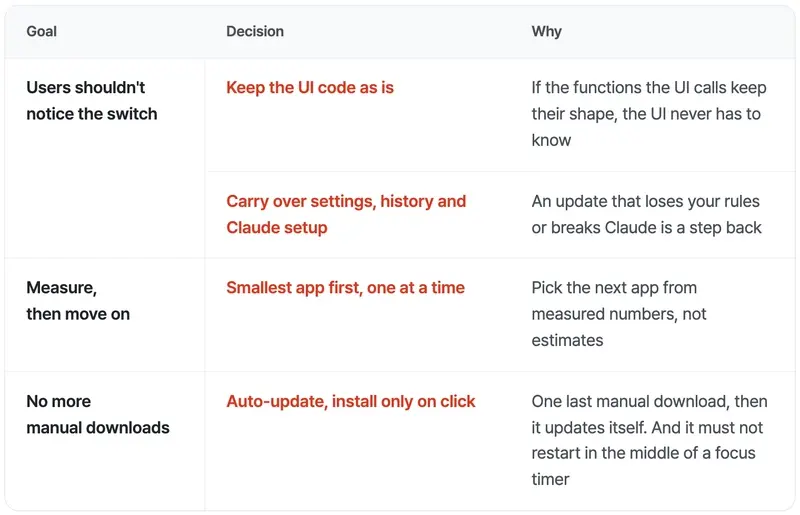
Three core goals guided the migration: maintaining the existing user experience, ensuring a seamless transition for current users, and achieving the aforementioned reductions in resource usage. The developer was particularly concerned with the "invisible" transition. A smaller installer would be of little value if the update process inadvertently wiped a user’s custom rules or broke existing integrations.
To achieve this, the developer focused on the "boundary" between the frontend UI and the backend logic. In the original Electron apps, the UI communicated with the system via a specific object, often referred to as window.electronAPI. By creating a small shim in Tauri that mimicked this exact object, the developer was able to keep the UI code—including 38 React components in the pet app—virtually untouched. The UI continues to call the same functions and receive the same data structures, unaware that the backend had been swapped from Node.js to Rust.

Smash! and the Model Context Protocol integration
The migration of Smash! presented a higher degree of difficulty. The application is more than a simple file mover; it includes a rule engine, a folder watcher, trash handling, and a history log. Most notably, it features an integration with Claude Code and Claude Desktop through the Model Context Protocol (MCP).
The MCP server allows users to interact with Smash! via AI, giving commands like "tidy my Downloads" directly through a chat interface. In the Electron era, this worked by launching the bundled Electron binary as a Node.js process. In the Tauri version, the application binary itself handles these requests using a --mcp flag, removing Node.js from the equation entirely.
This change introduced a potential breaking point for existing users. Those who had already configured Claude to work with Smash! 1.x had file paths pointing to the old Electron binary. If the update simply replaced the app, the AI integration would fail silently. To solve this, ESeungJun implemented a migration script that runs the first time version 2.0 is launched. The app scans for Claude configuration files across various directories and automatically updates the paths to point to the new Tauri binary.
Addressing the limitations of automated testing
Despite porting 21 tests for the rule engine and file-handling logic to Rust, the developer discovered that automated tests could not catch every nuance of a framework migration. Several issues emerged during real-world testing of the installed applications.
One notable issue involved the way the application handled JSON configuration files. The initial Rust implementation for rewriting the Claude configuration inadvertently sorted all JSON keys alphabetically. While technically valid, this altered the user’s entire ~/.claude.json file, which might contain settings for many other tools. The developer had to adjust the logic to preserve the original key order, ensuring that only the Smash-related entries were modified.
Another bug was discovered in the user interface notifications. After the port, the "nag banner" that appears after a file is organized failed to display the folder name, resulting in a message that read "Tidied 1 file in" followed by a blank space. This was traced back to a logic error where the folder watcher was passing a raw path instead of a folder ID—a detail that the existing test suite had not been designed to validate.

The developer also noted a shift in their workflow. Initially, without a local Rust environment configured on their Mac, they relied on GitHub Actions for every build. This resulted in a ten-minute feedback loop for every minor compile error. By installing Rust locally, they were able to iterate quickly, using the remote Continuous Integration (CI) environment only for final Windows builds.
Modernizing the update experience
Prior to the Tauri migration, neither application featured an automated update mechanism. Users were required to manually download and install new versions from GitHub. With the move to Tauri, ESeungJun implemented a sophisticated background update system.
The apps are now programmed to check for updates 15 seconds after launch and every six hours thereafter. To avoid interrupting the user—particularly important for the pet app, which functions as a focus timer—the update is downloaded silently in the background. A prompt is then added to the system tray menu, allowing the user to "Install new version and restart" at their convenience. This ensures that a focus session is never interrupted by a forced software update.
Conclusion and takeaways
The migration from Electron to Tauri represents a significant evolution for these projects, proving that desktop utilities do not need to be heavy to be powerful. By leveraging Rust and system-native webviews, the developer was able to deliver a more professional, efficient, and user-friendly experience without sacrificing the cross-platform capabilities that made Electron attractive in the first place.
For the developer, the journey underscored the importance of testing against real-world configuration files and the value of a "silent" migration that respects the user’s existing setup. As these applications move forward, they serve as a compelling case study for other developers looking to escape the "Electron tax" and embrace a more performant future for desktop software.
 Software Development & Scripting for IT
The Two-Week Pivot: How Strategic Scoping is Redefining Mobile App Development Timelines
In the competitive landscape of digital entrepreneurship, a persistent myth often dictates...
 Software Development & Scripting for IT
Architecting Complexity: How a Structured Multi-Prompt Strategy Enabled an AI Agent to Build a Multi-Platform Messenger
In the rapidly evolving landscape of artificial intelligence, the narrative has shifted...
 Software Development & Scripting for IT
Enhancing Web Resilience: How Promise.allSettled is Redefining Asynchronous JavaScript Patterns
In the modern landscape of web development, the efficiency and reliability of...







