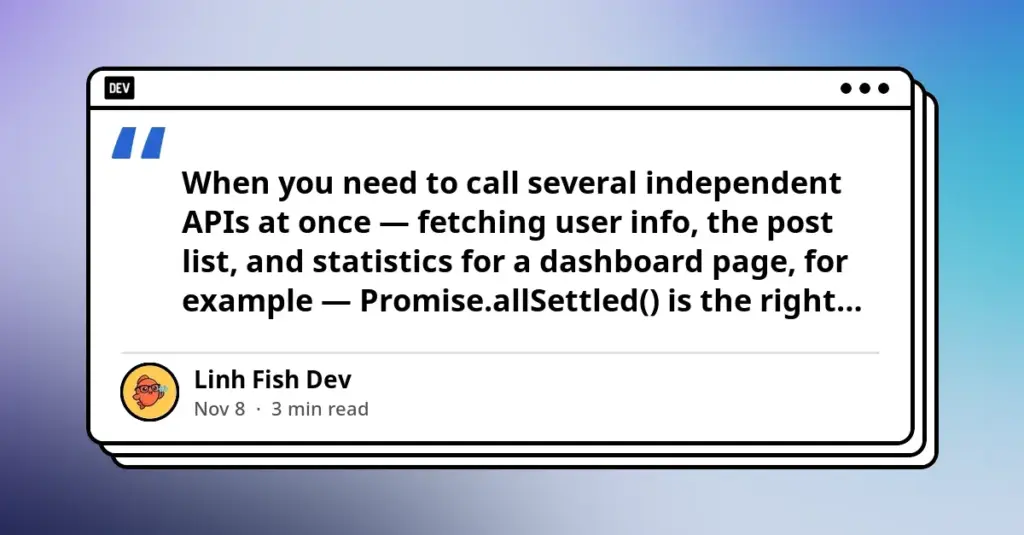
In the modern landscape of web development, the efficiency and reliability of data fetching have become paramount. As applications evolve from simple pages into complex, data-driven dashboards, developers increasingly find themselves managing multiple concurrent requests. Whether it is retrieving user profiles, aggregating social media feeds, or pulling real-time analytics, the ability to handle these operations simultaneously is a hallmark of a high-performance application. However, for years, a significant challenge persisted in the way JavaScript handled multiple asynchronous tasks: the "all-or-nothing" trap.
The introduction of Promise.allSettled() as part of the ES2020 specification marked a pivotal shift in how developers approach these challenges. By providing a mechanism to wait for every task to complete regardless of its success or failure, this feature has become an essential tool for building resilient user interfaces that can withstand partial failures without compromising the entire user experience.
The Problem of the All-or-Nothing Approach
For much of JavaScript’s history following the introduction of Promises, Promise.all() was the standard method for executing multiple asynchronous operations in parallel. While powerful, Promise.all() operates on a "fail-fast" principle. If any single promise in the array rejects, the entire operation is immediately terminated, and the overall promise is rejected.
Consider the architecture of a typical administrative dashboard. To provide a comprehensive view to the user, the application might need to call three independent APIs simultaneously: one to fetch personal user information, another to retrieve a list of recent blog posts, and a third to pull site-wide statistics. Using the traditional Promise.all() approach, the implementation might look like this:
const [user, posts, stats] = await Promise.all([
  fetch("/api/user").then((r) => r.json()),
  fetch("/api/posts").then((r) => r.json()),
  fetch("/api/stats").then((r) => r.json()),
]);
In an ideal environment where every network request succeeds, this code is efficient. However, the reality of web infrastructure is rarely ideal. If the statistics API encounters a 500 Internal Server Error, the entire Promise.all() block fails instantly. Even if the user data and post list were successfully retrieved and were ready to be displayed, they are effectively discarded.
From a user experience perspective, this is a catastrophic failure. Instead of seeing their profile and their content—with perhaps a small error message in the corner where the statistics should be—the user is often met with a blank screen or a generic "Something went wrong" message. The failure of a non-critical component (the statistics) has successfully "poisoned" the critical components (the user identity and core content). This lack of isolation between independent tasks forces the user to reload the entire page, hoping that the secondary API will function on the next attempt.
The Solution: A More Resilient Alternative
The development community recognized that the fail-fast behavior of Promise.all(), while useful for atomic operations where every step is vital, was often counterproductive for independent UI components. This led to the standardization of Promise.allSettled().
 Software Development & Scripting for IT
Decoding the Silent Failure: Why WordPress Image Uploads Trigger the Persistent HTTP Error
In the modern landscape of digital publishing, WordPress remains the dominant force,...
 Software Development & Scripting for IT
Solo Developer Launches TinySEOTool, a Suite of Over 100 Free, Privacy-Focused Browser Utilities
In an era where digital productivity often comes at the cost of...
 Software Development & Scripting for IT
Afterlight: Bridging the Supernatural and Open-Source AI in a New Browser-Based Storytelling Studio
As the final week of Hacktoberfest 2024 unfolds, the global developer community...