
FAQ
How is Promise.allSettled() different from Promise.all()?
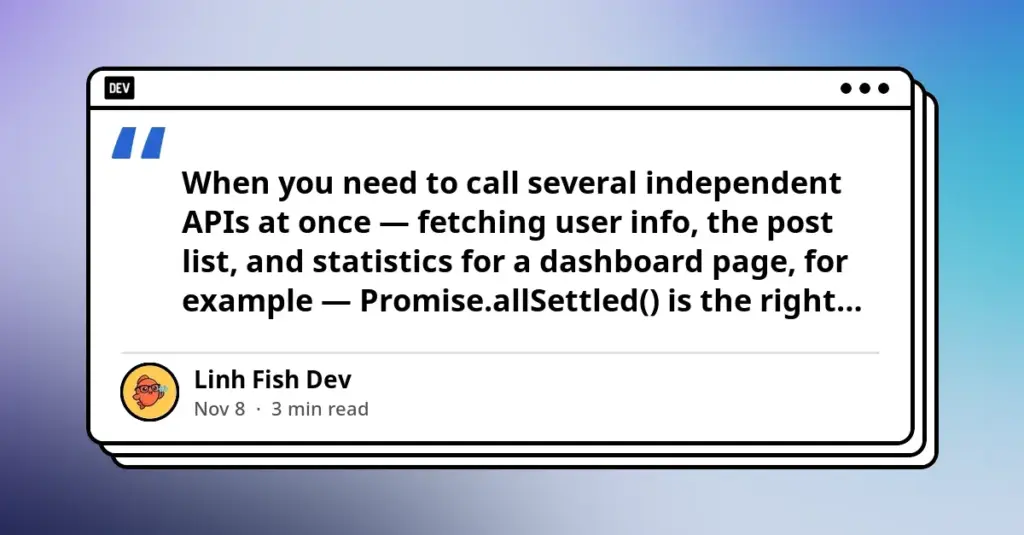
The fundamental difference lies in how they handle rejection. Promise.all() will reject as soon as any of the input promises reject, effectively ignoring any successful results from other promises. In contrast, Promise.allSettled() will always wait for every promise to finish, regardless of the outcome, and provide a comprehensive report on which tasks succeeded and which failed.
Do the results keep the same order as the input promises?
Yes. One of the most reliable features of Promise.allSettled() is that the resulting array maintains the exact order of the input array. This is true regardless of which promise resolves first or how long each one takes to complete. This consistency allows developers to reliably map results back to their original requests using index-based assignment.
When should I still use Promise.all() instead of Promise.allSettled()?
You should continue to use Promise.all() when the operations are part of a single logical unit where "all must succeed or none should proceed." Examples include multi-step database transactions or complex calculations where the final result is dependent on every sub-calculation being accurate and present.
Which browsers and Node.js versions support Promise.allSettled()?
As an ES2020 feature, Promise.allSettled() enjoys broad support in modern environments. It is available in Google Chrome 76 and later, Firefox 71 and later, and Safari 13 and later. For server-side development, it is supported in Node.js version 12.9.0 and above. For projects that must support legacy browsers, such as Internet Explorer, developers should utilize a polyfill or a compatibility library like core-js.
References
The adoption of Promise.allSettled() reflects a broader trend in software engineering toward resilience and fault tolerance. As web applications become more distributed and rely on an increasing number of third-party services, the ability to handle partial failures is no longer just a "nice-to-have" feature—it is a requirement for professional-grade software.
By understanding the nuances between these different promise-handling methods, developers can write code that is not only more efficient but also more empathetic to the end-user. The shift from a blank screen to a partially functional, informative interface represents a significant step forward in the maturity of web applications. As this pattern becomes standard, the expectation for "graceful failure" continues to rise, pushing the industry toward more stable and reliable digital experiences.
 Software Development & Scripting for IT
Critical "php2shell" Vulnerabilities Trigger Emergency PHP Security Updates to Prevent Remote Execution
The global PHP security team has issued an emergency set of updates...
 Software Development & Scripting for IT
Supply Chain Hijack: How a Vulnerability in Optimizely Turned Trusted Scripts into Weapons for Financial Theft and iOS Exploitation
On November 16, a sophisticated supply chain attack exploited a critical vulnerability...
 Software Development & Scripting for IT
Ensuring Operational Integrity in Data Engineering: A New Framework for Spark Pipeline Monitoring
In the complex ecosystem of modern data engineering, the successful completion of...







