Despite porting 21 tests for the rule engine and file-handling logic to Rust, the developer discovered that automated tests could not catch every nuance of a framework migration. Several issues emerged during real-world testing of the installed applications.
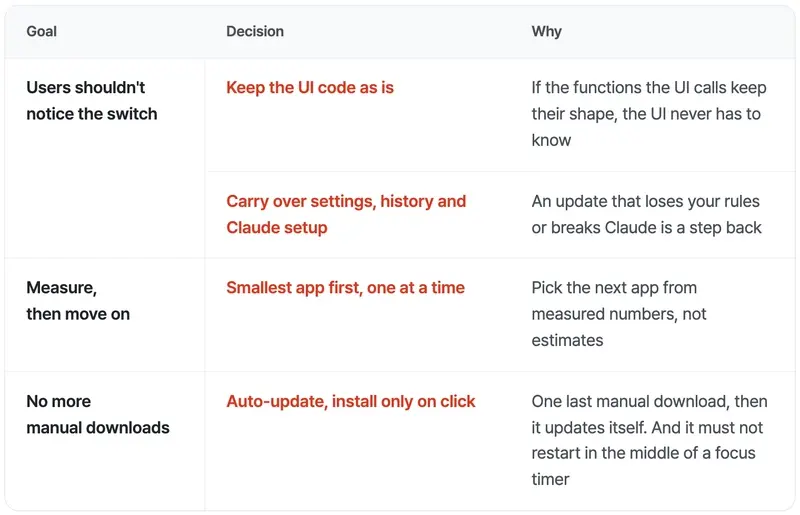
One notable issue involved the way the application handled JSON configuration files. The initial Rust implementation for rewriting the Claude configuration inadvertently sorted all JSON keys alphabetically. While technically valid, this altered the user’s entire ~/.claude.json file, which might contain settings for many other tools. The developer had to adjust the logic to preserve the original key order, ensuring that only the Smash-related entries were modified.
Another bug was discovered in the user interface notifications. After the port, the "nag banner" that appears after a file is organized failed to display the folder name, resulting in a message that read "Tidied 1 file in" followed by a blank space. This was traced back to a logic error where the folder watcher was passing a raw path instead of a folder ID—a detail that the existing test suite had not been designed to validate.

The developer also noted a shift in their workflow. Initially, without a local Rust environment configured on their Mac, they relied on GitHub Actions for every build. This resulted in a ten-minute feedback loop for every minor compile error. By installing Rust locally, they were able to iterate quickly, using the remote Continuous Integration (CI) environment only for final Windows builds.
Modernizing the update experience
Prior to the Tauri migration, neither application featured an automated update mechanism. Users were required to manually download and install new versions from GitHub. With the move to Tauri, ESeungJun implemented a sophisticated background update system.
The apps are now programmed to check for updates 15 seconds after launch and every six hours thereafter. To avoid interrupting the user—particularly important for the pet app, which functions as a focus timer—the update is downloaded silently in the background. A prompt is then added to the system tray menu, allowing the user to "Install new version and restart" at their convenience. This ensures that a focus session is never interrupted by a forced software update.
Conclusion and takeaways
The migration from Electron to Tauri represents a significant evolution for these projects, proving that desktop utilities do not need to be heavy to be powerful. By leveraging Rust and system-native webviews, the developer was able to deliver a more professional, efficient, and user-friendly experience without sacrificing the cross-platform capabilities that made Electron attractive in the first place.
For the developer, the journey underscored the importance of testing against real-world configuration files and the value of a "silent" migration that respects the user’s existing setup. As these applications move forward, they serve as a compelling case study for other developers looking to escape the "Electron tax" and embrace a more performant future for desktop software.
 Software Development & Scripting for IT
Modernizing Authentication: A Comprehensive Approach to Passkey Implementation in Symfony 8.1
The digital authentication landscape is undergoing a fundamental shift as the industry...
 Software Development & Scripting for IT
Innovative Desk-Based Prototype "DriveSignal" Redefines Driver Monitoring Through Personalized Eye-Tracking and Explainable AI
In the rapidly evolving landscape of automotive safety, the integration of driver...
 Software Development & Scripting for IT
The Crisis of the "Almost Right" Illusion: How AI-Driven Developer Burnout is Reshaping Software Engineering
The initial promise of Artificial Intelligence in software development was centered on...