The landscape of enterprise artificial intelligence is currently navigating a critical inflection point, transitioning from the era of simple chatbots to a new paradigm defined by sophisticated, multi-modal models and complex agentic workflows. As these systems evolve, they are exposing the inherent limitations of traditional data center designs. Conventional rack architectures, which have long been built around individual 8-GPU servers, are increasingly hitting what industry experts describe as an "infrastructure wall." In this new era of computing, the performance of an AI cluster is no longer defined solely by its raw floating-point operations per second (FLOPS). Instead, the true bottlenecks have shifted toward memory domain coherent boundaries, interconnect latency, and the physical limits of thermal dissipation.
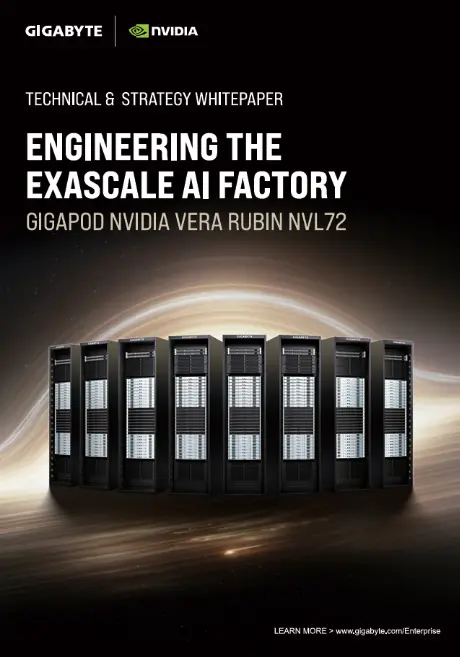
To address these escalating challenges, a new technical blueprint has emerged from a strategic co-engineering effort between GIGABYTE and NVIDIA. The introduction of the GIGAPOD NVIDIA Vera Rubin NVL72 represents a shift from component-based server design to a factory-integrated, turnkey rack-scale architecture. This solution is designed specifically to support the next generation of trillion-parameter agentic AI, providing the massive memory and interconnect speeds required to sustain long reasoning chains without the performance-degrading stalls associated with traditional hardware.
The transition toward agentic AI marks a fundamental change in how compute resources are utilized. Unlike standard request-and-response patterns, where a model generates a single output for a single input, agentic workflows involve models that act as autonomous or semi-autonomous entities. These agents must plan, reason, and execute multi-step tasks, often interacting with various data sources and other models in real-time. This process creates "long reasoning chains" that require constant access to massive amounts of data. When these models outgrow the memory capacity of a single server, they are forced to offload data to slower storage or system memory, leading to significant latency. The GIGAPOD architecture is engineered to eliminate these stalls by treating the entire rack as a single, unified compute entity.
At the heart of the GIGAPOD NVIDIA Vera Rubin NVL72 is a massive integration of processing power and high-bandwidth memory. The system unifies 72 NVIDIA Rubin GPUs and 36 NVIDIA Vera CPUs into a single, cohesive 20.7 TB HBM4 memory domain. This unification is made possible through the implementation of the 6th-Gen NVLink switch fabric, which provides an unprecedented 260 TB/s all-to-all interconnect. By allowing every GPU in the rack to communicate with every other GPU and CPU at such high speeds, the architecture effectively erases the boundaries between individual servers, creating a pool of resources that can handle the most demanding trillion-parameter models with ease.
Breaking the Infrastructure Wall
The "infrastructure wall" mentioned by industry leaders refers to the point where adding more individual servers no longer yields linear performance gains because the network between those servers becomes a bottleneck. In the context of agentic AI, the ability to maintain a unified rack-scale memory domain is essential. When a model’s parameters and its active "context window" can reside entirely within high-speed HBM4 memory across the entire rack, the system can maintain the continuity required for complex reasoning.
By eliminating memory-offloading stalls, the GIGAPOD ensures that the "time to first token" and the overall throughput of the model remain high, even as the complexity of the task increases. This is a departure from the previous generation of hardware, where large models had to be partitioned across multiple racks or nodes, introducing significant latency as data traveled across standard Ethernet or InfiniBand networks. While those networking technologies remain vital for cluster-scale communication, the NVLink fabric within the GIGAPOD handles the most intensive data exchanges at speeds that traditional networking cannot match.
 Helpdesk & IT Service Management (ITSM)
Qlik Secures AWS Data Competency for Relational Databases, Strengthening Hybrid Cloud Integration and AI Readiness
Qlik, a global leader in data integration, analytics, and artificial intelligence, has...
 Helpdesk & IT Service Management (ITSM)
US Authorities Disrupt Major Chinese State-Sponsored Cyber Infrastructure Linked to Integrity Technology Group
In a significant blow to state-sponsored cyber espionage operations, the United States...
 Helpdesk & IT Service Management (ITSM)
Uber Data Breach Exposes Personal Information of Thousands of Drivers Following Third-Party Vendor Compromise
A significant security breach has compromised the personal information of thousands of...