
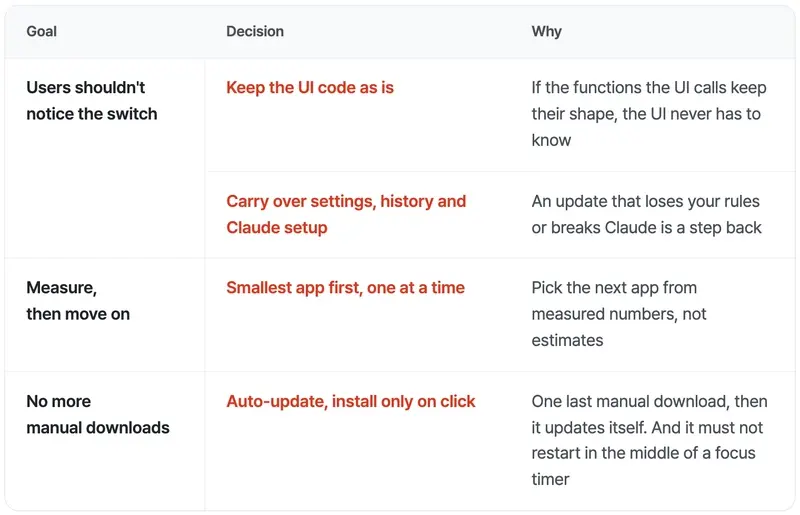
The focus-timer pet app was identified as the ideal starting point. Its main process was relatively lean at 494 lines of code, and its requirements were well-supported by Tauri’s native APIs. On the other end of the spectrum, DroidLens, an Android development tool with over 5,000 lines of backend logic, was placed on indefinite hold. The developer reasoned that for a specialized developer tool, the installer size was a less critical factor than the massive effort required for a rewrite.
The transition was not expected to yield significant speed improvements in terms of UI responsiveness. As ESeungJun observed, the original applications were never "slow" due to JavaScript; the bottleneck was always the resource overhead of the framework itself. The primary trade-off accepted during this phase was the shift to system-specific webviews (WebKit on macOS and WebView2 on Windows), which can occasionally result in subtle visual differences in the UI across different operating systems.
Strategic goals and the migration process
Three core goals guided the migration: maintaining the existing user experience, ensuring a seamless transition for current users, and achieving the aforementioned reductions in resource usage. The developer was particularly concerned with the "invisible" transition. A smaller installer would be of little value if the update process inadvertently wiped a user’s custom rules or broke existing integrations.
To achieve this, the developer focused on the "boundary" between the frontend UI and the backend logic. In the original Electron apps, the UI communicated with the system via a specific object, often referred to as window.electronAPI. By creating a small shim in Tauri that mimicked this exact object, the developer was able to keep the UI code—including 38 React components in the pet app—virtually untouched. The UI continues to call the same functions and receive the same data structures, unaware that the backend had been swapped from Node.js to Rust.

Smash! and the Model Context Protocol integration
The migration of Smash! presented a higher degree of difficulty. The application is more than a simple file mover; it includes a rule engine, a folder watcher, trash handling, and a history log. Most notably, it features an integration with Claude Code and Claude Desktop through the Model Context Protocol (MCP).
The MCP server allows users to interact with Smash! via AI, giving commands like "tidy my Downloads" directly through a chat interface. In the Electron era, this worked by launching the bundled Electron binary as a Node.js process. In the Tauri version, the application binary itself handles these requests using a --mcp flag, removing Node.js from the equation entirely.
This change introduced a potential breaking point for existing users. Those who had already configured Claude to work with Smash! 1.x had file paths pointing to the old Electron binary. If the update simply replaced the app, the AI integration would fail silently. To solve this, ESeungJun implemented a migration script that runs the first time version 2.0 is launched. The app scans for Claude configuration files across various directories and automatically updates the paths to point to the new Tauri binary.
Addressing the limitations of automated testing
 Software Development & Scripting for IT
Innovative Desk-Based Prototype "DriveSignal" Redefines Driver Monitoring Through Personalized Eye-Tracking and Explainable AI
In the rapidly evolving landscape of automotive safety, the integration of driver...
 Software Development & Scripting for IT
Enhancing Web Resilience: How Promise.allSettled is Redefining Asynchronous JavaScript Patterns
In the modern landscape of web development, the efficiency and reliability of...
 Software Development & Scripting for IT
UNC6240 Exploits Critical Oracle PeopleSoft Vulnerability Through Sophisticated WAF Bypass Techniques
A sophisticated cyber-espionage and data theft campaign has been identified targeting organizations...







