
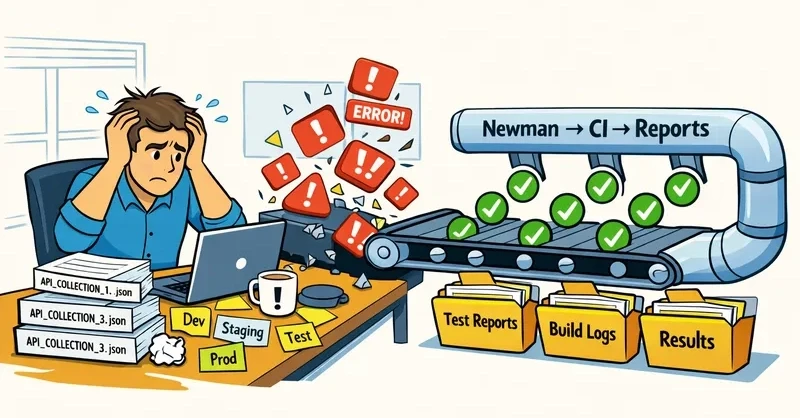
In the fast-paced landscape of modern software development, the gap between a functional API and a reliable one is often bridged by the quality of its testing suite. For years, Postman collections have served as the go-to tool for developers to explore endpoints and verify basic functionality. However, a growing sentiment among engineering leaders suggests that when these collections are left as informal "workspace junk," they generate more noise than confidence. The industry is currently seeing a significant shift toward formalizing these artifacts into versioned, CI-driven API regression suites, transforming them from ad-hoc checks into reliable quality gates that teams can measure and trust.
The necessity for this transformation stems from two recurring patterns that plague development teams: flaky manual runs and invisible drift. In many organizations, tests live exclusively in an individual developer’s workspace, leading to a "works on my machine" syndrome. Environments often differ by hard-coded URLs and exposed secrets, and most critically, runs frequently occur only after code has already landed in production. This "too late" approach results in long debug loops, duplicate fixes, and a gradual erosion of trust in automated checks as they begin to fail unpredictably.
Why Postman Collections Deserve Formal Regression Status
The push to treat Postman collections as first-class regression assets is rooted in three practical advantages: reproducibility, measurability, and a clear ownership surface for maintenance. By moving beyond the graphical user interface and utilizing Newman—the command-line companion for Postman—teams can achieve deterministic runs. These runs provide machine-readable exit codes and pluggable reporters that allow for seamless integration into broader automation frameworks.
Operational experts are increasingly advocating for a "smaller is better" philosophy regarding test design. A common rule of thumb emerging in high-performing teams is the preference for numerous small, stable tests over a single, massive end-to-end collection. This modular approach significantly reduces the "blast radius" of a failure, making the underlying cause of a breakdown immediately obvious to the engineering team. When a collection is focused on a specific microservice or a narrow functional area, the feedback loop is tightened, allowing for faster remediation.
Designing Collections and Environments for Reliable Automation
To achieve reliability within a Continuous Integration (CI) environment, developers are focusing on three primary levers: structure, variable scoping, and test independence. A formalized repository layout is becoming the standard for teams looking to institutionalize their testing. This typically involves a dedicated directory structure where collections, environment configurations, data files (such as CSVs for regression users), and CI-specific scripts are stored alongside the application code.
A standard repository layout often places Postman artifacts in a dedicated directory, separating "smoke tests"—which verify basic connectivity—from comprehensive "regression tests" that validate deep business logic. This organization ensures that the right tests are run at the right time in the development lifecycle.
The technical execution of these tests through the Newman CLI allows for highly customizable runs. By using specific flags, developers can point to staging environments, inject external data files, and trigger multiple reporters simultaneously. For instance, a single Newman command can generate a real-time CLI summary for the developer, a JUnit XML file for the CI server to parse, and a rich HTML report for human review.
A critical component of this design is "variable hygiene." Industry best practices now dictate that secrets and sensitive credentials should never be committed to environment files within a repository. Instead, developers are encouraged to commit placeholders and inject real values via CI secrets or the Postman API at runtime. This approach not only secures the pipeline but also ensures that the testing suite remains portable across different environments without manual intervention.
Running Newman in CI: Patterns That Scale
As organizations scale, they are adopting three practical patterns for running collections within CI pipelines. The first involves installing Newman directly into the CI job, which is often the simplest path for smaller projects. The second, and increasingly popular, method is the use of the official Docker image. By mounting workspace files into a containerized Newman environment, teams can ensure consistent test execution regardless of the underlying CI runner’s configuration. The third pattern involves the Postman CLI integration, which offers tighter integration with Postman’s enterprise features and internal governance tools.
In a typical GitHub Actions workflow, for example, the process is streamlined by utilizing the Docker-based approach. The workflow is triggered by a code push, which then checks out the repository and runs the Newman container. The container executes the regression suite against a specified environment, utilizing data-driven testing parameters where necessary. Once the run is complete, the generated reports—both the machine-readable JUnit files and the human-readable HTML summaries—are uploaded as artifacts. This ensures that every build has a corresponding record of API health that is easily accessible to the entire team.
For teams utilizing Jenkins, the integration often focuses on the visibility of test trends. By publishing the generated JUnit XML via the Jenkins JUnit plugin, teams can see detailed failure breakdowns and historical performance trends directly within the Jenkins UI. This visibility is crucial for identifying "leaky" APIs that may be degrading slowly over time rather than failing outright.
Versioning, Reporting, and Maintenance Practices That Stick
The transition from ephemeral testing to institutional regression suites is finalized through robust versioning and reporting. Without these, testing remains a localized activity rather than a corporate asset. Reporting tools play a vital role here, with different reporters serving different stakeholders.
JUnit is widely regarded as the best format for machine parsing and CI gating. Because it is a standard format, it can be consumed by almost any CI/CD tool, including Jenkins, GitLab CI, and Azure DevOps, to provide a "pass/fail" signal to the pipeline. On the human side, the "htmlextra" reporter—a community-maintained favorite—is frequently used to produce detailed iteration breakdowns. It offers a more granular view than the standard HTML reporter, making it easier for developers to diagnose exactly why a specific data set caused a test to fail. For teams requiring even more interactive and rich exploration of test results, the Allure framework is often integrated, though it requires an additional step to generate the final interactive reports from the raw results.
Versioning is equally important. Following Semantic Versioning (SemVer) principles for API collections allows teams to track changes in the testing logic alongside changes in the API itself. This ensures that as an API evolves from version 1.0 to 2.0, the regression suite remains synchronized, preventing false negatives or positives caused by outdated test logic.
Practical Application and Operational Checklists
To successfully transition a service to this formalized model, many teams are adopting a "conversion sprint"—a focused effort, usually lasting one to two days, dedicated to stabilizing a single service’s testing suite. During this sprint, the team works through a checklist that includes decoupling tests from hard-coded data, implementing proper variable scoping, and ensuring that the collection can run successfully in a headless environment.
Operational efficiency is further enhanced by using package.json scripts in Node.js environments. By defining a simple command like npm run ci:newman, developers can encapsulate complex Newman CLI strings, making it easy for any team member to run the full suite locally with the same parameters used in the CI pipeline.
The final piece of the puzzle is a robust troubleshooting process. When a CI run fails, teams need a clear path to resolution. This typically involves verifying that the environment variables were correctly injected, checking that the target service was reachable from the CI runner, and reviewing the HTML reports to see if the failure was a legitimate regression or a result of malformed test data.
By automating Postman collections into a repeatable, versioned regression suite, organizations can remove the manual variability that often leads to production incidents. This shift not only speeds up the feedback loop for developers but also makes failures actionable. Ultimately, it represents the difference between being surprised by a production regression and having the systems in place to stop it before it ever reaches a customer. As APIs continue to serve as the backbone of modern software architecture, the formalization of their testing suites is no longer an optional luxury—it is a foundational requirement for reliable delivery.
 Software Development & Scripting for IT
Bridging the Context Gap: TokenCap Introduces Schema Intelligence to Eliminate AI Coding Errors
In the rapidly evolving landscape of software development, the integration of Artificial...
 Software Development & Scripting for IT
The Crisis of the "Almost Right" Illusion: How AI-Driven Developer Burnout is Reshaping Software Engineering
The initial promise of Artificial Intelligence in software development was centered on...
 Software Development & Scripting for IT
Navigating the "Lakh and Crore" Divide: New AI Benchmark Exposes Significant Errors in Indian Real Estate Mathematics
The dream of homeownership in India is often a complex journey through...







