
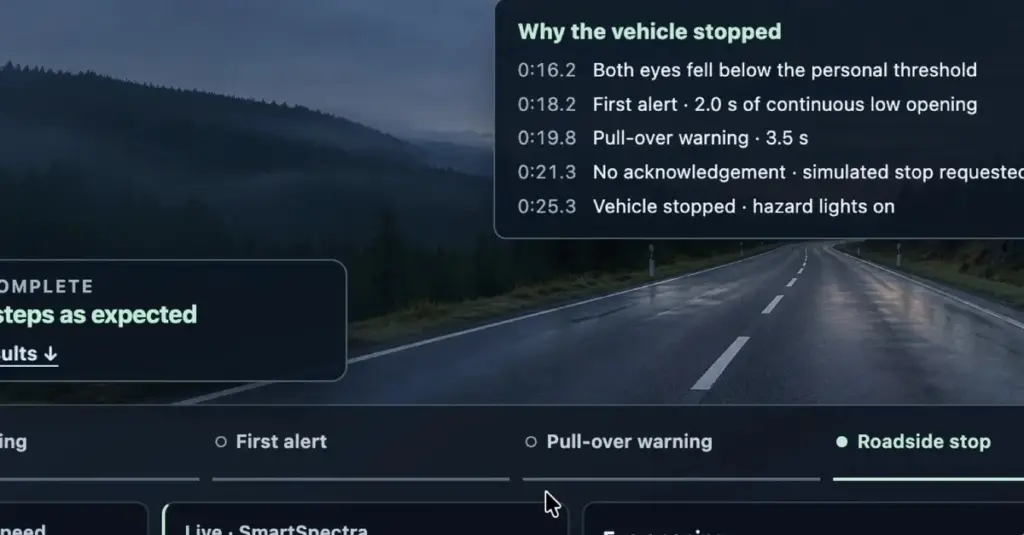
If the driver does not acknowledge the warning or if the eyes remain closed for five seconds, the system initiates a simulated roadside stop. In this phase, the virtual vehicle slows from 50 km/h to 40 km/h, then to 30 km/h, eventually pulling over with the hazard lights activated. This progression illustrates the potential for autonomous safety interventions when a driver is deemed non-responsive.
Testing the Human Element: The 20-Second Live Drive
To validate the system’s accuracy, the developer implemented a "20-second live drive test" that subjects the logic to a variety of human behaviors. During this test, the cockpit windshield displays six distinct prompts: talking normally, looking directly at the camera, squinting, yawning, looking away, and finally, closing the eyes for a sustained period.
The goal of the system is to remain "calm" and maintain cruising speed through the first five prompts. This tests the software’s ability to differentiate between normal driver behavior—such as talking or checking mirrors—and actual drowsiness. For instance, while a yawn might involve significant mouth movement, DriveSignal is designed to treat mouth cues as context rather than a primary trigger for a "pull-over" response.
During internal testing, the developer noted the complexities of mouth geometry. In one instance, a yawn was correctly identified, while in another, the widening of the mouth corners resembled a "wide opening" that the geometry alone could not fully resolve. These findings highlight the experimental nature of mouth-based tracking and the developer’s decision to prioritize eye-tracking as the primary safety metric.
The report generated after these tests provides a comprehensive breakdown of the results. It compares expected outcomes against measured data, including alert counts, tracking interruptions, and the lowest recorded eye opening. By explicitly marking tracking interruptions, the system makes unintended alerts visible during review, allowing for a more honest assessment of the software’s reliability.
Engineering Rigor and Rapid Development
The technical architecture of DriveSignal is as robust as its front-end simulation. Built using Node.js, the application’s decision engine is entirely independent of the browser views and the camera provider. This modularity allows the same logic to process live measurements, synthetic playback, and imported data traces.
The developer’s commitment to quality is evident in the inclusion of a rigorous verification suite. By running a single command, the system type-checks the JavaScript source code, executes unit and workflow tests, and performs property tests. These property tests are particularly significant, as they drive 1,500 seeded random sessions through the decision engine to identify potential edge cases or logic failures.
 Software Development & Scripting for IT
Bridging the Gap Between Logic and Instruction: An In-Depth Look at the Runbook Repair Lab
In the rapidly evolving landscape of software engineering, the "runbook"—a routine set...
 Software Development & Scripting for IT
The Architecture of Real-Time Presence: Why Pushing Wins in High-Stakes Media Operations
In the high-pressure environment of a media operations center, the reliability of...
 Software Development & Scripting for IT
The Hidden Risks of DNS Drift: Why Engineering Teams are Prioritizing Reconciliation Safety over Speed
In the modern landscape of cloud-native logistics and software-as-a-service platforms, the reliability...







