
In the rapidly evolving landscape of automotive safety, the integration of driver monitoring systems (DMS) has become a focal point for researchers and developers seeking to mitigate the risks associated with fatigue and distraction. A new entry into this field, a project titled "DriveSignal," has emerged as a sophisticated desk-based prototype designed to bridge the gap between complex biometric data and real-world driver safety applications. Developed as a submission for the Presage SmartSpectra SDK Challenge, DriveSignal offers a comprehensive simulation of a vehicle cockpit, utilizing advanced face-tracking technology to monitor driver attention and execute safety protocols in a controlled environment.
The project, which was conceptualized and executed within a rigorous three-day development cycle, serves as a proof of concept for how software-based monitoring can be personalized to individual users. Unlike traditional systems that may rely on generic averages for blink rates or eye-closure durations, DriveSignal emphasizes a calibration-heavy approach, ensuring that the system understands the unique physiological baselines of each participant before making critical safety decisions.
A New Vision for the Driver’s Cockpit
DriveSignal is structured as a virtual vehicle dashboard that consolidates several high-level metrics into a single, intuitive view. The prototype displays a virtual vehicle’s current speed, the status of hazard lights, and real-time eye signals. By integrating these elements, the system allows reviewers and developers to witness the immediate relationship between biometric input and vehicle response.
One of the most notable features of the DriveSignal dashboard is its ability to plot eye measurements over a rolling eight-second window. This temporal visualization provides a granular look at how a driver’s attention may wax and wane. Even after the camera is deactivated, the system maintains a visible count of triggers and the timestamp of the last alert, ensuring that data remains accessible for post-run analysis.
To enhance transparency, the developer integrated "Decision Cards" into the interface. these cards serve an educational and functional purpose, explaining which specific biometric signals—such as sustained eye closure—can trigger an alert, and which signals—such as mouth movements—are used merely for contextual analysis. This approach moves the project toward the realm of "explainable AI," where the logic behind a machine-driven decision is made clear to the human user.
The Mechanics of Personalized Calibration and Alert Escalation
At the heart of DriveSignal lies the Presage SmartSpectra SDK, a toolset that allows the application to decode live blink events and analyze face landmarks with high precision. The system’s logic is built upon a foundation of personal eye calibration. Before a monitoring session begins, the participant provides consented camera measurements to establish separate thresholds for their open and closed eye states.
The importance of this personalization cannot be overstated in a journalistic or safety context. By estimating a threshold for each eye based on individual samples, DriveSignal minimizes the risk of "false positives" that can occur in systems with one-size-fits-all settings. Once the calibration is complete and the demo is engaged, the system monitors for a specific condition: two continuous seconds where eye opening falls below both personal thresholds.
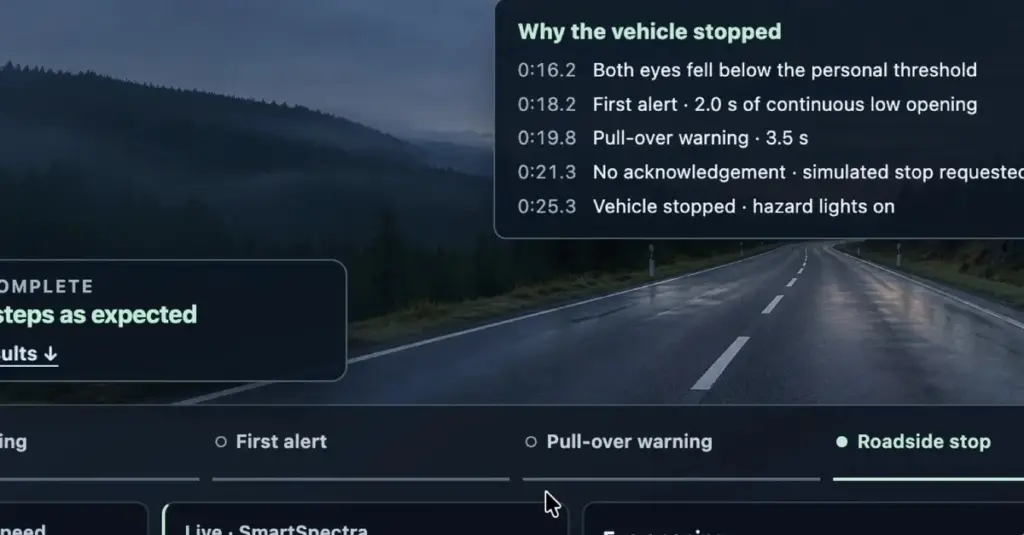
The escalation of alerts within DriveSignal follows a strict, time-based protocol designed to simulate the urgency of a real-world fatigue event. In a recent live cockpit test, the system recorded its first warning at precisely 2.03 seconds of sustained low eye opening. If the condition persists, the system escalates to a more prominent warning at 3.52 seconds, accompanied by a distinct auditory tone and a vibration request for supported devices.
If the driver does not acknowledge the warning or if the eyes remain closed for five seconds, the system initiates a simulated roadside stop. In this phase, the virtual vehicle slows from 50 km/h to 40 km/h, then to 30 km/h, eventually pulling over with the hazard lights activated. This progression illustrates the potential for autonomous safety interventions when a driver is deemed non-responsive.
Testing the Human Element: The 20-Second Live Drive
To validate the system’s accuracy, the developer implemented a "20-second live drive test" that subjects the logic to a variety of human behaviors. During this test, the cockpit windshield displays six distinct prompts: talking normally, looking directly at the camera, squinting, yawning, looking away, and finally, closing the eyes for a sustained period.
The goal of the system is to remain "calm" and maintain cruising speed through the first five prompts. This tests the software’s ability to differentiate between normal driver behavior—such as talking or checking mirrors—and actual drowsiness. For instance, while a yawn might involve significant mouth movement, DriveSignal is designed to treat mouth cues as context rather than a primary trigger for a "pull-over" response.
During internal testing, the developer noted the complexities of mouth geometry. In one instance, a yawn was correctly identified, while in another, the widening of the mouth corners resembled a "wide opening" that the geometry alone could not fully resolve. These findings highlight the experimental nature of mouth-based tracking and the developer’s decision to prioritize eye-tracking as the primary safety metric.
The report generated after these tests provides a comprehensive breakdown of the results. It compares expected outcomes against measured data, including alert counts, tracking interruptions, and the lowest recorded eye opening. By explicitly marking tracking interruptions, the system makes unintended alerts visible during review, allowing for a more honest assessment of the software’s reliability.
Engineering Rigor and Rapid Development
The technical architecture of DriveSignal is as robust as its front-end simulation. Built using Node.js, the application’s decision engine is entirely independent of the browser views and the camera provider. This modularity allows the same logic to process live measurements, synthetic playback, and imported data traces.
The developer’s commitment to quality is evident in the inclusion of a rigorous verification suite. By running a single command, the system type-checks the JavaScript source code, executes unit and workflow tests, and performs property tests. These property tests are particularly significant, as they drive 1,500 seeded random sessions through the decision engine to identify potential edge cases or logic failures.
Perhaps most impressive is the timeline of the project’s creation. The developer discovered the challenge on a Thursday evening and began the building process on Friday morning. By utilizing AI coding agents for rapid prototyping and Claude Code for final quality reviews and improvements, the project reached completion by Sunday. This rapid development cycle underscores the potential for AI-assisted engineering to produce high-quality, specialized tools in a fraction of the traditional time.
Transparency and the "Why" of Automated Decisions
One of the most innovative aspects of DriveSignal is its focus on the driver’s perspective following an automated intervention. When a simulated vehicle comes to a stop, the windshield interface answers the inevitable question: "Why did the vehicle stop?"
The system provides a plain-language explanation, listing each decision and its corresponding timestamp. It details the timeline from the early warning to the first alert, the lack of acknowledgment, and the final decision to pull over. If a driver successfully acknowledges a warning and continues driving, the system similarly explains why the vehicle remained in motion. This level of transparency is a critical component of "Best Thoughtful Real-World Use," one of the prize categories for which the project was submitted.
Privacy and Ethical Considerations
In an era of increasing concerns over biometric privacy, DriveSignal takes a proactive stance on data handling. The project was designed as a solo endeavor, with testing conducted only by the developer and a second consenting adult participant.
Crucially, the system is designed never to show or record actual camera images. The small face view visible in demonstration videos is a separate camera preview added specifically for the recording, ensuring that viewers can understand the context of the movements. Within the application itself, the camera data is processed into metrics and then discarded, adhering to a privacy-first philosophy that is essential for any modern monitoring technology.
Future Horizons for DriveSignal
While DriveSignal remains a desk-based prototype with no current vehicle integration, its development provides a roadmap for future explorations in driver monitoring. The developer has indicated that the next steps would involve further refining the signals the app already handles, without crossing into the territory of medical diagnosis.
The project stands as a testament to the power of modern SDKs like Presage SmartSpectra and the efficiency of AI-augmented development. By focusing on personalized calibration, explainable logic, and rigorous testing, DriveSignal offers a compelling glimpse into a future where vehicles are not just machines, but attentive partners in ensuring road safety. As the automotive industry continues to move toward higher levels of automation, the principles demonstrated in this prototype—transparency, personalization, and safety—will undoubtedly remain at the forefront of the conversation.
 Software Development & Scripting for IT
The Eloquence of Deception: Why Businesses Are Turning to AI-as-Judge to Combat Hallucinations
In the rapidly evolving landscape of generative artificial intelligence, a troubling paradox...
 Software Development & Scripting for IT
The Evolution of Polymorphic Serialization: Why System.Text.Json Offers a Safer Path for Obfuscated .NET Applications
In the landscape of .NET development, maintaining the integrity of serialized data...
 Software Development & Scripting for IT
Hard-Coding Discipline: Why LLM Agent Instructions Must Become Enforced Logic to Control Context and Cost
In the rapidly evolving landscape of autonomous AI agents, a recurring challenge...







