
Perhaps most impressive is the timeline of the project’s creation. The developer discovered the challenge on a Thursday evening and began the building process on Friday morning. By utilizing AI coding agents for rapid prototyping and Claude Code for final quality reviews and improvements, the project reached completion by Sunday. This rapid development cycle underscores the potential for AI-assisted engineering to produce high-quality, specialized tools in a fraction of the traditional time.
Transparency and the "Why" of Automated Decisions
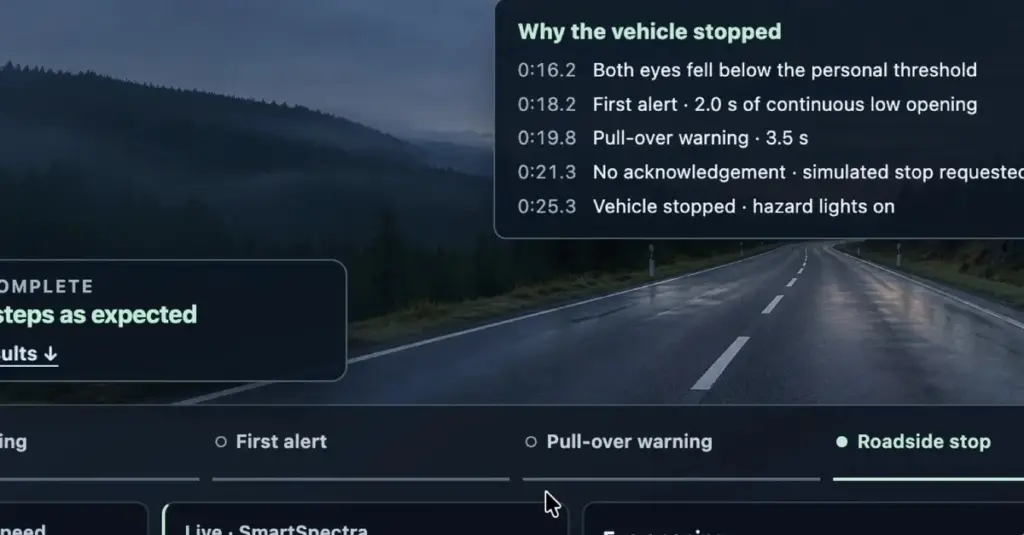
One of the most innovative aspects of DriveSignal is its focus on the driver’s perspective following an automated intervention. When a simulated vehicle comes to a stop, the windshield interface answers the inevitable question: "Why did the vehicle stop?"
The system provides a plain-language explanation, listing each decision and its corresponding timestamp. It details the timeline from the early warning to the first alert, the lack of acknowledgment, and the final decision to pull over. If a driver successfully acknowledges a warning and continues driving, the system similarly explains why the vehicle remained in motion. This level of transparency is a critical component of "Best Thoughtful Real-World Use," one of the prize categories for which the project was submitted.
Privacy and Ethical Considerations
In an era of increasing concerns over biometric privacy, DriveSignal takes a proactive stance on data handling. The project was designed as a solo endeavor, with testing conducted only by the developer and a second consenting adult participant.
Crucially, the system is designed never to show or record actual camera images. The small face view visible in demonstration videos is a separate camera preview added specifically for the recording, ensuring that viewers can understand the context of the movements. Within the application itself, the camera data is processed into metrics and then discarded, adhering to a privacy-first philosophy that is essential for any modern monitoring technology.
Future Horizons for DriveSignal
While DriveSignal remains a desk-based prototype with no current vehicle integration, its development provides a roadmap for future explorations in driver monitoring. The developer has indicated that the next steps would involve further refining the signals the app already handles, without crossing into the territory of medical diagnosis.
The project stands as a testament to the power of modern SDKs like Presage SmartSpectra and the efficiency of AI-augmented development. By focusing on personalized calibration, explainable logic, and rigorous testing, DriveSignal offers a compelling glimpse into a future where vehicles are not just machines, but attentive partners in ensuring road safety. As the automotive industry continues to move toward higher levels of automation, the principles demonstrated in this prototype—transparency, personalization, and safety—will undoubtedly remain at the forefront of the conversation.
 Software Development & Scripting for IT
The End of Software Scarcity: How AI-Driven Reverse Engineering is Turning Proprietary Code into a Common Good
Seven months ago, a provocative thesis sent ripples through the technology and...
 Software Development & Scripting for IT
Chain of Recall: A New Architectural Blueprint for Long-Running AI Agent Memory
As artificial intelligence shifts from simple chat interfaces to "super-agents" capable of...
 Software Development & Scripting for IT
The Hidden Risks of DNS Drift: Why Engineering Teams are Prioritizing Reconciliation Safety over Speed
In the modern landscape of cloud-native logistics and software-as-a-service platforms, the reliability...







