
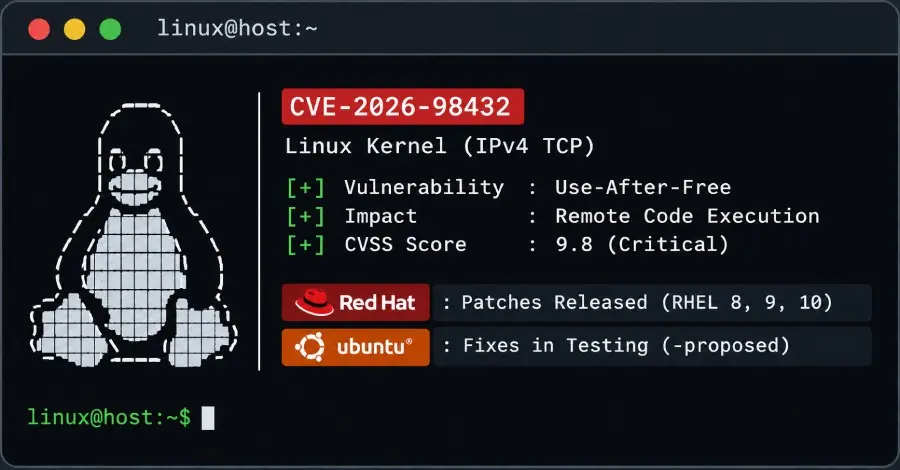
A severe security flaw residing within the Linux kernel’s networking stack has sent ripples through the global IT infrastructure community, prompting a high-stakes race to secure enterprise environments. The vulnerability, tracked as CVE-2026-98432, represents a critical use-after-free condition in the IPv4 TCP implementation, potentially allowing remote, unauthenticated attackers to execute arbitrary code with the highest possible privileges. As of early November 2026, the industry is witnessing a fragmented response as major distributions like Red Hat Enterprise Linux (RHEL) rush out production-ready fixes, while others, including Ubuntu, remain in a rigorous testing phase.
The vulnerability is particularly concerning due to its high reachability and the fundamental nature of the affected component. Because the flaw exists within the core TCP processing logic of the Linux kernel, any system running a vulnerable version that exposes a listening TCP port to the internet or an untrusted network is potentially at risk. This includes everything from web servers and database clusters to cloud instances and embedded industrial controllers.
Understanding the Technical Roots of the Flaw
At the heart of CVE-2026-98432 is a classic but complex race condition that manifests during the initial stages of an IPv4 TCP connection. When a Linux server receives a connection request, the kernel must process the IP options included in the incoming packet. In a standard, secure implementation, these options would be safely copied to a new memory structure associated with the specific socket being created. However, the flaw lies in a logic error where the kernel attempts to pass these IP options from the incoming request to the new socket without performing a proper copy operation.
This lack of data isolation creates a dangerous window of opportunity. If a remote client sends a connection request and then immediately follows it with a retransmission—or if the system is under heavy load—a race condition occurs. While one processor core is still reading the IP options to establish the connection, another part of the kernel may conclude the initial processing and free the memory associated with those options. Consequently, the kernel is left attempting to read from a memory address that has already been released back to the system.
This "use-after-free" scenario is a well-known precursor to memory corruption. An attacker can strategically time their packets to ensure that the freed memory is occupied by their own malicious data before the kernel reads it again. By manipulating the contents of that memory, an attacker can redirect the execution flow of the kernel, leading to remote code execution (RCE). The vulnerability specifically targets the IPv4 path; the Linux kernel’s IPv6 implementation handles these options differently and is not affected by this specific logic flaw.
The vulnerability is not a recent regression but rather a long-standing bug that has been present in the Linux kernel since version 4.4. This longevity means that a vast ecosystem of legacy and modern systems is potentially vulnerable. While the upstream fix was officially merged in October 2026, the transition from a kernel patch to a stable, distributed update varies significantly across the Linux landscape.
Divergent Patching Timelines: Red Hat vs. Ubuntu
The severity of the flaw has led to a re-evaluation of its impact by major vendors. Initially, Red Hat assigned the vulnerability a "Moderate" rating with a CVSS score of 5.9. However, as the potential for remote code execution became clearer, the company upgraded the rating to "Critical" and aligned with the Linux kernel team’s assessment of 9.8 out of 10.
 Cybersecurity Basics & Security News
OpenSSH "SSHole" Vulnerability and the Persistence of Simple Misconfigurations Lead Weekly Cybersecurity Briefing
The cybersecurity landscape in late 2026 continues to demonstrate a paradoxical truth:...
 Cybersecurity Basics & Security News
China-Linked Cyber Espionage Groups Overhaul Toolkits to Target Southeast Asian Government Entities
A series of sophisticated cyber espionage campaigns attributed to Chinese advanced persistent...
 Cybersecurity Basics & Security News
PHP Project Issues Warning Over New Session Vulnerability as PHP2Shell Exploit Attempts Surge Globally
The PHP development team has issued a formal warning regarding a newly...







