
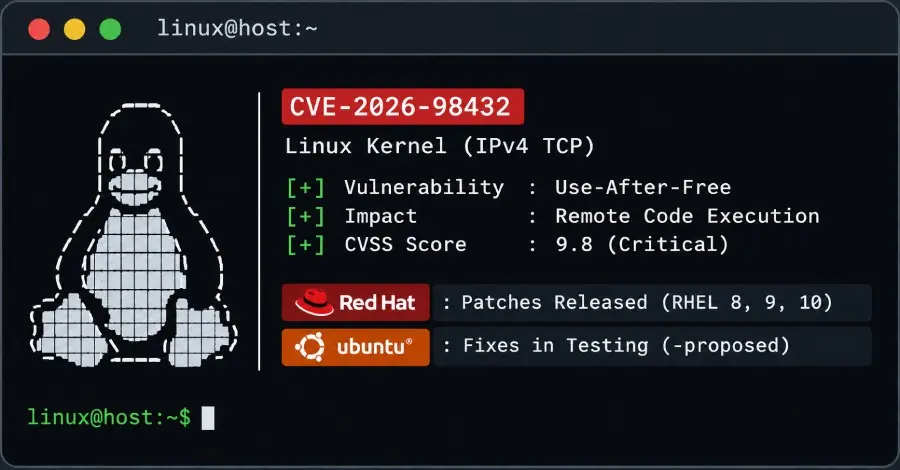
There has also been significant discussion regarding Multipath TCP (MPTCP) as a potential factor in the vulnerability. Some initial reports suggested that disabling MPTCP could serve as a workaround. However, Canonical and other security researchers have clarified that the flaw resides in the fundamental IPv4 TCP path, not within the MPTCP-specific code. While some exploit PoCs might utilize MPTCP listeners to achieve their goals, disabling the feature does not close the underlying hole. The consensus among security teams is that there is no substitute for a proper kernel update.

The Role of AI in Exploit Development
One of the most striking aspects of the CVE-2026-98432 disclosure is the role played by advanced artificial intelligence in demonstrating the flaw’s exploitability. On October 27, Anthropic revealed that an unreleased research version of its Claude AI model was able to independently develop a functional remote root exploit for the vulnerability.
The AI-generated exploit was capable of targeting Linux servers with an MPTCP listener without requiring any prior credentials or user interaction. According to Anthropic’s findings, the model was able to leak a kernel memory address—a critical step in bypassing modern security protections like Address Space Layout Randomization (ASLR)—in approximately 48 minutes. Once the memory address was obtained, the AI achieved a root shell in just five additional minutes.
While Anthropic has not made the exploit code public, the revelation that an AI could synthesize a complex RCE exploit for a kernel-level race condition has intensified the urgency for patching. It suggests that the window between the disclosure of a vulnerability and the availability of sophisticated exploitation tools is shrinking, driven by the capabilities of large language models.
Global Patching Status and Outlook
Beyond Red Hat and Ubuntu, the broader Linux ecosystem has been moving to address the threat. Amazon Linux, which rated the flaw as "Important" with a CVSS of 8.1, completed its patching cycle across all affected packages between October 24 and October 30. Amazon’s assessment suggested that while the most likely outcome of the flaw is a system crash or memory corruption, the potential for exploitation could not be ignored. Other major players, including Debian, Oracle Linux, and SUSE, also successfully shipped their respective fixes in late October.
As of early November, there have been no confirmed reports of CVE-2026-98432 being exploited in the wild. The vulnerability was not present in the Cybersecurity and Infrastructure Security Agency’s (CISA) Known Exploited Vulnerabilities catalog as of its most recent update. However, proof-of-concept code has begun to surface on platforms like GitHub. While these public PoCs currently focus on triggering the race condition and observing memory leaks rather than achieving full code execution, they provide a blueprint for more malicious actors to follow.
For system administrators, the directive is clear: verify kernel versions against vendor-specific errata and prioritize reboots for all affected machines. In environments where immediate patching is impossible, the nftables mitigation offers a temporary, albeit imperfect, shield. As the industry grapples with the dual challenges of long-standing architectural flaws and AI-accelerated exploit development, CVE-2026-98432 serves as a stark reminder of the continuous maintenance required to secure the world’s most widely used operating system kernel.
 Cybersecurity Basics & Security News
MALFEX Campaign Escalates: New Malicious ‘imgdecode’ Package Discovered Targeting Windows Systems via npm Registry
The landscape of software supply chain security has faced a persistent and...
 Cybersecurity Basics & Security News
Unmasking Lunex: The Rapid Expansion of a Sophisticated Malware-as-a-Service Platform Targeting Ukraine
The cybersecurity landscape is witnessing the emergence of a highly sophisticated Malware-as-a-Service...
 Cybersecurity Basics & Security News
Chinese Espionage Group Armory Castle Exploits Critical VMware vCenter Zero-Day in Sophisticated Data Theft Campaign
Cybersecurity researchers have uncovered a high-stakes espionage operation led by a suspected...







