
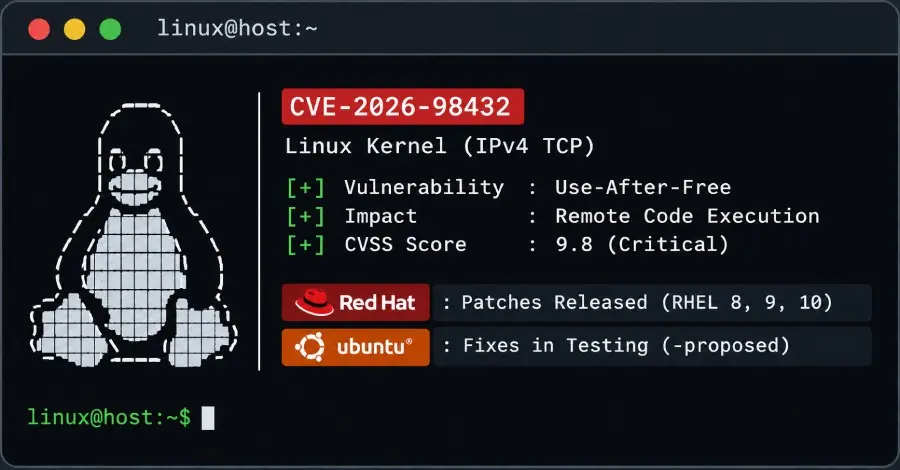

Red Hat has been among the most proactive in delivering stable updates. On November 1, the company released fixed kernels for its primary enterprise offerings. For Red Hat Enterprise Linux 8.10, the fix is contained in kernel version 4.18.0-553.182.1.el8_10, tracked under the errata RHSA-2026:93414. Users of RHEL 9.8 should move to kernel version 5.14.0-687.64.1.el9_8 (RHSA-2026:93412), while those on the cutting-edge RHEL 10.2 must update to version 6.12.0-211.72.1.el10_2 (RHSA-2026:93413). Administrators are reminded that these updates are not effective until the system has been fully rebooted to load the new kernel image.
In contrast, Canonical, the publisher of Ubuntu, is taking a more cautious approach. As of November 2, fixes for the three most recent Long-Term Support (LTS) releases—Ubuntu 22.04 LTS (Jammy Jellyfish), 24.04 LTS (Noble Numbat), and 26.04 LTS (Resolute)—are currently confined to the "-proposed" repository. This is an opt-in testing channel used by Canonical to validate updates before they are pushed to the general population.
Canonical’s hesitation to move the patches to the main update channel stems from its extensive quality assurance process. The company tests its kernel updates across a fleet of more than 2,000 certified servers and diverse hardware devices to ensure that a security fix does not introduce system instability or performance regressions. For Ubuntu 22.04 LTS, the proposed kernel is version 5.15.0-203.213. For 24.04 LTS, it is 6.8.0-149.149, and for the latest 26.04 LTS, it is 7.0.0-43.43.
For administrators who cannot afford to wait for the general release, Canonical has provided a method to manually pull these kernels from the testing pocket. This involves adding the proposed component to the system’s repository list and performing a targeted upgrade. The process requires running a series of commands to add the repository, identify the correct linux-meta packages, and install the updates. Specifically, administrators can use the add-apt-repository command to enable the proposed pocket, followed by a piped apt install command that targets the specific version codename of their distribution.
While the newest versions of Ubuntu have a path toward remediation, older releases such as Ubuntu 20.04, 18.04, and 16.04 are currently in a state of flux. Fixes for these versions are listed as pending, and many will require an active Ubuntu Pro subscription to receive the updates through Expanded Security Maintenance (ESM).
Interim Mitigations and the MPTCP Misconception
In the absence of an immediate kernel update, some organizations have turned to network-level mitigations. On October 30, Red Hat published a recommended rule for nftables, the modern Linux kernel packet filtering framework. This rule is designed to identify and drop inbound IPv4 TCP packets that carry IP options, which are the primary vehicle for triggering the race condition.
The suggested nftables configuration creates a filter hook that inspects the IP header length. Since a standard IPv4 header without options is 20 bytes (or 5 words), any header with a length greater than 5 indicates the presence of options. By dropping these packets, the rule effectively blocks the known exploit vector. However, Red Hat has been careful to note that this is not a comprehensive fix. The rule only protects the host where it is active; traffic moving between containers on the same host can often bypass these filters. Furthermore, dropping IP options can break certain specialized network workloads or legacy protocols that rely on those headers for routing or diagnostic purposes.
 Cybersecurity Basics & Security News
NGINX Issues Critical Security Updates to Address Five Vulnerabilities, Including a Two-Decade-Old Memory Bug
NGINX, the high-performance web server and reverse proxy that powers a vast...
 Cybersecurity Basics & Security News
Chinese Espionage Group Armory Castle Exploits Critical VMware vCenter Zero-Day in Sophisticated Data Theft Campaign
Cybersecurity researchers have uncovered a high-stakes espionage operation led by a suspected...
 Cybersecurity Basics & Security News
Unmasking Lunex: The Rapid Expansion of a Sophisticated Malware-as-a-Service Platform Targeting Ukraine
The cybersecurity landscape is witnessing the emergence of a highly sophisticated Malware-as-a-Service...







