
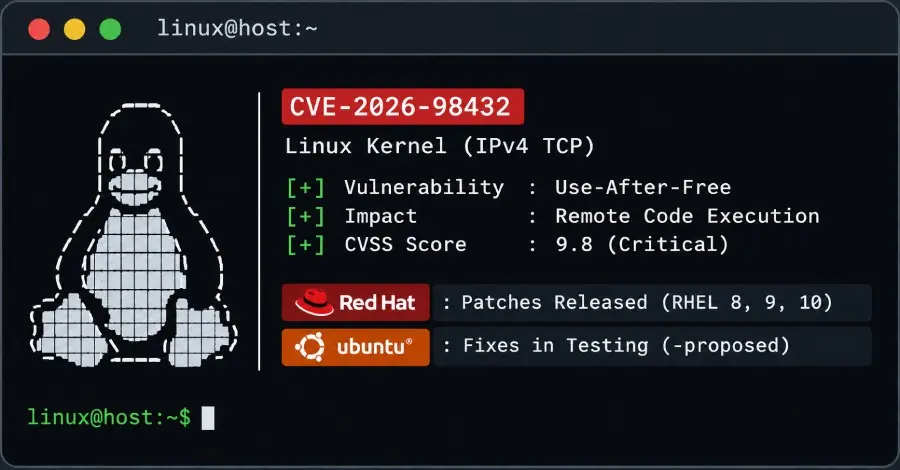
A severe security flaw residing within the Linux kernel’s networking stack has sent ripples through the global IT infrastructure community, prompting a high-stakes race to secure enterprise environments. The vulnerability, tracked as CVE-2026-98432, represents a critical use-after-free condition in the IPv4 TCP implementation, potentially allowing remote, unauthenticated attackers to execute arbitrary code with the highest possible privileges. As of early November 2026, the industry is witnessing a fragmented response as major distributions like Red Hat Enterprise Linux (RHEL) rush out production-ready fixes, while others, including Ubuntu, remain in a rigorous testing phase.
The vulnerability is particularly concerning due to its high reachability and the fundamental nature of the affected component. Because the flaw exists within the core TCP processing logic of the Linux kernel, any system running a vulnerable version that exposes a listening TCP port to the internet or an untrusted network is potentially at risk. This includes everything from web servers and database clusters to cloud instances and embedded industrial controllers.
Understanding the Technical Roots of the Flaw
At the heart of CVE-2026-98432 is a classic but complex race condition that manifests during the initial stages of an IPv4 TCP connection. When a Linux server receives a connection request, the kernel must process the IP options included in the incoming packet. In a standard, secure implementation, these options would be safely copied to a new memory structure associated with the specific socket being created. However, the flaw lies in a logic error where the kernel attempts to pass these IP options from the incoming request to the new socket without performing a proper copy operation.
This lack of data isolation creates a dangerous window of opportunity. If a remote client sends a connection request and then immediately follows it with a retransmission—or if the system is under heavy load—a race condition occurs. While one processor core is still reading the IP options to establish the connection, another part of the kernel may conclude the initial processing and free the memory associated with those options. Consequently, the kernel is left attempting to read from a memory address that has already been released back to the system.
This "use-after-free" scenario is a well-known precursor to memory corruption. An attacker can strategically time their packets to ensure that the freed memory is occupied by their own malicious data before the kernel reads it again. By manipulating the contents of that memory, an attacker can redirect the execution flow of the kernel, leading to remote code execution (RCE). The vulnerability specifically targets the IPv4 path; the Linux kernel’s IPv6 implementation handles these options differently and is not affected by this specific logic flaw.
The vulnerability is not a recent regression but rather a long-standing bug that has been present in the Linux kernel since version 4.4. This longevity means that a vast ecosystem of legacy and modern systems is potentially vulnerable. While the upstream fix was officially merged in October 2026, the transition from a kernel patch to a stable, distributed update varies significantly across the Linux landscape.
Divergent Patching Timelines: Red Hat vs. Ubuntu
The severity of the flaw has led to a re-evaluation of its impact by major vendors. Initially, Red Hat assigned the vulnerability a "Moderate" rating with a CVSS score of 5.9. However, as the potential for remote code execution became clearer, the company upgraded the rating to "Critical" and aligned with the Linux kernel team’s assessment of 9.8 out of 10.

Red Hat has been among the most proactive in delivering stable updates. On November 1, the company released fixed kernels for its primary enterprise offerings. For Red Hat Enterprise Linux 8.10, the fix is contained in kernel version 4.18.0-553.182.1.el8_10, tracked under the errata RHSA-2026:93414. Users of RHEL 9.8 should move to kernel version 5.14.0-687.64.1.el9_8 (RHSA-2026:93412), while those on the cutting-edge RHEL 10.2 must update to version 6.12.0-211.72.1.el10_2 (RHSA-2026:93413). Administrators are reminded that these updates are not effective until the system has been fully rebooted to load the new kernel image.
In contrast, Canonical, the publisher of Ubuntu, is taking a more cautious approach. As of November 2, fixes for the three most recent Long-Term Support (LTS) releases—Ubuntu 22.04 LTS (Jammy Jellyfish), 24.04 LTS (Noble Numbat), and 26.04 LTS (Resolute)—are currently confined to the "-proposed" repository. This is an opt-in testing channel used by Canonical to validate updates before they are pushed to the general population.
Canonical’s hesitation to move the patches to the main update channel stems from its extensive quality assurance process. The company tests its kernel updates across a fleet of more than 2,000 certified servers and diverse hardware devices to ensure that a security fix does not introduce system instability or performance regressions. For Ubuntu 22.04 LTS, the proposed kernel is version 5.15.0-203.213. For 24.04 LTS, it is 6.8.0-149.149, and for the latest 26.04 LTS, it is 7.0.0-43.43.
For administrators who cannot afford to wait for the general release, Canonical has provided a method to manually pull these kernels from the testing pocket. This involves adding the proposed component to the system’s repository list and performing a targeted upgrade. The process requires running a series of commands to add the repository, identify the correct linux-meta packages, and install the updates. Specifically, administrators can use the add-apt-repository command to enable the proposed pocket, followed by a piped apt install command that targets the specific version codename of their distribution.
While the newest versions of Ubuntu have a path toward remediation, older releases such as Ubuntu 20.04, 18.04, and 16.04 are currently in a state of flux. Fixes for these versions are listed as pending, and many will require an active Ubuntu Pro subscription to receive the updates through Expanded Security Maintenance (ESM).
Interim Mitigations and the MPTCP Misconception
In the absence of an immediate kernel update, some organizations have turned to network-level mitigations. On October 30, Red Hat published a recommended rule for nftables, the modern Linux kernel packet filtering framework. This rule is designed to identify and drop inbound IPv4 TCP packets that carry IP options, which are the primary vehicle for triggering the race condition.
The suggested nftables configuration creates a filter hook that inspects the IP header length. Since a standard IPv4 header without options is 20 bytes (or 5 words), any header with a length greater than 5 indicates the presence of options. By dropping these packets, the rule effectively blocks the known exploit vector. However, Red Hat has been careful to note that this is not a comprehensive fix. The rule only protects the host where it is active; traffic moving between containers on the same host can often bypass these filters. Furthermore, dropping IP options can break certain specialized network workloads or legacy protocols that rely on those headers for routing or diagnostic purposes.
There has also been significant discussion regarding Multipath TCP (MPTCP) as a potential factor in the vulnerability. Some initial reports suggested that disabling MPTCP could serve as a workaround. However, Canonical and other security researchers have clarified that the flaw resides in the fundamental IPv4 TCP path, not within the MPTCP-specific code. While some exploit PoCs might utilize MPTCP listeners to achieve their goals, disabling the feature does not close the underlying hole. The consensus among security teams is that there is no substitute for a proper kernel update.

The Role of AI in Exploit Development
One of the most striking aspects of the CVE-2026-98432 disclosure is the role played by advanced artificial intelligence in demonstrating the flaw’s exploitability. On October 27, Anthropic revealed that an unreleased research version of its Claude AI model was able to independently develop a functional remote root exploit for the vulnerability.
The AI-generated exploit was capable of targeting Linux servers with an MPTCP listener without requiring any prior credentials or user interaction. According to Anthropic’s findings, the model was able to leak a kernel memory address—a critical step in bypassing modern security protections like Address Space Layout Randomization (ASLR)—in approximately 48 minutes. Once the memory address was obtained, the AI achieved a root shell in just five additional minutes.
While Anthropic has not made the exploit code public, the revelation that an AI could synthesize a complex RCE exploit for a kernel-level race condition has intensified the urgency for patching. It suggests that the window between the disclosure of a vulnerability and the availability of sophisticated exploitation tools is shrinking, driven by the capabilities of large language models.
Global Patching Status and Outlook
Beyond Red Hat and Ubuntu, the broader Linux ecosystem has been moving to address the threat. Amazon Linux, which rated the flaw as "Important" with a CVSS of 8.1, completed its patching cycle across all affected packages between October 24 and October 30. Amazon’s assessment suggested that while the most likely outcome of the flaw is a system crash or memory corruption, the potential for exploitation could not be ignored. Other major players, including Debian, Oracle Linux, and SUSE, also successfully shipped their respective fixes in late October.
As of early November, there have been no confirmed reports of CVE-2026-98432 being exploited in the wild. The vulnerability was not present in the Cybersecurity and Infrastructure Security Agency’s (CISA) Known Exploited Vulnerabilities catalog as of its most recent update. However, proof-of-concept code has begun to surface on platforms like GitHub. While these public PoCs currently focus on triggering the race condition and observing memory leaks rather than achieving full code execution, they provide a blueprint for more malicious actors to follow.
For system administrators, the directive is clear: verify kernel versions against vendor-specific errata and prioritize reboots for all affected machines. In environments where immediate patching is impossible, the nftables mitigation offers a temporary, albeit imperfect, shield. As the industry grapples with the dual challenges of long-standing architectural flaws and AI-accelerated exploit development, CVE-2026-98432 serves as a stark reminder of the continuous maintenance required to secure the world’s most widely used operating system kernel.
 Cybersecurity Basics & Security News
China-Linked Cyber Espionage Groups Overhaul Toolkits to Target Southeast Asian Government Entities
A series of sophisticated cyber espionage campaigns attributed to Chinese advanced persistent...
 Cybersecurity Basics & Security News
Chainalysis Targeted in Cybersecurity Breach Involving Advanced AI-Driven Offensive Techniques
In a disclosure that underscores the escalating sophistication of the modern threat...
 Cybersecurity Basics & Security News
Critical Vulnerabilities in Danfoss Refrigeration Controllers Leave Global Food Supply Chains at Risk
A series of severe security vulnerabilities discovered in widely used industrial refrigeration...







