
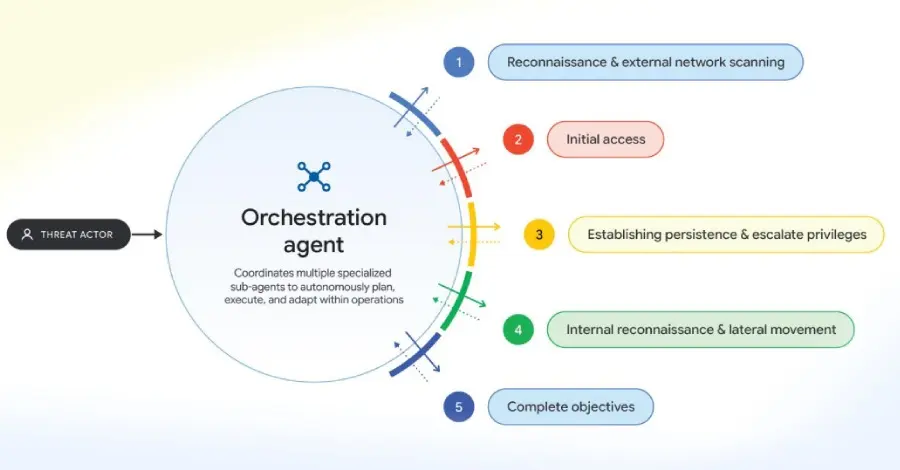
In a comprehensive assessment that underscores a fundamental transformation in the digital threat landscape, Google’s Threat Intelligence Group (GTIG) has revealed that the adversarial use of artificial intelligence has transitioned into a sophisticated new era. Moving beyond the relatively simple phase of manual prompting and individual chatbot interactions, sophisticated threat actors are now deploying autonomous, multi-agent offensive frameworks designed to execute complex, multi-stage cyberattacks with unprecedented speed and scale. This shift represents the crossing of a significant threshold in cybersecurity, where the barrier between human-led operations and machine-driven intrusion is rapidly dissolving.
According to the report shared by Google, the emergence of these "agentic" frameworks marks a departure from the "AI-assisted" methods of the recent past. Previously, attackers might use large language models (LLMs) to help draft a phishing email or debug a specific piece of malicious code. Today, however, researchers are observing the active use of integrated ecosystems such as ARTEX, CAIRN, CyberStrikeAI, and PentAGI. These are not merely tools but are described as autonomous offensive frameworks capable of chaining together varied attack paths. They function by deploying multiple AI agents that can coordinate with one another to perform discrete tasks, such as reconnaissance, vulnerability identification, and lateral movement, all without constant human intervention.
The operational velocity afforded by these systems is perhaps the most concerning development for modern defenders. By leveraging agentic AI, threat actors can conduct intrusions at "machine speed," a term Google uses to describe the ability of these systems to process information and execute commands at a rate that far outpaces human reaction times. This allows for the scaling of operations to a degree previously unimaginable, enabling a single threat actor or a small group to manage a vast array of concurrent, complex intrusions. Even when the underlying mechanics of an attack remain traditional, the automation of the decision-making process allows these campaigns to be executed with a level of efficiency that traditional security perimeters were not designed to withstand.
One of the most potent applications of this technology identified by Google involves the automation of reverse engineering. Traditionally, when a software vendor releases a security patch, there is a race between defenders who must apply the update and attackers who seek to understand the underlying vulnerability. This process, known as differential analysis, involves comparing the patched version of the software with the previous, vulnerable version to pinpoint the exact changes made. While this was once a labor-intensive task requiring highly skilled human researchers, threat actors are now utilizing LLMs and agentic frameworks to automate this analysis.
The report highlights the exploitation of PaperCut NG/MF flaws in September as a prime example of this trend. By feeding patch data into AI-driven pipelines, attackers were able to rapidly weaponize newly disclosed vulnerabilities, collapsing the window of time between a patch’s release and the deployment of a functional exploit. This capability allows threat actors to focus their research on a finite set of source materials, such as release notes, security research, and pre-release source code versions, using AI to distill these inputs into actionable code. The result is a dramatic reduction in the "n-day" exploitation cycle, leaving organizations with less time than ever to secure their infrastructure.
 Cybersecurity Basics & Security News
Critical Check Point Flaw Grants Unauthenticated Root Access to Management Servers
A severe security vulnerability has been identified within Check Point’s Security Management...
 Cybersecurity Basics & Security News
AI vs. AI: How Researchers Used Claude Opus 5 to Breach OpenAI’s Internal Systems
In a sophisticated demonstration of the "double-edged sword" nature of generative artificial...
 Cybersecurity Basics & Security News
OpenAI Dismisses Safety Researchers Following Leak of Confidential Infrastructure Data Amid Growing Security Concerns
OpenAI has terminated the employment of three prominent members of its safety...







