
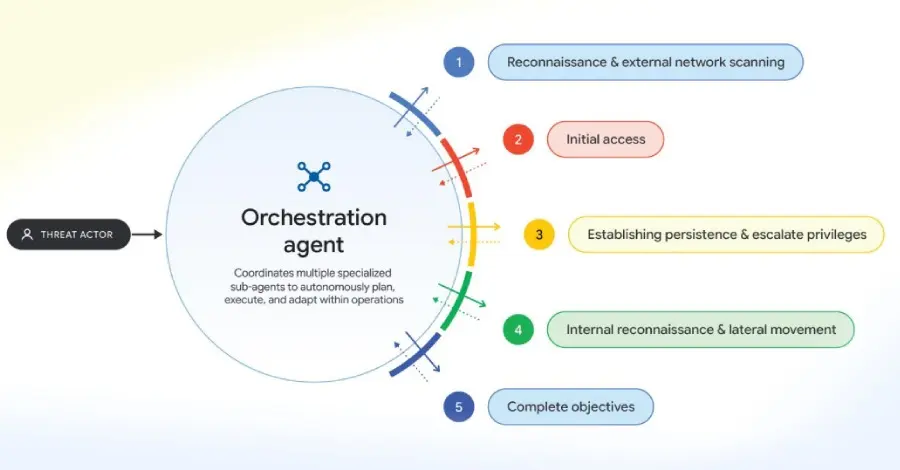
In a comprehensive assessment that underscores a fundamental transformation in the digital threat landscape, Google’s Threat Intelligence Group (GTIG) has revealed that the adversarial use of artificial intelligence has transitioned into a sophisticated new era. Moving beyond the relatively simple phase of manual prompting and individual chatbot interactions, sophisticated threat actors are now deploying autonomous, multi-agent offensive frameworks designed to execute complex, multi-stage cyberattacks with unprecedented speed and scale. This shift represents the crossing of a significant threshold in cybersecurity, where the barrier between human-led operations and machine-driven intrusion is rapidly dissolving.
According to the report shared by Google, the emergence of these "agentic" frameworks marks a departure from the "AI-assisted" methods of the recent past. Previously, attackers might use large language models (LLMs) to help draft a phishing email or debug a specific piece of malicious code. Today, however, researchers are observing the active use of integrated ecosystems such as ARTEX, CAIRN, CyberStrikeAI, and PentAGI. These are not merely tools but are described as autonomous offensive frameworks capable of chaining together varied attack paths. They function by deploying multiple AI agents that can coordinate with one another to perform discrete tasks, such as reconnaissance, vulnerability identification, and lateral movement, all without constant human intervention.
The operational velocity afforded by these systems is perhaps the most concerning development for modern defenders. By leveraging agentic AI, threat actors can conduct intrusions at "machine speed," a term Google uses to describe the ability of these systems to process information and execute commands at a rate that far outpaces human reaction times. This allows for the scaling of operations to a degree previously unimaginable, enabling a single threat actor or a small group to manage a vast array of concurrent, complex intrusions. Even when the underlying mechanics of an attack remain traditional, the automation of the decision-making process allows these campaigns to be executed with a level of efficiency that traditional security perimeters were not designed to withstand.
One of the most potent applications of this technology identified by Google involves the automation of reverse engineering. Traditionally, when a software vendor releases a security patch, there is a race between defenders who must apply the update and attackers who seek to understand the underlying vulnerability. This process, known as differential analysis, involves comparing the patched version of the software with the previous, vulnerable version to pinpoint the exact changes made. While this was once a labor-intensive task requiring highly skilled human researchers, threat actors are now utilizing LLMs and agentic frameworks to automate this analysis.
The report highlights the exploitation of PaperCut NG/MF flaws in September as a prime example of this trend. By feeding patch data into AI-driven pipelines, attackers were able to rapidly weaponize newly disclosed vulnerabilities, collapsing the window of time between a patch’s release and the deployment of a functional exploit. This capability allows threat actors to focus their research on a finite set of source materials, such as release notes, security research, and pre-release source code versions, using AI to distill these inputs into actionable code. The result is a dramatic reduction in the "n-day" exploitation cycle, leaving organizations with less time than ever to secure their infrastructure.
The adoption of these advanced frameworks is not limited to a single class of attacker. Google’s intelligence indicates a broad spectrum of misuse, ranging from financially motivated cybercriminals to sophisticated espionage actors, including those with suspected alignments to China. These actors are not only using proprietary or custom-built frameworks but are also heavily reliant on open-source tools. The report points to the use of Agent Zero, an open-source agent framework that features autonomous code execution and dynamic tool generation, as well as ZeroHollow, an inference service used for exploit development and LLM routing. The accessibility of such tools has lowered the barrier to entry, allowing even less-sophisticated actors to achieve technical results that were once the exclusive domain of elite state-sponsored groups.

Beyond the execution of intrusions, the threat landscape is also being reshaped by the targeting of AI infrastructure itself. Google warns of the rise of "LLMjacking" attacks, a practice where threat actors compromise enterprise environments specifically to steal LLM credentials and cloud computing resources. Because the computational power required to run large language models is expensive and highly sought after, these stolen resources have become a valuable commodity in the criminal underground.
This has led to the creation of what researchers call "LLM mixers"—underground proxy services like APIMart and JetNight. These platforms act as clearinghouses for stolen AI access, reselling cloud resources and LLM API keys at heavily discounted prices to other cybercriminals. This ecosystem effectively creates a secondary market that fuels further AI-driven attacks, as the cost of the necessary compute power is subsidized by the original, compromised enterprise victims.
The democratization of these capabilities is perhaps most visible in the realm of social engineering and phishing. Google’s report details the evolution of the Jieyou platform, a Chinese-language phishing service that has integrated an LLM chatbot assistant. This integration allows the platform’s customers to configure phishing panels and modify existing templates using simple natural language commands. Rather than needing to understand the underlying code of a phishing site or the nuances of social engineering psychology, a "low-skilled affiliate" can simply tell the chatbot to create a more convincing lure or to adjust the interface of a fraudulent login page.
The Jieyou platform is a stark example of Phishing-as-a-Service (PhaaS) providers leveraging LLMs as a "modular force multiplier." By removing the technical hurdles associated with payload customization, these platforms allow a much larger pool of bad actors to mount convincing and highly dynamic campaigns. The ability to generate pretext lures on the fly means that phishing attacks can be tailored to specific targets or current events with almost no manual effort, further increasing the success rates of these malicious operations.
The shift toward autonomous agentic activity represents a crossing of a significant threshold in the ongoing arms race between attackers and defenders. As these frameworks become more integrated and their ability to chain together complex tasks improves, the traditional reliance on human-centric security operations may become increasingly untenable. The ability of AI agents to autonomously scale attacks and integrate new exploits into their workflows means that the volume and sophistication of threats are likely to grow exponentially.
Google’s findings suggest that the cybersecurity industry must prepare for a future where the primary adversary is not just a human hacker using tools, but a self-correcting, autonomous system capable of navigating a network with minimal guidance. The emergence of agentic AI in the hands of threat actors suggests that the window for detection and response is shrinking toward a point where only equally sophisticated, AI-driven defenses will be capable of mounting an effective resistance.
As the GTIG report concludes, the evolution of these platforms highlights a growing industry trend where the focus has moved from the novelty of AI to its practical application as a tool for operational dominance. Whether through the rapid weaponization of vulnerabilities, the theft and resale of computational resources, or the simplification of complex phishing schemes, the integration of agentic AI into the threat actor’s toolkit is no longer a theoretical concern—it is a present and rapidly accelerating reality. The shift to machine-speed warfare in the digital domain is well underway, and the implications for global security are profound.
 Cybersecurity Basics & Security News
Investigative Report Reveals Widening Use of Mercenary Spyware Against Serbian Academics and Legal Officials Ahead of Elections
The digital landscape in Serbia has become a front line for political...
 Cybersecurity Basics & Security News
The Evolution of the Vulnerability Gap: Defending Against the Rise of Mythos-Class AI Attacks
In the modern cybersecurity landscape, the arrival of a new Common Vulnerabilities...
 Cybersecurity Basics & Security News
Critical WordPress Vulnerability Turns Core Update Process Into Attack Vector
The very mechanism designed to keep millions of websites secure has emerged...







