
In the rapidly evolving landscape of corporate technology, the conversation among C-suite executives has shifted from the novelty of generative AI to the practicalities of industrial-scale implementation. As businesses move past the initial excitement of large language models, a new set of challenges has emerged: How does a company transform from a collection of experimental pilots into a "Frontier Firm"—an organization where AI is not just a tool, but a self-reinforcing system of continuous learning?
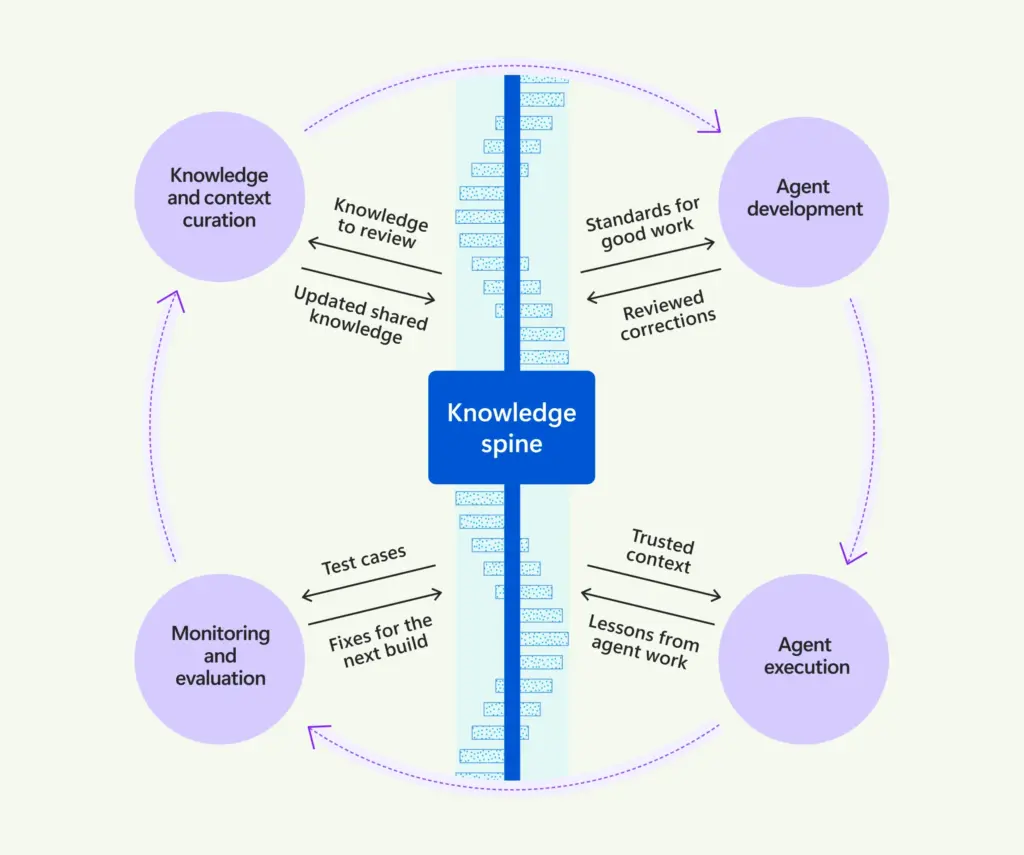
New research launched by Microsoft in collaboration with the global technology and advisory firm Keystone offers a data-driven look into this transformation. The study, which culminated in a Harvard Business School working paper titled “Organizing AI at Enterprise Scale: Agentic Operating Models and Firm Outcomes,” suggests that the most successful organizations are moving away from isolated AI applications. Instead, they are building what researchers call a "knowledge spine"—a centralized, shared infrastructure that allows AI agents to learn from one another and the business at large.
The findings come at a critical time. While thousands of companies have deployed basic AI chat functions, the research indicates that only a tiny fraction—roughly 3%—have successfully implemented the full architectural building blocks required for a truly agentic operating model. However, those who have made significant strides in this direction are already seeing measurable financial advantages.
The Rise of the Knowledge Spine
At the heart of the research is the concept of the "knowledge spine." In the early days of the AI boom, many firms deployed agents in silos—one for customer service, another for supply chain logistics, and perhaps a third for internal HR queries. While these agents may perform their specific tasks well, they often operate in isolation, meaning a lesson learned by one agent is lost to the rest of the organization.
The study defines the knowledge spine as a shared system that stores and updates the context these agents rely on. More importantly, it acts as a repository for the corrections, tests, and operational lessons derived from the agents’ daily work. When a human corrects an agent’s mistake, that "fix" is fed back into the spine, ensuring that every other agent in the system benefits from that single interaction.
This approach turns a company’s operational history into a proprietary asset. While the underlying AI models may be developed by third parties, the "knowledge spine" is built from the unique context of the company itself. Researchers found that companies implementing these practices saw significantly higher gains in operating margins and return on assets between 2022 and 2025. Specifically, companies in the top quartile of the study’s maturity scale improved their operating margins by over 5 percentage points more than those in the bottom quartile.
A Framework for Enterprise Transformation
To help leaders navigate this transition, the research team—which included scholars from Harvard and experts from Keystone—developed a four-stage maturity framework for AI transformation. This framework was built after an extensive period of investigation, including interviews with leaders at 29 organizations with advanced AI deployments and a detailed survey of more than 200 enterprises across sectors such as healthcare, finance, and manufacturing.

The first stage is characterized by a patchwork of AI pilot projects. In these organizations, AI efforts are often uncoordinated and limited to basic chat functions. Because these tools are not integrated into real business workflows, they show minimal impact on the bottom line.
Stage two represents a step forward, where companies begin using agents to tackle specific business problems. However, these firms still lack a centralized system for management. Instead, they rely on human-heavy processes—committees and teams—to prioritize investments and check the agents’ work. This "human orchestration" model is difficult to scale, as the cost of oversight often eats into the efficiency gains provided by the AI.
Stage three is identified by researchers as the crucial turning point. At this level, companies begin to use systems, rather than people, to coordinate their agents. This might involve sharing a common knowledge base or implementing automated monitoring. While this often begins within a single department or a specific set of workflows, it marks the beginning of a shift toward a more autonomous operating model.
The final stage, stage four, is where the "knowledge spine" fully matures. In these organizations, orchestration, governance, and a shared context layer are all in place. Lessons from agent activities are automatically fed back into the system, creating a single, agentic operating model where the system itself takes on the burden of coordination and learning.
The Economic Reality of the J-Curve
While the financial rewards for AI maturity are clear, the research also highlights a phenomenon that economists call the "J-curve." This theory suggests that when a major new technology is introduced, the payoff often dips or lags initially as companies undergo the painful and expensive process of reorganizing their work around the new tool.
For many companies in the bottom half of the study’s rankings, operating margins remained stagnant despite AI investments. The researchers suggest this lag occurs when companies deploy agents faster than they build the infrastructure to manage them. Without a knowledge spine, the cost of human review and the inefficiency of uncoordinated agents can offset any initial productivity gains.
To manage this, the study found that leading firms are becoming more disciplined about AI spending. While many start by giving employees broad access to tools, the most advanced firms are beginning to tie "token" or compute budgets to specific results. By understanding what each "good outcome" costs, these companies can move from a model of experimentation to one of rigorous operational efficiency.
Building the Infrastructure for Autonomy
For organizations looking to emulate the 3% of "Frontier Firms" identified in the study, the research outlines four foundational practices.

First, companies must collect context from diverse sources—including internal documentation, systems of record, and chat applications—and store it in a central, accessible location. This ensures that agents are always working from the most current and accurate information.
Second, firms are encouraged to treat every correction as valuable data. If a human has to fix an agent’s output, that failure should be turned into a test case for the next version of the system. This leads to the creation of what researchers call a "golden dataset"—a consistent benchmark used to ensure that AI agents meet the company’s specific standards before they are deployed.
Third, the information stored in the knowledge spine must be used to actively shape agent actions. The goal is not just to correct a single answer, but to change the logic of how the agent handles that specific category of work in the future.
Finally, the study emphasizes the need for accountability. A knowledge spine requires an owner—someone responsible for determining which data sources are trustworthy, resolving conflicts between different pieces of information, and purging outdated data from the system.
Underpinning all these practices is the principle of observability. The highest-scoring companies in the study maintain searchable, detailed records of every action an agent takes. This allows them to identify exactly why a mistake happened and how to prevent it. In these advanced firms, agents "earn" their autonomy based on evidence; as the system proves its reliability through telemetry and testing, the company can choose to widen the scope of what the agent is allowed to do independently.
The Path Forward: From Capabilities to Systems
The transition from isolated AI capabilities to a coordinated AI infrastructure represents a fundamental shift in how modern enterprises operate. As the research suggests, the underlying models will continue to change as technology advances, but the proprietary lessons a company’s agents learn from their own unique workflows will remain a permanent advantage.
Building a firm-wide knowledge spine is a daunting task, and the study’s authors note that few companies will achieve it overnight. However, the research offers a practical roadmap: start small. By building a knowledge spine for a single team or a handful of connected workflows, organizations can prove the value of the system before scaling it across the entire enterprise.
As Microsoft and Keystone continue to track these "Frontier Firms," the evidence suggests that the winners of the AI era will not be those who simply deploy the most models, but those who build the best systems to coordinate, check, and learn from them. The shift from "isolated intelligence" to "coordinated intelligence" is no longer a theoretical concept—it is the emerging standard for enterprise excellence in the age of agents.
 Productivity Software & Office Suites
Microsoft Reimagines Copilot as a Comprehensive AI System for Enterprise Automation and Custom Development
In a significant shift that signals the next phase of the generative...
 Productivity Software & Office Suites
Microsoft Outlines Strategic Roadmap for Enterprise AI: Navigating the Shift from Hype to Economic Value
In a comprehensive memo addressed to the global business community, Jared Spataro,...
 Productivity Software & Office Suites
Microsoft Reimagines the Future of Productivity with a New Generation of Copilot and Autonomous Agents
Microsoft has announced a significant evolution of its artificial intelligence strategy, unveiling...







