
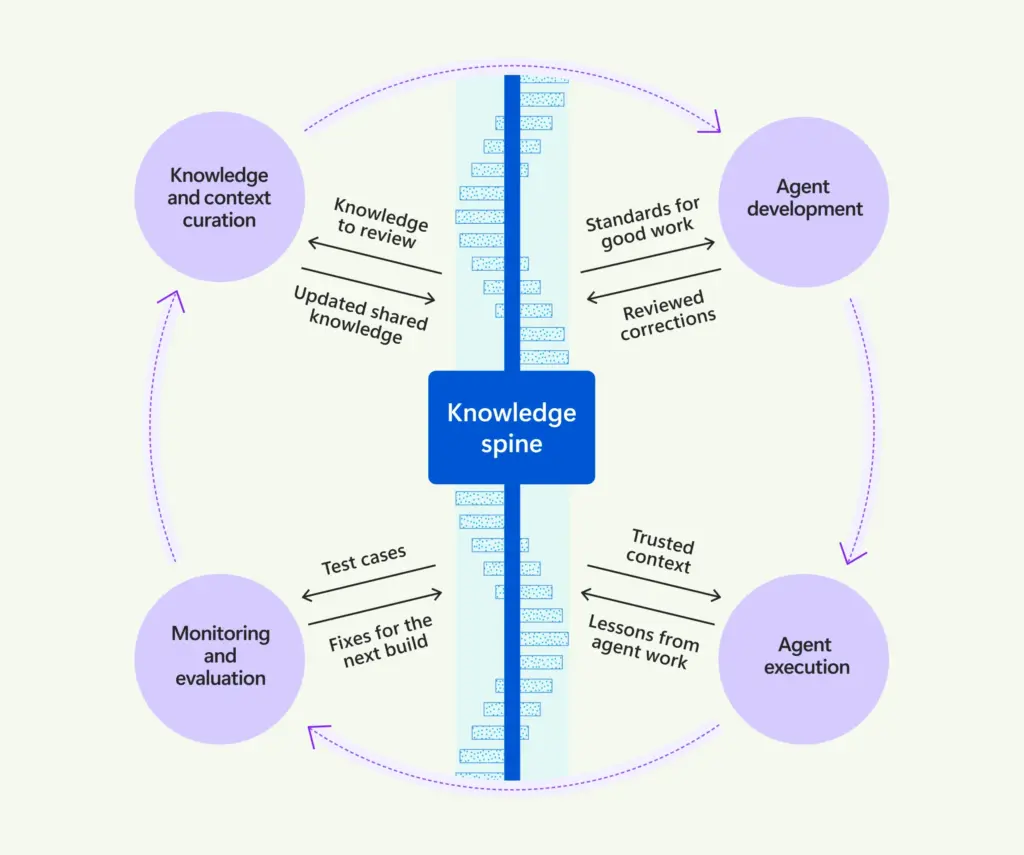
Second, firms are encouraged to treat every correction as valuable data. If a human has to fix an agent’s output, that failure should be turned into a test case for the next version of the system. This leads to the creation of what researchers call a "golden dataset"—a consistent benchmark used to ensure that AI agents meet the company’s specific standards before they are deployed.
Third, the information stored in the knowledge spine must be used to actively shape agent actions. The goal is not just to correct a single answer, but to change the logic of how the agent handles that specific category of work in the future.
Finally, the study emphasizes the need for accountability. A knowledge spine requires an owner—someone responsible for determining which data sources are trustworthy, resolving conflicts between different pieces of information, and purging outdated data from the system.
Underpinning all these practices is the principle of observability. The highest-scoring companies in the study maintain searchable, detailed records of every action an agent takes. This allows them to identify exactly why a mistake happened and how to prevent it. In these advanced firms, agents "earn" their autonomy based on evidence; as the system proves its reliability through telemetry and testing, the company can choose to widen the scope of what the agent is allowed to do independently.
The Path Forward: From Capabilities to Systems
The transition from isolated AI capabilities to a coordinated AI infrastructure represents a fundamental shift in how modern enterprises operate. As the research suggests, the underlying models will continue to change as technology advances, but the proprietary lessons a company’s agents learn from their own unique workflows will remain a permanent advantage.
Building a firm-wide knowledge spine is a daunting task, and the study’s authors note that few companies will achieve it overnight. However, the research offers a practical roadmap: start small. By building a knowledge spine for a single team or a handful of connected workflows, organizations can prove the value of the system before scaling it across the entire enterprise.
As Microsoft and Keystone continue to track these "Frontier Firms," the evidence suggests that the winners of the AI era will not be those who simply deploy the most models, but those who build the best systems to coordinate, check, and learn from them. The shift from "isolated intelligence" to "coordinated intelligence" is no longer a theoretical concept—it is the emerging standard for enterprise excellence in the age of agents.
 Productivity Software & Office Suites
Microsoft Unveils the "New Copilot" Ecosystem: Integrating Autonomous Agents, Custom Code, and Advanced Office Workflows
REDMOND, Wash. — In a major step toward redefining the intersection of...
 Productivity Software & Office Suites
Microsoft Announces Fifth Annual Power Platform Community Conference in Las Vegas to Bridge the Gap Between AI Innovation and Business Process
As the global enterprise landscape continues to evolve, the fundamental machinery of...
 Productivity Software & Office Suites
Microsoft Announces Fifth Annual Power Platform Community Conference in Las Vegas to Explore the Future of AI-Driven Business Processes
The landscape of modern enterprise operations is undergoing a fundamental shift. For...







