
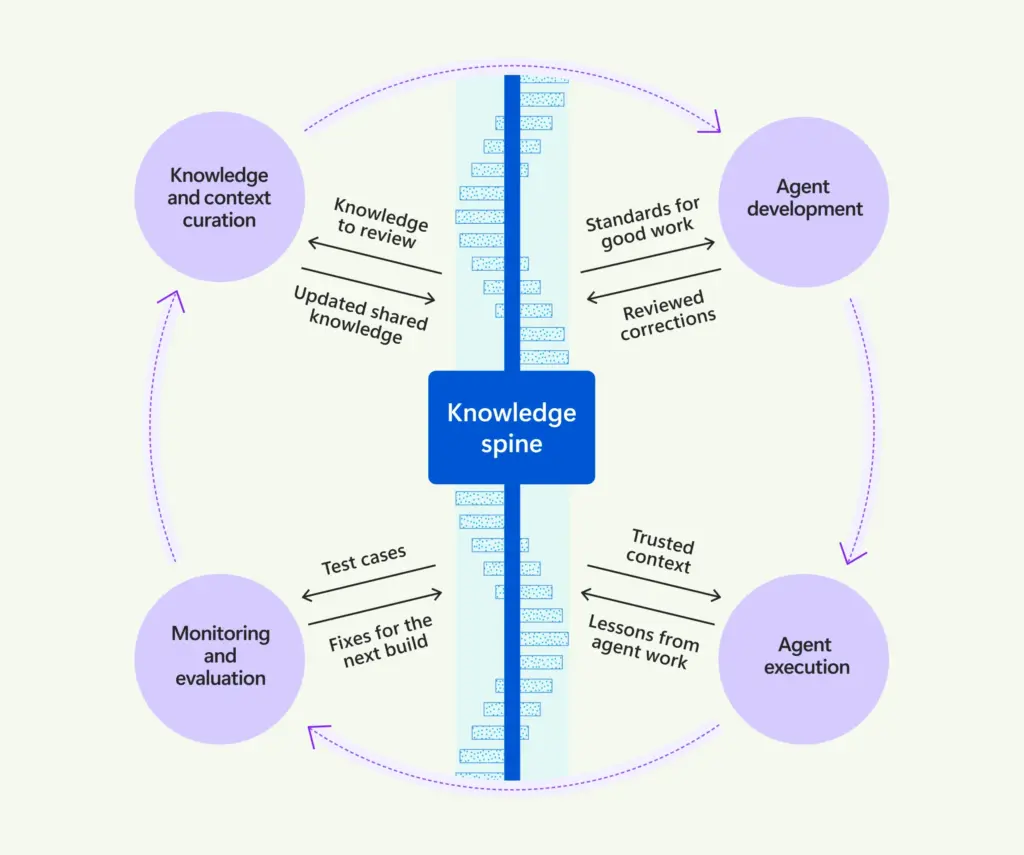
Stage two represents a step forward, where companies begin using agents to tackle specific business problems. However, these firms still lack a centralized system for management. Instead, they rely on human-heavy processes—committees and teams—to prioritize investments and check the agents’ work. This "human orchestration" model is difficult to scale, as the cost of oversight often eats into the efficiency gains provided by the AI.
Stage three is identified by researchers as the crucial turning point. At this level, companies begin to use systems, rather than people, to coordinate their agents. This might involve sharing a common knowledge base or implementing automated monitoring. While this often begins within a single department or a specific set of workflows, it marks the beginning of a shift toward a more autonomous operating model.
The final stage, stage four, is where the "knowledge spine" fully matures. In these organizations, orchestration, governance, and a shared context layer are all in place. Lessons from agent activities are automatically fed back into the system, creating a single, agentic operating model where the system itself takes on the burden of coordination and learning.
The Economic Reality of the J-Curve
While the financial rewards for AI maturity are clear, the research also highlights a phenomenon that economists call the "J-curve." This theory suggests that when a major new technology is introduced, the payoff often dips or lags initially as companies undergo the painful and expensive process of reorganizing their work around the new tool.
For many companies in the bottom half of the study’s rankings, operating margins remained stagnant despite AI investments. The researchers suggest this lag occurs when companies deploy agents faster than they build the infrastructure to manage them. Without a knowledge spine, the cost of human review and the inefficiency of uncoordinated agents can offset any initial productivity gains.
To manage this, the study found that leading firms are becoming more disciplined about AI spending. While many start by giving employees broad access to tools, the most advanced firms are beginning to tie "token" or compute budgets to specific results. By understanding what each "good outcome" costs, these companies can move from a model of experimentation to one of rigorous operational efficiency.
Building the Infrastructure for Autonomy
For organizations looking to emulate the 3% of "Frontier Firms" identified in the study, the research outlines four foundational practices.

First, companies must collect context from diverse sources—including internal documentation, systems of record, and chat applications—and store it in a central, accessible location. This ensures that agents are always working from the most current and accurate information.
 Productivity Software & Office Suites
Microsoft Advances AI for Finance with Specialized Copilot Skills and Enhanced Traceability in Excel
The history of computing has long followed a predictable trajectory: new technology...
 Productivity Software & Office Suites
Microsoft Reimagines Copilot as a Centralized AI Ecosystem for the Modern Enterprise
In a significant move to redefine the landscape of digital productivity, Microsoft...
 Productivity Software & Office Suites
Microsoft Reimagines Copilot as a Unified AI Platform for the Next Generation of Work
In a significant shift that signals the next phase of the artificial...







